91- 6303239042
 CAT WhatsApp Group



 Preferred Source

 Google Discover
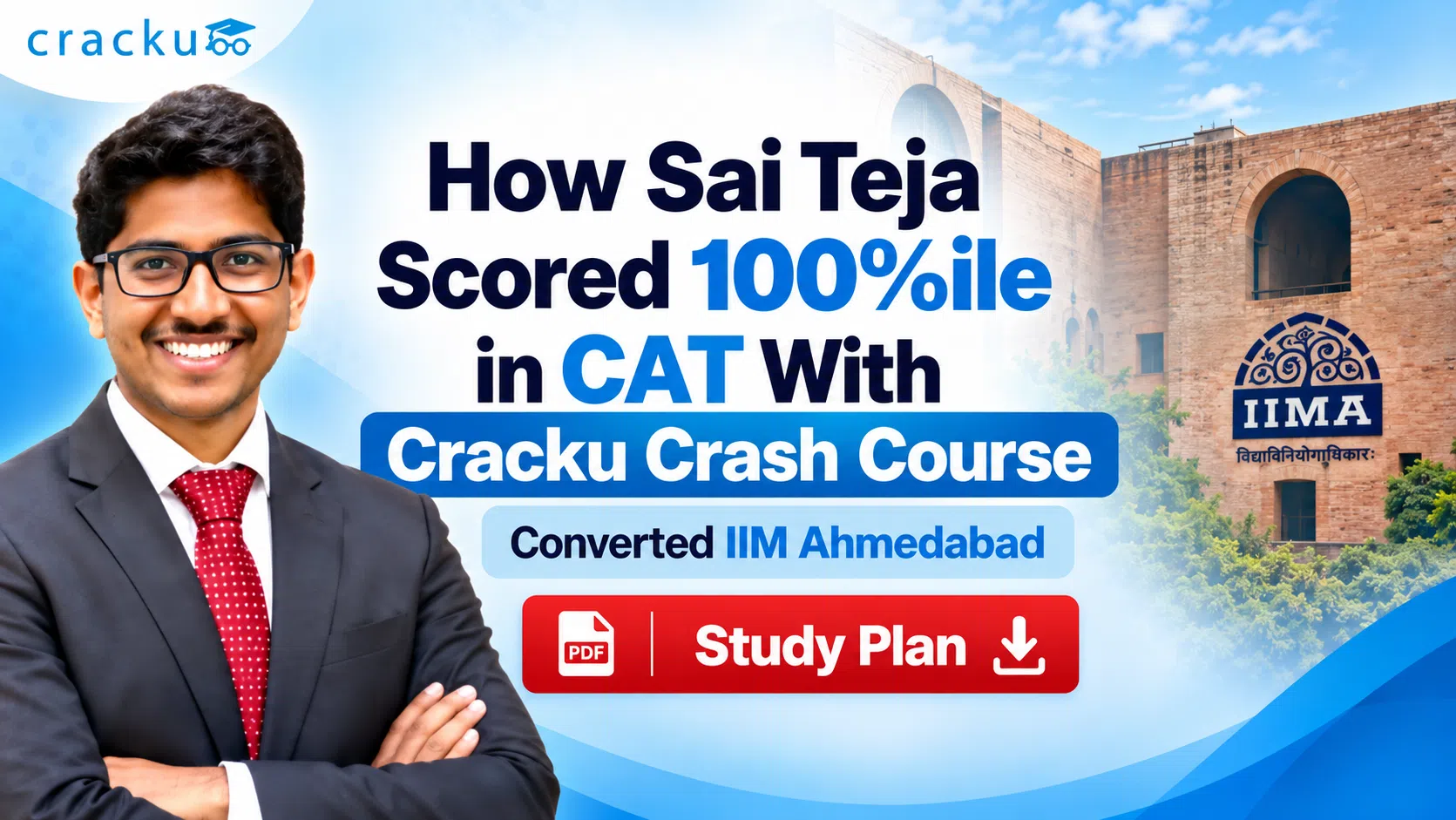
How Sai Teja Scored 100%ile in CAT?
"When the going gets tough, the tough get going." Sai Teja's IIM Ahmedabad conversion is a apt reflection of this. How does an engineering graduate turn preparation into a perfect CAT score? Sai Teja answered that question with a 100 percentile in CAT 2020. An IIT Madras Electrical Engineering graduate, he had zero work experience during his preparation. His journey combined focused practice, regular mocks, and steady improvement. He also joined the CAT Crash Course in October, adding structure during the crucial final preparation phase.
Sai Teja’s Academic Background and CAT Journey
Sai Teja graduated in Electrical Engineering from IIT Madras before appearing for CAT 2020. With zero work experience, his preparation depended heavily on academic strengths and disciplined practice.
He considered Quantitative Aptitude a natural advantage because of his engineering background. However, he did not rely only on that comfort zone during preparation.
DILR required greater attention because he could occasionally remain stuck inside one set. He worked specifically on this weakness through repeated practice and sectionals.
Profile | Details |
Name | Sai Teja |
Final Admission | IIM Ahmedabad (2021-2023) |
CAT Year | CAT 2020 |
CAT Percentile | 100%ile |
VARC Percentile | 99.94 |
DILR Percentile | 99.97 |
QA Percentile | 99.98 |
Graduation | Electrical Engineering |
College | IIT Madras |
Work Experience | Zero |
Cracku Course | Joined Cracku Crash Course in October |
IIMs Applied | 6 |
IIMs Converted | 6 |
His CAT preparation strategy became stronger once he began measuring performance through repeated mock attempts.
Instead of judging his ability from one score, he focused on patterns across several tests. This helped him remain calm when marks moved up or down.
Sai Teja’s Section-Wise CAT Preparation Strategy
Sai Teja approached each section differently because every area demanded a separate method. His preparation included reading, timed practice, previous-year questions, and targeted mock analysis.
How Sai Teja Prepared for VARC
- Sai Teja worked on reading speed long before the actual examination arrived. He regularly read Daily Articles novels, journals, and news articles.
- This habit exposed him to different writing styles, arguments, tones, and unfamiliar subjects. Therefore, RC passages gradually became easier to process under time pressure.
- He also focused on understanding the intent of each passage rather than reading every line mechanically. This mattered because certain RC questions could feel highly subjective.
- His approach: Understand why the author wrote something before judging individual answer choices. That awareness helped him separate the passage’s central argument from distracting interpretations.
- Regular reading also improved his ability to locate important ideas without repeatedly returning to previous lines.
- For additional practice, CAT previous-year questions could help you understand recurring RC types and question styles.
How Sai Teja Prepared for DILR
- DILR was the section that demanded deliberate improvement during Sai Teja’s preparation.
- He noticed that he could get stuck for around 10 to 15 minutes on one set. Continuing with that set could quickly consume valuable examination time.
- Therefore, he used CAT sectional mock tests to improve his decision-making. He practiced identifying when a set was worth pursuing and when leaving it was wiser.
- His focus was not simply solving more sets. Regularly practising CAT DILR questions helped him develop better judgment about set selection and time allocation.
- This approach gradually reduced the chances of losing excessive time on difficult sets. Regular practice also made unfamiliar arrangements feel less intimidating during timed tests.
Also Read: 25+ Most Important DILR Sets for CAT 2026 (Most Expected)
How Sai Teja Prepared for Quantitative Aptitude
- Sai Teja already viewed QA as his stronger area because of his engineering background. However, he still followed a careful process while solving questions.
Even students who are comfortable with Quant should regularly practise CAT Quant questions to maintain accuracy across different difficulty levels. - Rather than rushing toward an answer, he concentrated on the complete solution process. This helped him avoid confusion and prevent avoidable calculation mistakes.
- His method shows an important point about CAT preparation strategy. A strong section still needs disciplined execution because easy questions can carry costly errors.
- Revising important CAT Quant formulas can also reduce the time spent recalling basic concepts during timed practice.
- He also understood that confidence should come from consistent performance rather than one excellent mock score.
How Sai Teja Approached CAT Mock Tests
Mock tests became an important part of Sai Teja’s preparation during the final months.
He attempted around 20 to 25 full-length mocks and at least 10 to 11 sectionals for each section. DILR received additional attention because he wanted stronger control over CAT DILR set selection.
Mock Practice | Sai Teja’s Approach |
Full-Length Mocks | Around 20–25 |
VARC Sectionals | Minimum 10–11 |
DILR Sectionals | Minimum 10–11, with extra focus |
QA Sectionals | Minimum 10–11 |
Main Focus | Accuracy, time management, and set selection |
Mock Learning | Review mistakes and improve decision-making |
His biggest lesson was not to judge your preparation from one or two CAT mock test scores.
A mock could produce a higher score one day and a much lower score later. That variation does not automatically define your actual potential.
Instead, he focused on maintaining balance and checking performance across a larger sample. This helped him understand whether weaknesses were genuine or simply caused by one difficult test.
CAT full-length mock tests become much more useful when you know how to analyse CAT mocks instead of merely completing them.
CAT 2020 Exam Pattern and Structure
Sai Teja appeared for CAT 2020, which introduced a shorter examination format than earlier editions.
CAT 2020 Exam Pattern
Section | Questions | Time Limit |
VARC | 26 | 40 minutes |
DILR | 24 | 40 minutes |
QA | 26 | 40 minutes |
Total | 76 | 120 minutes |
The current CAT exam pattern is different from the CAT 2020 format Sai Teja attempted, so present-day aspirants should follow the latest structure while planning mocks. The examination lasted 120 minutes, with 40 minutes allotted to each section. It carried 228 marks and was conducted across three shifts on November 29, 2020. Compared to CAT 2025, there were more questions at that time.
Why Sai Teja Joined Cracku Crash Course
Sai Teja joined the Cracku Crash Course in October, close to the final stretch of CAT preparation.
- At this stage, structured resources could help bring concepts, practice, and mock preparation together.
- The course provided an organised CAT preparation framework while he continued working on his weaker areas.
- His preparation also benefited from combining course-based learning with independent reading and mock practice.
- For you, a CAT Crash Course can provide structure when the syllabus feels broad, and examination pressure starts increasing. It can also complement CAT online coaching resources, mock tests, and targeted practice.
- Sai Teja’s experience shows that joining a course late does not mean preparation must become rushed. Focused execution can still create significant improvement.
Sai Teja’s IIM Interview Experience
Sai Teja applied to six IIMs and successfully converted all six, but he chose IIM Ahmedabad. His interview experiences differed depending on the institute and interview panel.
A few interviews focused heavily on specific topics, while others developed into normal conversations. He first checked the interview process after receiving his CAT results.
He began serious interview preparation in January 2021, giving himself time to understand what each stage could demand.
His preparation covered several areas beyond academics. He also prepared for WAT-IIM Ahmedabad.
Interview Area | Sai Teja’s PI Preparation |
Personal Profile | Reviewed academics, interests, and background |
College | Prepared questions related to IIT Madras |
Residential Area | Read about his place of residence |
Current Affairs | Followed relevant news and developments |
WAT | Practised possible writing topics |
Academic Topics | Revised important concepts from his degree |
Interview Style | Prepared for both technical and conversational formats |
This preparation helped him stay ready for different interview styles. He understood that interviews could shift direction quickly.
Therefore, preparing your profile thoroughly can give you greater confidence when unexpected questions appear.
Key Lessons From Sai Teja’s CAT Preparation Journey
Sai Teja’s journey offers practical lessons for anyone preparing for CAT and aiming for IIM Ahmedabad.
Do not judge yourself through one mock score.
A single test can produce an unusually high or low result. Track performance across several tests instead.
Give weaker sections deliberate attention.
Sai Teja strengthened DILR because he knew getting stuck could hurt his timing.
Read regularly to improve VARC.
Consistent reading of novels, journals, and news can build speed and improve comprehension over time.
Follow the complete solving process.
QA may feel comfortable, but rushing can still create avoidable errors.
Balance preparation across all sections.
A strong area should not receive attention at the expense of weaker sections.
Use mocks as learning tools.
CAT daily targets, sectionals, and full-length mocks can reveal patterns in your performance.
Prepare for interviews before they arrive.
Your profile, academics, current affairs, college, and WAT preparation all deserve attention.
Sai Teja’s 100 percentile did not come from one magical preparation trick. It came from steady habits, targeted practice, and honest performance checking. His journey also shows why balance matters throughout CAT preparation. Strong preparation gives you confidence, while awareness keeps that confidence grounded.
How Sai Teja Scored 100%ile in CAT: Conclusion
Sai Teja's CAT 100 percentile strategy shows that a top CAT score depends on much more than being naturally strong in one section. His preparation combined regular reading for VARC, deliberate DILR improvement, disciplined Quant solving, sectional tests and around 20–25 full-length mocks. More importantly, he evaluated his preparation across multiple tests instead of allowing one poor mock score to affect his confidence.
His journey from IIT Madras to IIM Ahmedabad also highlights the importance of preparing beyond CAT itself. After securing 100 percentile in CAT 2020, he prepared systematically for WAT and personal interviews and eventually converted all six IIMs he applied to. For CAT aspirants, the key takeaway is simple: consistent practice, smart mock analysis and targeted improvement can be more valuable than chasing perfect scores in every practice test.