91- 6303239042
 CAT WhatsApp Group


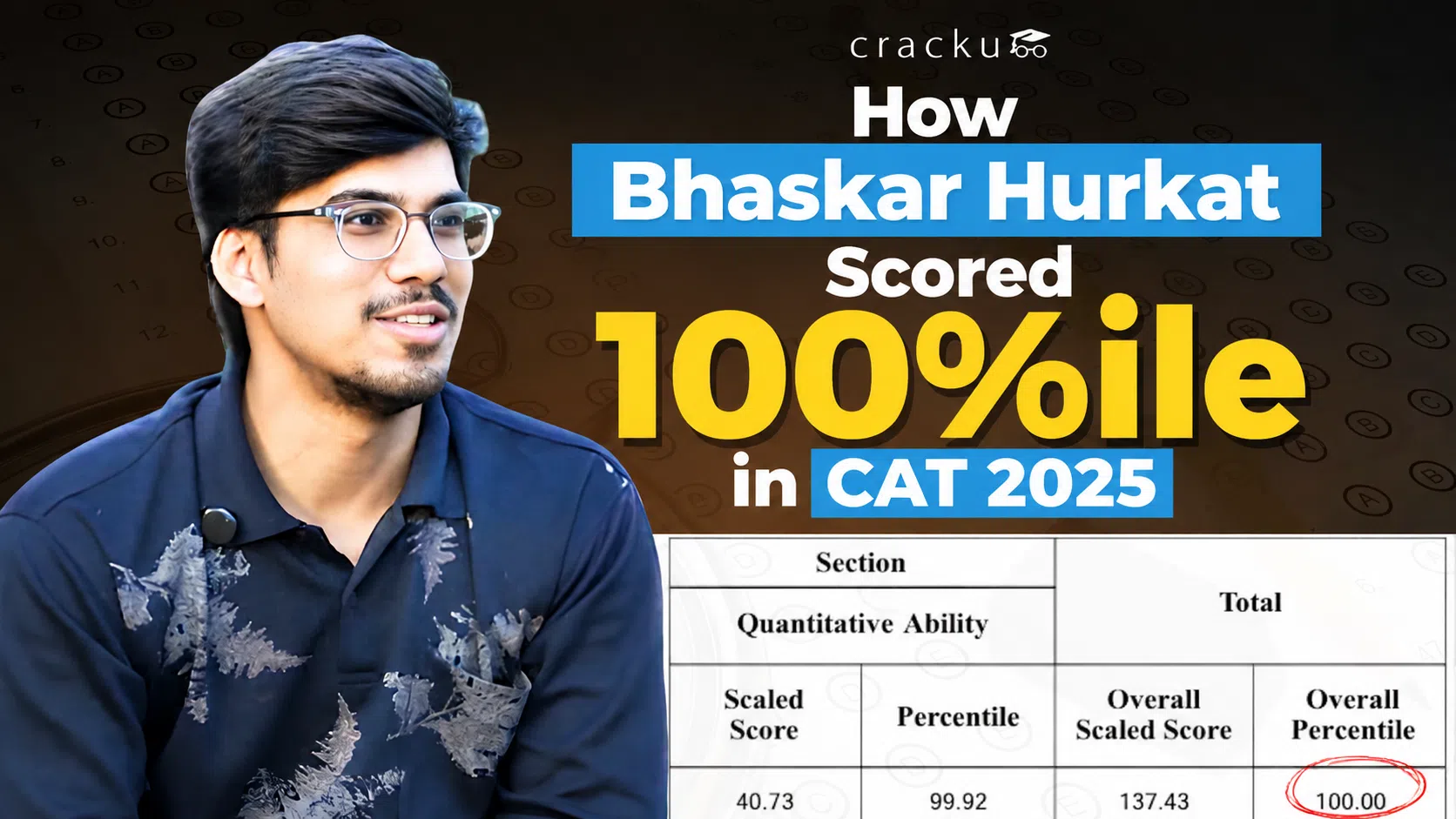
How Bhaskar Hurkat Scored 100%ile in CAT 2025?
Is it just luck to get 100%ile in CAT or the result of hardwork? What changes when a 97.3 percentile attempt becomes a 100 percentile result? Bhaskar Hurkat’s CAT 2025 score is remarkable. Through the whole CAT preparation time he was disciplined, tracked the mistakes, and sharpened execution.
He scored 97.3 percentile in CAT 2024, then returned with a structured approach for CAT 2025. This time, he secured 100 percentile, despite starting preparation alongside a job. His preparation included attempting 312 CAT Daily targets, regular mocks, detailed accuracy tracking, and Daily CAT RC practice. More importantly, Bhaskar identified exactly where his previous attempt went wrong. His journey shows how small changes in preparation can completely transform your CAT performance.
From CAT 97.3 to 100 Percentile: Bhaskar’s CAT Journey & Background
Bhaskar Hurkat completed his schooling across Surat and Navi Mumbai before joining IIT BHU. He pursued Mining Engineering and graduated in 2025 with an 8.07 CPI. His academic record included 92% in Class 10 and 95% in Class 12.
His first CAT attempt happened during a crowded final year of college. Placements, college exams, interviews, and CAT preparation competed for attention. He even appeared for placement tests around the time of his CAT exam.
The second attempt looked completely different because Bhaskar had graduated before beginning serious preparation. He started around the end of May and knew that his job would begin in July.
Personal & CAT Journey | CAT 2024 | CAT 2025 |
Academic status | Final-year college | Graduate + working |
Preparation start | Less focused | End of May |
CAT percentile | 97.3+ | 100 |
Preparation style | Divided attention | Structured preparation |
Major challenge | Time management | VARC accuracy |
Quant performance | Attempted only 8 questions | Better question selection |
Daily preparation | Less consistent | Daily targets |
Mock approach | Insufficient analysis | Detailed tracking |
Daily targets | Not highlighted | 312 completed |
Maximum daily-target streak | — | 45–46 days |
The jump was not created by suddenly becoming better at every section. Bhaskar already had strong Quant and DILR fundamentals.
His biggest shift came from identifying his weak areas before investing additional effort. That awareness helped him spend time where improvement could actually change his result.
Why Bhaskar Failed to Reach His Potential in CAT 2024?
Bhaskar’s CAT 2024 result was already strong, but his preparation had several avoidable gaps. His attention remained divided because college responsibilities continued until the examination.
His NSI SIMS ended two days before CAT, while placement activities were also approaching. On the CAT day itself, he gave two placement tests. Three additional placement tests followed the next day. This created a preparation environment where CAT could not receive his complete attention. His mock volume and preparation depth were also lower than required.
Quant became the biggest execution problem during the actual examination. Bhaskar entered CAT 2024 with good Quant ability, yet his question selection broke down under pressure. He recalled seeing only 30 seconds remaining after attempting just eight Quant questions. That moment showed him that knowing concepts was not enough.
- College commitments divided his preparation time.
- Placement tests competed directly with CAT preparation.
- Mock practice was not sufficient before the examination.
- Mock analysis lacked the depth he later adopted.
- Quant consumed too much time during the actual CAT.
- VARC accuracy remained inconsistent across different tests.
- His preparation lacked a strong progress-tracking system.
The important lesson was not that CAT 2024 went badly. Instead, Bhaskar discovered that his preparation had not matched his actual potential.
That realization became the foundation for his CAT 2025 preparation.
He mentioned his thought to Sayali Ma’am as “The biggest mistake that a person can make is to not analyse what position they are in when they start their preparation.”
How Bhaskar Prepared Differently for CAT 2025 to Score 100 Percentile
Bhaskar began preparing around the end of May after leaving college. Before his job started in July, he used the available time to understand his current level.
He attempted two or three CAT mock tests initially rather than blindly starting topic-wise preparation. His first two scores were around 132–134 and 156, creating a strong confidence boost.
Later mocks brought scores around 108 and 117, bringing his typical range closer to 120. Instead of panicking, Bhaskar used those results to identify patterns.
His approach became simple: diagnose first, practice second, track continuously.
- Used initial mocks to understand his starting position.
- Identified Quant and DILR as relatively strong sections.
- Recognised VARC as the section needing consistent improvement.
- Practiced RCs regularly instead of relying only on full mocks.
- Worked on CAT PYQs and question selection instead of forcing difficult Quant questions.
- Maintained CAT daily targets even during busy days.
- Analysed his CAT mock tests on the same day whenever possible.
- Tracked accuracy rather than looking only at total marks.
- Gradually increased mock frequency as CAT approached.
Once his job began, weekdays became tighter. Bhaskar usually had only two to two-and-a-half hours available after work and recovery time.
Therefore, his weekday routine focused on a few questions and daily practice. Weekends became his major testing and analysis window.
“If you are consistent but you don't mark your progress, you don't know if you have progressed.”
That single idea captures a major difference between his two attempts. Bhaskar did not merely study more. He created evidence showing whether his preparation was improving.
Bhaskar’s CAT Mock Test Strategy: Tracking Attempts, Accuracy & Progress
Mocks became Bhaskar’s preparation dashboard. He created an Excel sheet to track his performance after every test.
His records included questions attempted, accuracy rate, marks, and sectional performance. Whenever accuracy fell below 80%, he marked the percentage red.
This gave him a quick visual signal about recurring weaknesses. He could also check whether his attempt rate was improving across mocks.
Mock Tracking Element | What Bhaskar Tracked | Why It Helped |
Questions attempted | Section-wise attempts | Checked attempt volume |
Accuracy | Percentage of correct answers | Exposed careless errors |
Marks | Mock score | Measured performance |
Accuracy below 80% | Marked red | Flagged weak performance |
VARC attempts | RC and question attempts | Improved section coverage |
Section-wise trend | Performance across mocks | Identified recurring issues |
Mock analysis | Same-day review | Converted mistakes into lessons |
Frequency | Weekly, then increased | Built exam readiness |
Bhaskar generally attempted one CAT practice test every weekend during his earlier preparation phase. He gave the mock in the morning and analysed it later the same day.
As CAT approached, his frequency increased. He suggested one mock weekly until May or June, followed by two mocks weekly.
During October and the first two weeks of November, he recommended three or four CAT mocks each week.
The crucial point was not the number of mocks alone. The analysis after each mock created the real learning loop.
How Bhaskar Improved VARC Accuracy for CAT 2025
VARC was Bhaskar’s weakest section because his accuracy fluctuated sharply. In different practice tests, his accuracy moved from 60% to 100%.
A 100% mock looked impressive, but Bhaskar correctly recognised that luck could influence such an extreme result. His actual target was narrower and more reliable accuracy.
He wanted his performance to remain around the 70–80% or 75–85% range. That consistency mattered more than chasing occasional perfect scores.
VARC Indicator | Bhaskar’s Experience |
Lowest mock accuracy | 60% |
Highest mock accuracy | 100% |
Preferred accuracy range | 70–80% / 75–85% |
Daily RC practice | 1 RC |
Target attempt approach | Up to 24 questions |
RC time target | About 6–7 minutes each |
Bhaskar eventually made daily RC practice a fixed part of his preparation. Even when he could not take a sectional test, he solved one RC. After solving, he checked why an option was correct or incorrect. This habit gradually improved his understanding of RC question logic.
He also divided RC attempts by time. His target was around six minutes per RC, with seven minutes as the upper limit. This approach helped him increase his VARC attempts gradually. He reported reaching 20 to 24 attempts across practice tests.
Also Read: How to Attempt a VARC Sectional Test Effectively, Check Now
Bhaskar’s Quant Strategy: Learning When to Leave Difficult Questions
Quant was not a conceptual weakness for Bhaskar. His major issue was not knowing when to stop spending time on one question.
CAT 2024 taught him that lesson painfully. He attempted only eight Quant questions before running out of time.
For CAT 2025, he changed his decision rule. If a question consumed around one to one-and-a-half minutes without meaningful progress, he moved ahead.
The important mental shift was simple. Time already spent could not be recovered, but additional time could still be protected.
- Leave a question when the solution path remains unclear.
- Avoid staying because you already invested time.
- Return later if the question appears manageable.
- Protect easy questions waiting further down the section.
- Review whether difficult questions repeatedly caused time losses.
- Treat question selection as part of Quant preparation.
Bhaskar noticed this pattern during mock analysis. He sometimes spent three minutes on one question while easier questions remained untouched.
His improvement came from recognising that letting go is also a Quant skill.
Also Read: CAT Quants Preparation Strategy 2026, Study Materials, Questions
The Role of CAT Daily Targets in Bhaskar’s 100 Percentile Journey
One of Bhaskar’s strongest preparation habits was completing 312 CAT Daily targets. The streak became a simple psychological trigger that kept him connected with preparation.
His highest streak reached around 45–46 consecutive days. Even when work or travel disrupted his routine, completing a daily target gave him a sense of progress.
The daily target did not require an enormous study session. On difficult days, it simply ensured that his preparation did not completely stop.
- 312 CAT daily targets created a strong consistency record.
- A 45–46 day streak reinforced his commitment.
- Daily practice kept his mind focused on CAT.
- Travel days could still include a short test.
- Busy work days did not automatically become zero-preparation days.
- Small daily actions protected his preparation momentum.
- The streak created visible evidence of consistency.
Bhaskar compared this motivation with social-media streaks. Watching the number grow created satisfaction and encouraged him to protect the streak.
That habit mattered because CAT preparation stretches across months. A strong routine can survive days when motivation becomes weaker.
CAT 2026 Preparation Advice from a 100 Percentile Scorer
Bhaskar’s first recommendation for anyone starting CAT preparation is straightforward: take a Free CAT mock test immediately.
However, he warns against judging your ability from one mock alone. He recommends taking two or three mocks and checking whether the results remain reasonably consistent.
Once you understand your starting point, your preparation can become more targeted.
- Take an online free CAT mock test first instead of studying without knowing your level.
- Use two or three mocks to verify your starting position.
- Identify your weakest section before allocating extra preparation time.
- Work on all three sections if every area needs improvement.
- Give extra time to the section showing weaker performance.
- Track your progress instead of relying on memory.
- Use one mock weekly during the earlier preparation phase.
- Increase to two mocks weekly from June to September.
- Move towards three or four mocks weekly during October and early November.
- Analyse every mock carefully instead of collecting scores.
- Practice daily, even when your available time is limited.
- Review accuracy trends to spot recurring errors.
Bhaskar’s CAT 2025 success was not built around one magical resource or shortcut. His transformation came from better awareness, consistent practice, detailed checking, and smarter decisions. The jump from 97.3+ percentile to 100 percentile shows what can happen when preparation becomes more deliberate.
His journey also offers a useful reminder for CAT 2026 aspirants. Your first mock score is not a verdict; it is a starting signal. If you know where marks are being lost, you can attack those gaps directly. If you track the changes, you can verify whether your effort is working.
Bhaskar’s biggest advantage was not studying endlessly. It was understanding what deserved his time, what needed improvement, and when to move on.
How Bhaskar Hurkat Scored 100%ile in CAT 2025: Conclusion
Bhaskar Hurkat’s CAT 100 percentile journey proves that a great CAT score is not only about intelligence or luck. His jump from 97.3 percentile to 100 percentile came from understanding mistakes, improving execution, tracking progress, and making better preparation decisions.
For CAT 2026 aspirants, the biggest lesson from Bhaskar’s journey is the importance of self-analysis. Regular CAT mock tests, daily practice, accuracy tracking, and focused improvement can create a major difference in performance. A perfect CAT percentile is built through months of small improvements. Bhaskar’s story shows that when preparation becomes structured and consistent, even a strong previous attempt can be transformed into an exceptional result.








































![Top CAT Quant Quadratic Equations Questions [Download PDF]](/media/cache/c2/05/c205c0abdf778ffd7663c253d9b95a8a.webp "Top CAT Quant Quadratic Equations Questions [Download PDF]")



![Top CAT Quant Linear Equations Questions [Download PDF]](/media/cache/cb/00/cb00fafca1806baf52b208410d968299.webp "Top CAT Quant Linear Equations Questions [Download PDF]")
![Top CAT Quant Logarithms Questions [Download PDF]](/media/cache/a9/43/a9435ad60edf01c1f1e0017c9d6f741d.webp "Top CAT Quant Logarithms Questions [Download PDF]")





















































![Top CAT Quant Logarithms Questions [Download PDF]](/media/cache/e7/2a/e72ae927072fbaa76b2febbd50c0f61c.webp "Top CAT Quant Logarithms Questions [Download PDF]")





![Top CAT Quant Progressions & Series Questions [Download PDF]](/media/cache/1e/18/1e1804f8e048fddfc82227c7d80319eb.webp "Top CAT Quant Progressions & Series Questions [Download PDF]")