91- 6303239042
 CAT WhatsApp Group



 Preferred Source

 Google Discover

Does Daily Practice Really Improve CAT Percentile?
Every CAT aspirant has heard the same advice countless times practice daily, stay consistent, and avoid breaks. But an important question often goes unanswered: does daily practice actually lead to a better CAT percentile, or is it just motivational advice?
To answer this, we analyzed performance data from thousands of students who used Cracku’s CAT Daily Target feature and later appeared for the CAT exam. The goal was to find a measurable link between consistency and performance and the results clearly show a strong correlation.
What Is the CAT Daily Target?
The CAT Daily Target is a structured daily practice system designed to build accuracy, speed, and problem-solving ability over time. Unlike full-length mock tests, which simulate the entire exam, daily targets focus on topic-wise drilling across all three sections VARC, DILR, and QA.
Over time, this consistent practice helps students become more comfortable with different question types and improves their ability to solve problems efficiently.
A simple way to understand this:
- Mock Tests evaluate where you stand
- Daily Targets help you improve every day
CAT Daily Targets vs Mock Tests: Understanding the Difference
Both Daily Targets and CAT Mock Tests are essential, but they serve different roles in your CAT preparation.
| Aspect | Daily Targets | Mock Tests |
|---|---|---|
| Purpose | Skill building | Performance evaluation |
| Focus | Topic-wise improvement | Full exam simulation |
| Frequency | Daily | Weekly |
| Outcome | Improves accuracy & speed | Measures readiness |
Relying only on mocks without consistent daily practice often leads to slower improvement, as concepts are not reinforced regularly.
Cracku's Data Analysis: Daily Targets vs CAT Percentile
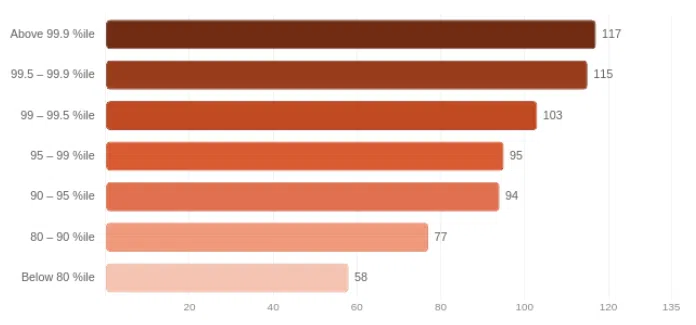
When we compared the number of Daily Targets attempted with final CAT percentiles, the trend was consistent across all ranges higher practice led to higher scores.
| CAT Percentile | Avg. Daily Targets Attempted |
|---|---|
| Above 99.9 | 117 |
| 99.5 – 99.9 | 115 |
| 99 – 99.5 | 103 |
| 95 – 99 | 95 |
| 90 – 95 | 94 |
| 80 – 90 | 77 |
| Below 80 | 58 |
This data highlights a clear pattern: students in the top percentile ranges attempted nearly double the number of daily targets compared to lower percentile groups.
Key Insights from the Data
A closer look at the numbers reveals some important patterns that every CAT aspirant should understand.
The 99 Percentile Threshold Requires Extra Consistency
Students moving from the 95–99 percentile range to the 99+ bracket typically attempt around 8–10 more daily targets. While this may seem small, over time it results in:
- 100+ additional questions solved
- Better familiarity with CAT patterns
- Faster and more confident decision-making
Even Moderate Practice Creates Noticeable Improvement
The difference between students scoring below 80 percentile and those in the 80–90 range is significant. The latter group attempts around 77 daily targets compared to 58.
This shows that even moving from irregular to moderately consistent practice can lead to meaningful improvement.
Top Performers Show Similar Practice Patterns
Students in the 99–99.9 percentile range typically complete between 103 and 117 daily targets. This consistency indicates that at the top level, success is driven more by sustained effort than by last-minute preparation.
Why Daily Practice Improves CAT Performance
The strong relationship between daily practice and CAT performance is rooted in how the exam is designed.
CAT is not a memory-based exam. It tests skills such as comprehension, logical reasoning, and problem-solving, which improve only through repeated practice.
Daily practice helps in multiple ways:
- It keeps your mind consistently engaged with problem-solving
- It builds familiarity with CAT-level questions
- It reduces hesitation and improves speed under pressure
- It allows targeted improvement in weak areas
Another key factor is the compounding effect. Solving even one daily target consistently over four months leads to more than 100 practice sessions, exposing you to a wide variety of question types and strategies.
How Many Daily Targets Should You Aim For?
Your target should depend on your CAT percentile goal, but the data provides clear benchmarks.
For 99+ Percentile Aspirants
You should aim to complete 100+ Daily Targets during your preparation. This typically means maintaining a consistent daily streak for 3–4 months.
For 90–95 Percentile Aspirants
Aiming for around 90 Daily Targets is both realistic and effective. Consistency at this level can significantly boost performance.
For Beginners
If you are just starting, focus on building the habit first. Begin with a few sessions per week and gradually move toward daily practice.
Best Strategy to Use Daily Targets Effectively
To maximize the benefit of Daily Targets, it is important to use them strategically rather than mechanically.
- Start early (ideally 4–5 months before CAT)
- Maintain consistency instead of relying on bursts of effort
- Analyze mistakes after each session
- Combine daily targets with weekly mock tests
This combination ensures both skill development and performance tracking.
More Daily Target, Better CAT Score: Conclusion
The data clearly shows that consistent daily practice is one of the biggest differentiators in CAT preparation.
Students who regularly attempted daily targets were not just more prepared they were faster, more accurate, and more confident during the exam. The gap between different percentile ranges is largely explained by the level of consistency maintained over time.