91- 6303239042
 CAT WhatsApp Group


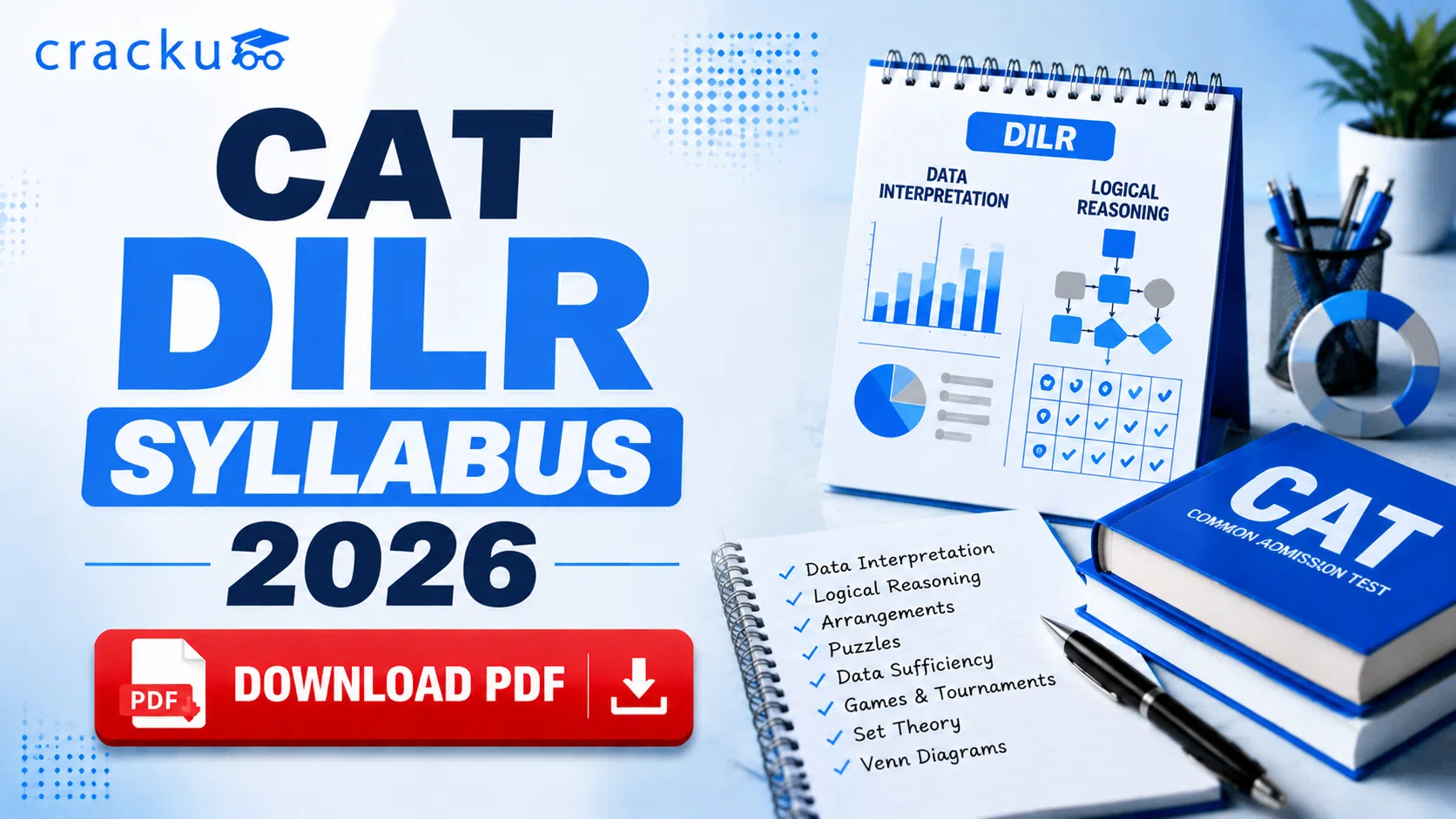
CAT DILR Syllabus 2026
The DILR section in the CAT is mainly divided into two main parts: Logical Reasoning (LR) and Data Interpretation (DI). The LR part mostly focuses on using your logic to solve the given question. While on the other hand, the DI questions are based on how you analyze the data given in the question.
Each part has its own and different set of topics that you need to master. Here are the DILR topics for CAT. Also, preparing for DILR will be helpful in cracking other exams, as some topics overlap with OMET syllabus.
CAT 2026 Exam Pattern and Weightage
The CAT 2026 exam pattern is designed to assess candidates across key aptitude areas required for management education. Understanding the structure of the exam helps aspirants plan their preparation strategy, focus on important sections, and improve time management. The weightage distribution highlights the relative importance of each section and helps candidates prioritise their practice effectively.
Section | Questions | Marks | Weightage |
VARC | 24 | 72 | 35.30% |
DILR | 22 | 66 | 32.35% |
QA | 22 | 66 | 32.35% |
Total | 68 | 204 | 100% |
CAT 2026 DLIR: Logical Reasoning Syllabus
The CAT Logical Reasoning syllabus focuses on evaluating a candidate’s ability to analyse information, identify patterns, and solve complex problems using logical thinking. This section requires strong problem-solving skills, structured approach, and practice with different types of reasoning-based sets. Understanding the important topics helps aspirants build accuracy, improve speed, and develop the ability to handle challenging questions effectively.
Topics | |||
Linear Arrangements | Circular Arrangements | Complex Arrangements | |
Seating Arrangements | Scheduling | Floor Puzzles | |
2-set Venn Diagram | 3-set Venn Diagram | 4-set Venn Diagram | |
Visual Reasoning | Logical Connectives | ||
Logical Matching | |||
CAT 2026 DILR: Data Interpretation Syllabus
The CAT Data Interpretation syllabus focuses on testing a candidate’s ability to analyse, interpret, and draw conclusions from complex data sets. This section evaluates skills such as logical analysis, calculation accuracy, and decision-making based on given information. Aspirants need to develop a strong understanding of different data representation formats and practise solving varied sets to improve speed and accuracy.
| Topics | Topics | Topics | Topics |
Data Table | Profit and Loss Table | ||
Graphs | Line Graph | Bar Graph | Pie Chart |
Histograms | Scatter Plots | Area Charts | |
Caselets | Data Sufficiency | Analytical Reasoning | |
Logical Data Analysis | Sufficiency Conditions | DI with connected data sets | |
- | - |
Most Important DILR Topics for CAT 2026
IIMs do not release an official chapter-wise weightage for DILR before CAT. Therefore, previous papers remain the best source for identifying recurring question types. CAT 2025 continued the recent 22-question DILR structure across all three slots. Each slot contained five sets, with a mix of LR, DI, and integrated caselets.
Your CAT 2026 preparation should cover both classic DILR chapters and newer mixed-set formats. The following CAT DILR topic analysis aim should be building set-solving flexibility rather than memorising fixed methods.
DILR Topics | Sub DILR Topics |
Table-Based DI | Missing values and interconnected tables |
Venn Diagrams | Set relationships and overlapping groups |
Charts | Bar graphs, line graphs and mixed charts |
Miscellaneous LR | Varied reasoning structures |
LR Puzzles | Condition-based deduction sets |
Scheduling | Event ordering and time-based constraints |
Quant-based DI | Ratios, percentages, averages and calculations |
Quant-based LR | Mathematical logic and numerical deductions |
Special Charts | Unconventional graphical representations |
Data Change Over Period | Growth, decline and comparison across years |
LR Arrangements | Linear, circular and matrix arrangements |
Selection with Conditions | Team formation and restricted selection |
Connected DI Sets | Interlinked datasets requiring sequential deductions |
Truth-Lie Concepts | Statements, truth values and logical consistency |
Games & Tournaments | Matches, rankings, scores and points |
2D & 3D LR | Spatial relationships and visual reasoning |
Coins & Weights | Logical weighing and distribution problems |
DI Miscellaneous | Mixed formats and unfamiliar datasets |
Data Interpretation Basics | Fundamental reading and calculation skills |
DI Maxima-Minima | Highest, lowest and optimisation-based questions |
Routes & Networks | Paths, connectivity and network-based reasoning |
The CAT 2025 paper gave greater importance to reasoning-heavy sets than calculation-heavy DI. Logical Reasoning accounted for 39 of the 66 questions across three slots. Mixed DI-LR caselets contributed 15 questions, while pure DI contributed 12 questions.
DILR Category | Questions in 3 Slots | Approx. Share |
Logical Reasoning | 39 | 59.1% |
Mixed DI-LR Caselets | 15 | 22.7% |
Pure Data Interpretation | 12 | 18.2% |
Total | 66 | 100% |
The pattern shows why you cannot prepare DILR through graphs and tables alone. Arrangement, ranking, scheduling, deduction, and logical distribution deserve equal attention.
CAT DILR Topics for Data Interpretation and Logical Reasoning
The CAT DILR combines the major themes reported across CAT 2025 slots. The figures help identify recurring areas rather than predict exact CAT 2026 questions.
Topic | Questions Across Slots | Approx. Weightage | Priority for CAT 2026 |
Ranking, Promotions & Scoring | 10 | 15.2% | Very High |
Arrangements & Seating | 8 | 12.1% | Very High |
Scheduling & Timeline | 5 | 7.6% | High |
Logical Distribution / Assignment | 4 | 6.1% | High |
Puzzle / Sequencing | 4 | 6.1% | High |
Logical Matrix / Deduction | 4 | 6.1% | High |
Comparison / Ordering | 4 | 6.1% | High |
Data Interpretation | 12 | 18.2% | Very High |
Mixed DI-LR Caselets | 15 | 22.7% | Very High |
CAT 2025 particularly rewarded your ability to connect clues instead of performing lengthy calculations. The paper featured practical situations involving rankings, schedules, trade, ratings, and logical relationships.
CAT DILR Practice Questions: Data Interpretation Topics
Topic | Topic |
Connected Data Sets | |
Data Interpretation Basics | |
CAT DILR Practice Questions: Logical Reasoning Topics
Topic | Practice Questions |
| Blood Relations |
CAT DILR Syllabus 2026: Conclusion
The CAT DILR Syllabus 2026 requires more than learning formulas or fixed methods. The section tests your ability to analyse information, identify patterns, and make logical decisions under time pressure. Topics like arrangements, puzzles, scheduling, charts, tables, and mixed DI-LR sets should be practised consistently to build confidence.
A strong CAT DILR preparation strategy should focus on solving diverse sets, analysing previous year trends, and improving set selection skills. Since DILR can significantly impact your overall percentile, mastering important CAT DILR topics and practising regularly can help you handle unexpected question patterns effectively.