91- 6303239042
 CAT WhatsApp Group



 Preferred Source

 Google Discover

CAT DILR Marathon Questions 2026 Part 3
As CAT 2026 gets closer, DILR preparation should gradually move from simply solving more questions to solving the right sets within a limited time. CAT DILR can present unfamiliar arrangements, games, charts, tables and reasoning-based cases, so adaptability becomes just as important as knowing standard methods.
CAT DILR Marathon Questions 2026 Part 3 is designed to give aspirants another round of intensive CAT-level DILR practice. The live session covers important CAT DILR questions and helps you work on set selection, interpretation, calculation efficiency and logical reasoning.
For the best results, download the questions first and attempt the sets independently. Once you have worked through them, use the live-session video solutions to understand alternative approaches and identify where you could have saved time.
Download CAT DILR Marathon Questions PDF
The CAT DILR Marathon Questions 2026 Part 3 PDF contains the questions discussed during the live marathon session. Downloading the PDF before watching the session allows you to use the marathon as an actual practice exercise rather than passively following solutions.
Try solving every set independently and note three things: time taken, accuracy and where you got stuck. These observations are more useful than simply recording whether your final answer was correct.
After completing the PDF, watch the solutions and compare your approach with the one discussed during the session. Pay particular attention to sets where you spent considerable time without making progress, as these can reveal weaknesses in set selection or interpretation.
How to Use CAT DILR Marathon 2026 Part 3 Effectively
Part 3 can be particularly useful if you treat it as a DILR decision-making exercise, rather than another collection of practice questions.
Follow this approach:
- Download the CAT DILR Marathon Questions PDF
- Attempt every question or set on your own.
- Set a time limit while solving each set.
- Mark the questions you find difficult.
- Watch Maruti Sir and Sayali Ma'am's explanation and compare your approach.
- Note the shortcuts, logical approaches and set-selection techniques.
- Reattempt the difficult questions after a few days.
Most importantly, ask yourself whether you would have selected that particular set during an actual CAT DILR section.
This distinction matters. A difficult set that you eventually solve in 25 minutes may improve your reasoning skills, but learning to avoid such a set during the exam can improve your CAT score even more.
CAT DILR Marathon Questions 2026 Part 3: Video Solutions
The CAT DILR Marathon 2026 Part 3 video solutions help you understand not just the final answers but the reasoning used to break down each set.
Watch the session below:
While watching the session, avoid following every solution from beginning to end without attempting the question. Pause before the discussion of a new set and spend a few minutes identifying the variables, restrictions and possible starting points yourself.
Then compare your method with the approach explained in the session.
Pay attention to questions such as:
- Was there a simpler way to represent the information?
- Which clue or data point should have been used first?
- Did you create unnecessary cases?
- Could options have been eliminated without completely solving the set?
- Was the set worth attempting under CAT time pressure?
These observations can gradually improve both your DILR speed and set-selection ability.
CAT DILR Questions with Solutions
Read the following information carefully and answer the questions which follow.
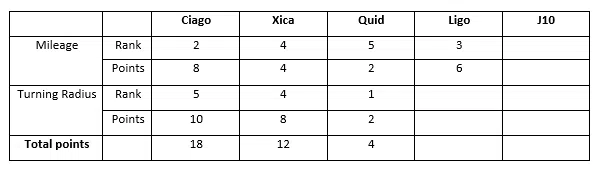
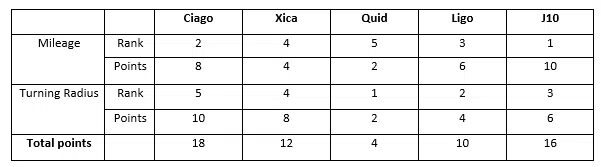
Priyank compared 5 different cars among Xica, Ligo, Ciago, Quid and J10 in terms of parameters mileage and turning radius, to buy the best car among these. For mileage – the car ranked first had the highest mileage; the car ranked second had the second highest mileage and so on. For turning radius – the car ranked first had largest turning radius, the car ranked second had the second largest turning radius and so on. Priyank also gave points for each category of comparison. In the ranking of mileage, the car ranked first got 10 points, the car ranked second got 8 points and so on till the car ranked fifth got 2 points. In the ranking of turning radius, the car ranked first got 2 points, the car ranked second got 4 points and so on till car ranked fifth got 10 points.
Further following information is also known:
a) Ciago scored two points less than a maximum number of possible points.
b) Only Xica got the same rank in both the parameter.
c) Quid scored least possible points.
d) Only Quid and Xica had lesser mileage than Ligo.
Question 1
For how many cars exact ranking in both the parameters can be uniquely determined?
Question 2
What are the total points scored by J10?
(Type ‘0’ if the points cannot be determined)
Question 3
Which car scored the third highest total points?
Question 4
If ‘a’ is the absolute difference between the total value of rank and total points scored by Xica and ‘b’ is the absolute difference between the total value of rank and total points scored by Ligo, then what is the absolute difference between a and b?
correct answer:- 1
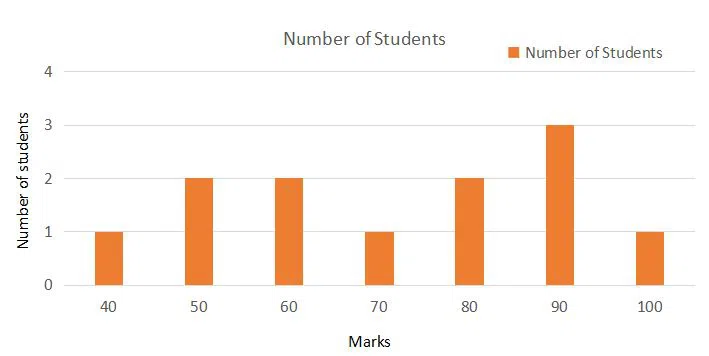
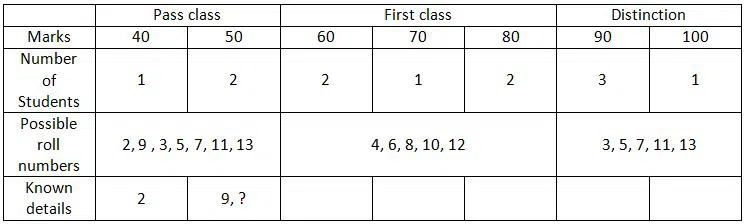
12 students with roll numbers from 2 to 13 are studying at a school. All of them take an exam. The scores are awarded in multiples of 10 starting from 40.
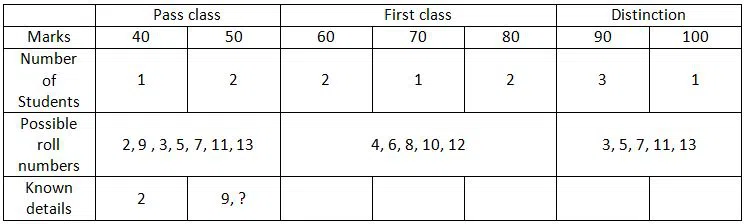
A score below 60 marks [ 40 or 50 marks] is considered pass class. A score of 60, 70 or 80 is considered first class. A score of 90 or 100 is considered distinction.
The following frequency diagram shows the number of people getting each score.
Further, the following information is known:
Students with prime roll numbers have not secured first class.
Students with composite roll numbers have not secured distinction.
Students with even roll numbers have not scored above 80 marks.
Students with odd roll numbers have not scored below 50 marks.
The sum of the roll numbers of students who secured first class in even.
Question 1
If the sum of the roll numbers of students who got pass class is 18, what is the sum of the roll numbers of students who got distinction?

correct answer:- 2

Question 2
If the sum of the roll numbers of the students who got less than 70 marks is 46, what is the sum of the roll numbers of students who scored above 80 marks?

correct answer:- 1
Question 3
If it is known that the students with roll numbers less than 5 have scored less than 70 marks, then the marks of how many persons can be uniquely determined?
Question 4
If it is known that the roll number of student who scored the second lowest is 10 less than the person who scored the highest, what is the sum of roll numbers of the students who scored 90 marks is

correct answer:- 4
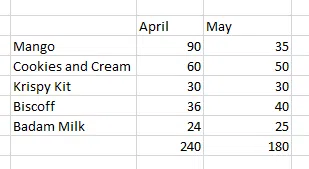
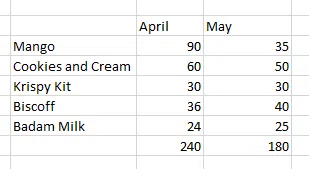
An ice cream stall sold five flavours of ice cream—Badam Milk, Krispy Kit, Mango, Biscoff, and Cookies and Cream—during April and May. The given pie chart represents the percentage distribution of the number of units sold of the five flavours in April.
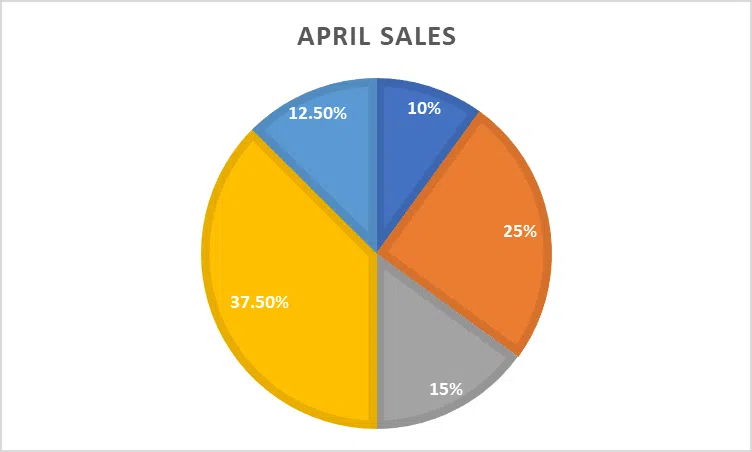
The following information is known:
- The median of the number of units sold in April has exactly 9 factors.
- The number of units sold of Mango ice cream in April are equal to the sum of the number of units sold of Cookies and Cream and Krispy Kit.
- The number of units sold of each flavour in May are distinct, non-zero multiples of 5.
- Cookies and Cream recorded the highest number of units sold among the five flavours in May.
- Exactly one flavour recorded the same number of units sold in both April and May.
- The total number of units sold in May was 25% lower than the total number of units sold in April.
- The number of units sold of Mango ice cream decreased by $$\dfrac{550}{9}\%$$ from April to May.
- Badam Milk recorded the lowest number of units sold in both April and May, and the sum of its number of units sold across the two months is a perfect square
Question 1
The number of units sold across the two months was the highest for which of these flavours?
Question 2
What is the difference in the highest and lowest number of units sold in the Month of May
correct answer:- 3

Question 3
What percentage of the total ice creams sold in May were Krispy Kit?
Question 4
Find the sum of number of units sold of Biscoff in April and May
correct answer:- 1
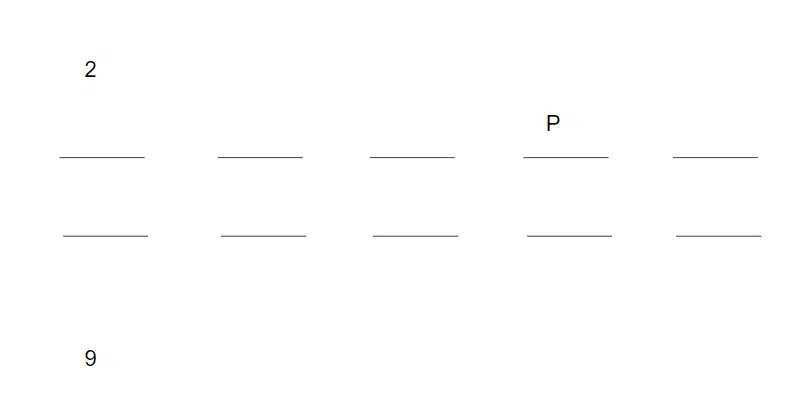
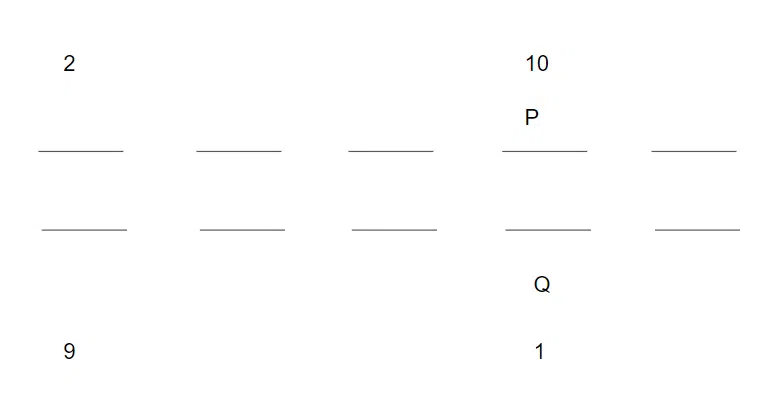
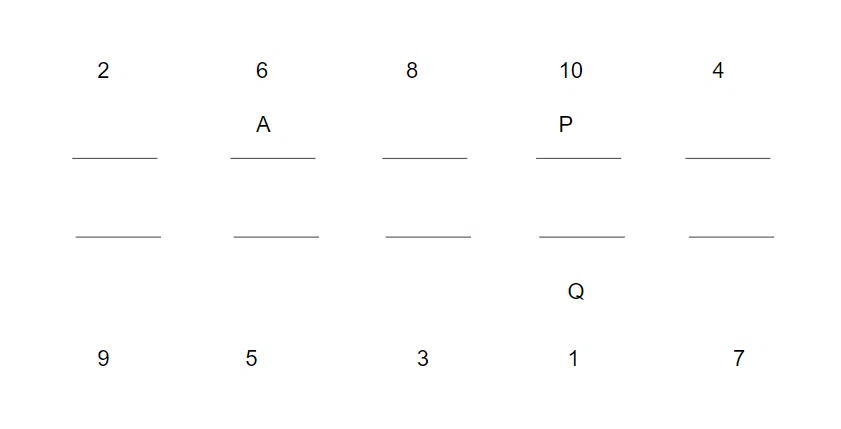
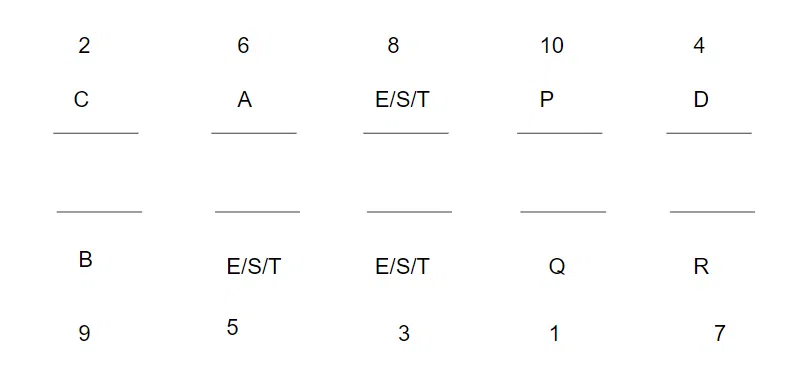
10 persons - A, B, C, D, E, P, Q, R, S, and T are sitting on 2 parallel rows having 5 seats each. The rows are arranged such that one of the rows is facing the North and the other is facing the south. Each person in a row is facing another person in the parallel row. Further, it is known that each person has a different number of coins with him from 1 to 10.
- The sum of the number of coins with any 2 persons facing each other is the same.
- The person with 2 coins is sitting third to the right of P.
- Q is second to the right of the person with 5 coins. And he does not sit in any of the corners.
- A is not facing the person who has 3 coins but is sitting next to the person who has 8 coins.
- The difference between the number of coins with B and C is equal to the number of coins with R.
- B is not a neighbour of A or R.
- The person facing P has 9 coins less than him.
- In each row, exactly one of the 2 persons sitting at the corners has a prime number of coins.
- No person who faces the North has an even number of coins.
- C faces B. D has 3 coins less than the person he faces.
Question 1
If the sum of the number of coins with T and E is not 11, then the sum of the number of coins with A and S cannot be
Question 2
If the difference between the number of coins with S and T is even, then the person who has half the number of coins as E is
Question 3
If T is not sitting to the immediate right of the person with an odd number of coins, then the difference between the number of coins with T and the number of coins with the person who faces P is
Question 4
The difference between the number of coins with C and R is
Question 5
The person sitting second to the right of the person with 8 coins has
correct answer:- 4
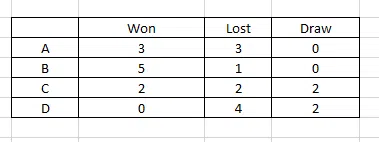
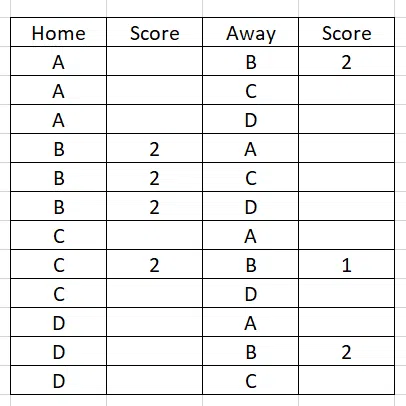
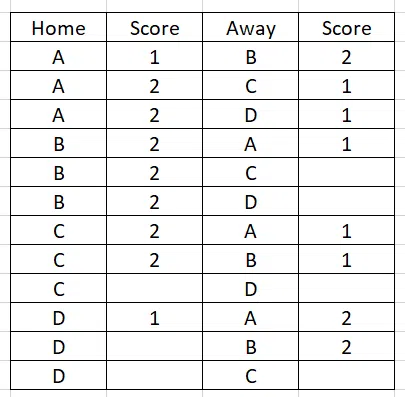
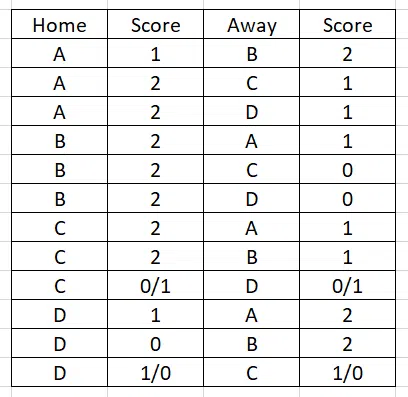
Four teams- A, B, C, D- participated in a football tournament. A home match is played on the team's own field, while an away match is played on the opponent's field. Each team played one home match and one away match against another team. Any match could result in a win, loss, or a draw for any team. The following things are known about the games -
1) A won both its matches against a team, lost both its matches against another and won a match and lost another match against the third team.
2) The number of wins for each team is distinct, and any non-zero number of wins is prime.
3) C won two of its home matches. None of B's matches ended in a draw.
4) The sum of the goals scored by A and the opponent is the same across all of A's matches. The total number of goals scored by A is 9.
5) B scored a total of 11 goals and conceded 4 goals. D scored 3 goals in the tournament.
6) The matches that were drawn had different scores.
7) No team scored more than 2 goals in any match.
Question 1
Considering all the matches that B has played against C, find the total number of goals scored by the two teams in these matches.
Question 2
Against which team did D score non-zero goals?
Question 3
How many goals did D concede throughout the tournament?
Question 4
How many goals did C score in the tournament?
correct answer:- 4
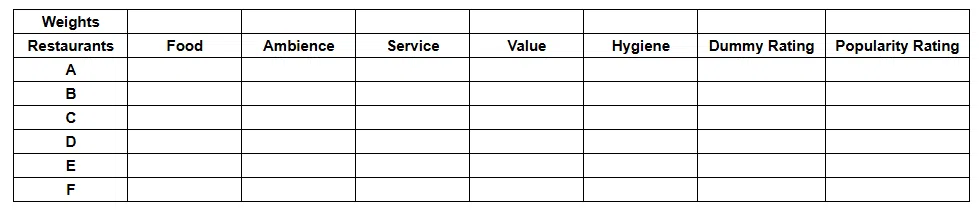
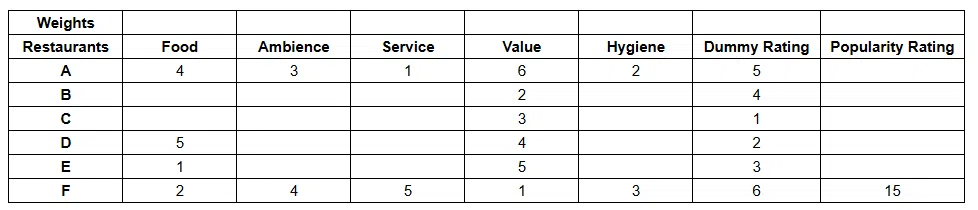
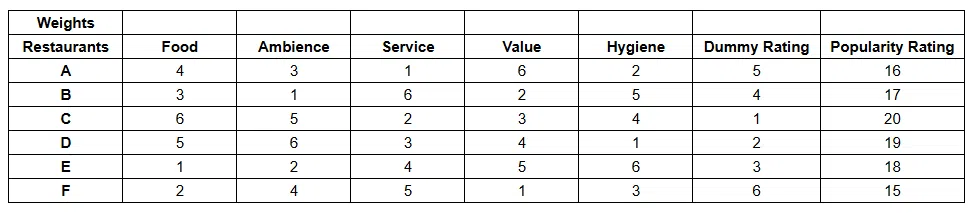
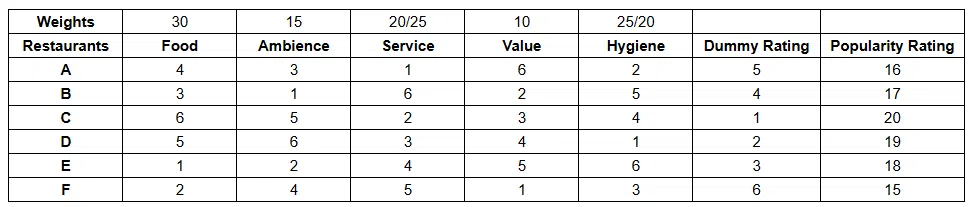
Six restaurants, A, B, C, D, E, and F, were evaluated in five categories: Food, Ambience, Service, Value, and Hygiene. Each rating ranges from 1 to 6, with no two restaurants receiving the same rating and no restaurant receiving the same rating in more than one category. Restaurants were ranked according to two rating systems. The first, the Popularity Rating, is released to the public and calculated as the sum of ratings across all categories. The second, the Compliance Rating, is released by the FDA and is determined by applying category-specific weights and taking the weighted sum. In both systems, the restaurant with the highest total rating receives rank 1, and the restaurant with the lowest total rating receives rank 6.
The following information is provided regarding the ratings of the restaurants:
- The ratings of E in Food, B in Value, and F in Ambience form an increasing geometric progression with common ratio X, in that sequence.
- A's ratings in Hygiene, Food, and Value form an increasing arithmetic progression. The ratings not assigned to C, E, and A also form an increasing arithmetic progression. Both progressions are formed in the same order and their common difference is X.
- D's rating in Value is 2X. Additionally, E's Hygiene rating is the highest possible.
- A's rating in Ambience matches F's rating in Hygiene. Similarly, D's Food rating matches F's Service rating.
- F has the lowest possible Popularity Rating.
Now, we have the following information about the category weights, which will be used to calculate the Compliance Rating.
- All the weights are going to be in an arithmetic progression, and the sum of all the weights will be 100.
- Food will have the highest weightage, Ambience will be the second lowest, and the difference between their weights will be 15.
- The weight of Value is twice the difference between the weights of Hygiene and Service.
Question 1
What is the Popularity Rating of restaurant D?
Question 2
If the weight of Hygiene is 25, what is the Compliance Rating of restaurant B?
Question 3
If the Compliance Rating of restaurant A is 295, what is the Compliance Rating of restaurant E?
Question 4
What is the rating received by restaurant D in Service?
Question 5
What is the difference between the Compliance Rating and Popularity Rating of restaurant C if the weight of Service is 25?
correct answer:- 395
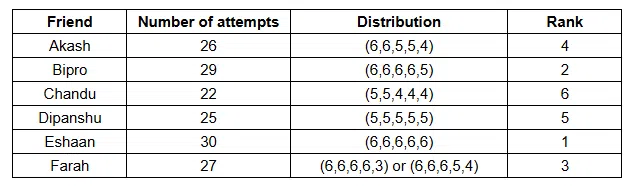
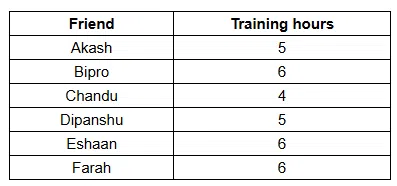
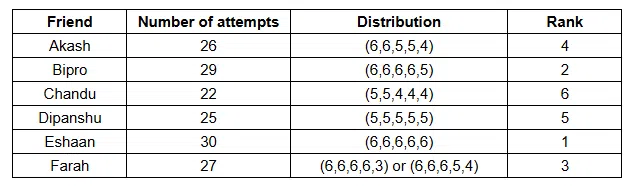
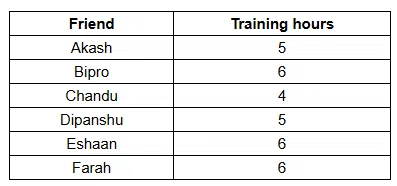
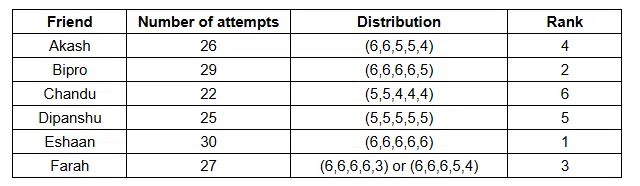
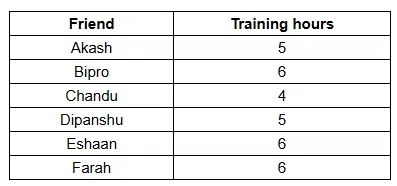
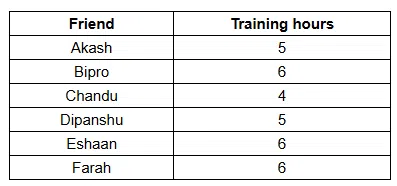
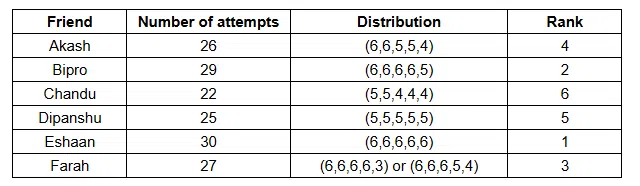
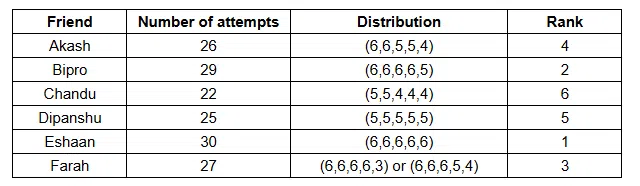
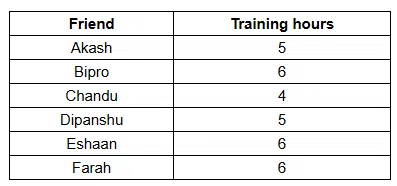
Six friends, Akash, Bipro, Chandu, Dipanshu, Eshaan, and Farah, enrolled in a shooting training course. Prior to the course, each took a test involving five targets, with a maximum of six attempts allowed per target. Their average attempts across all targets were 4.4, 5, 5.2, 5.4, 5.8, and 6 (in any order), and they shot all targets. Friends were ranked by this average, with the highest average receiving rank 1, and the lowest receiving rank 6. The training was attended in order of rank, with rank 1 attending first and rank 6 last.
The following information pertains to the number of attempts each friend took to hit the targets:
- The number of attempts was constant across all the targets for exactly two friends. Chandu attended the crash course last and never took the maximum possible attempts on any target.
- Eshaan and Bipro attended the training first and second, respectively. The mode of attempts of Farah exceeded her mean number of attempts.
- Akash's median number of attempts was 5, and his range was 2 (Range = Maximum Attempts - Minimum Attempts).
- For Chandu, attempts of exactly three targets formed a geometric progression, and the attempts for the other two targets were equal.
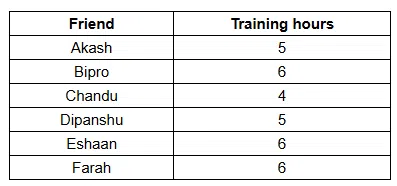
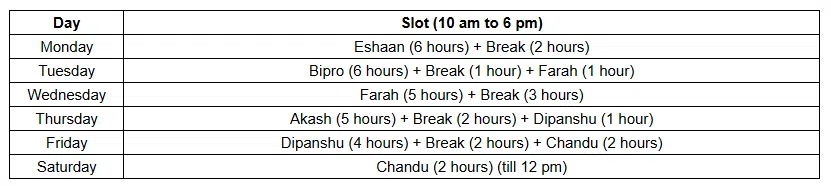
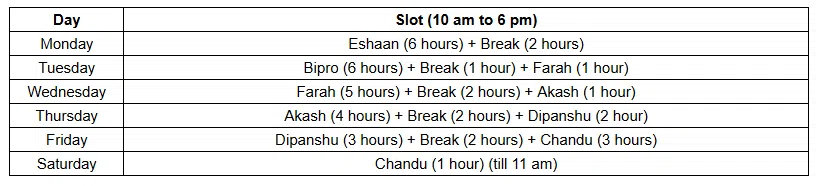
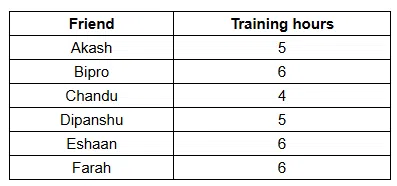
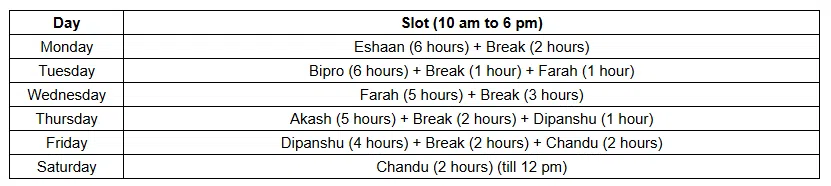
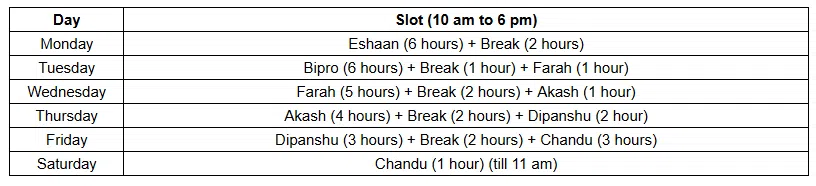
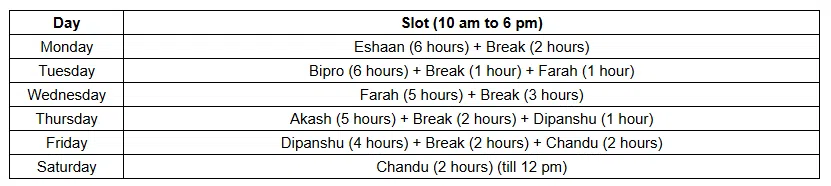
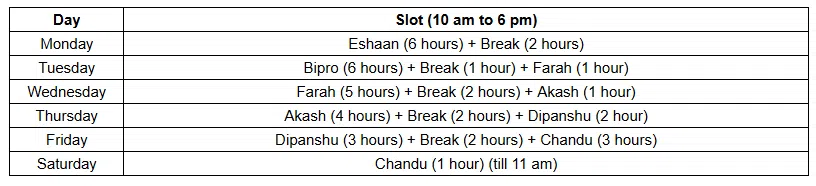
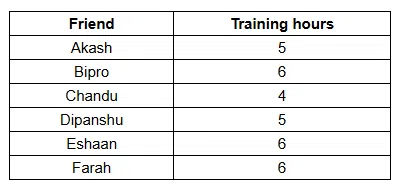
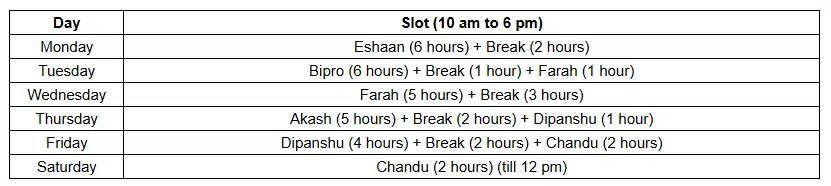
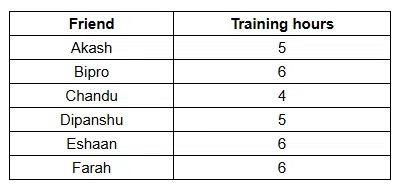
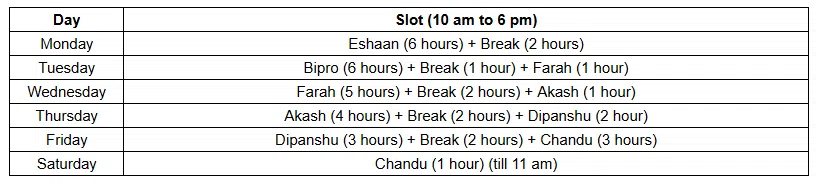
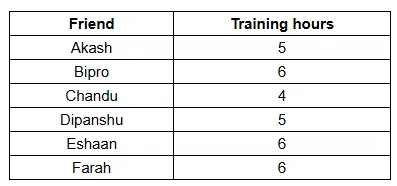
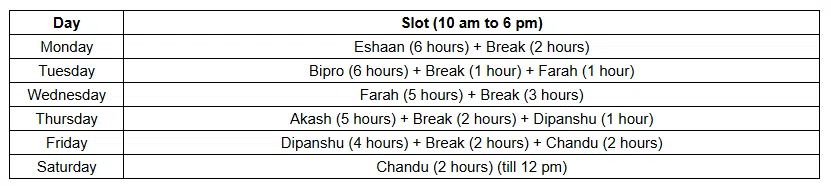
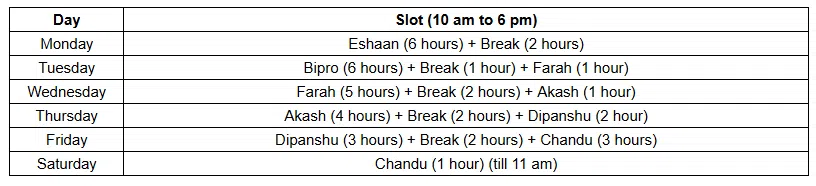
Training was held Monday to Saturday, from 10 am to 6 pm. Each friend trained for a number of hours equal to the mode of their target attempt counts. If there were multiple modes, training hours equalled the smaller mode. Between any two candidates, the trainer took a break during the slots, which was equal to the previous candidate's range of attempts, or 2 hours if the range was zero. Furthermore, if the trainer completes a candidate's session and the break within the time slot, he immediately begins training the next candidate in the remaining time. For example, if the trainer finishes training D in 4 hours and takes a 2-hour break, he will use the remaining 2 hours of the slot to train the next candidate. If a friend's training is not finished in a single day, it will continue the next day, and the trainer will not work overtime.
Question 1
If the training course ended on Saturday at 12 pm, which friend attended the training session on two different days?
correct answer:- 3
Question 2
If Akash attended the training on two different days, what time did the course end on Saturday?
correct answer:- 3
Question 3
Which friend can attend the training on Thursday?
correct answer:- 2
Question 4
For how many hours did Farah attend the training?
correct answer:- 1

Question 5
Who among the following can attend the training after Bipro and before Dipanshu?
correct answer:- 1
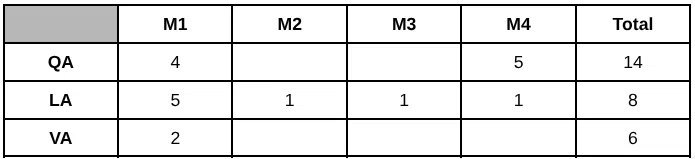
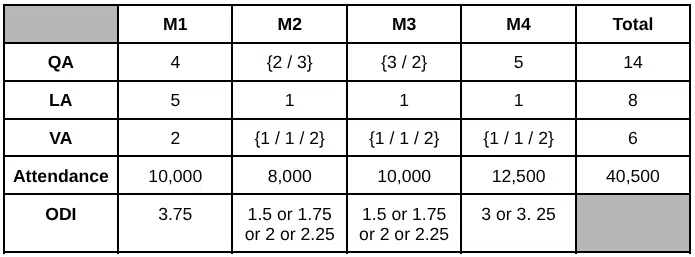
An EdTech platform conducted a flagship test series of 4 sequential All India Mock Tests, namely M1, M2, M3, and M4, in that order. Each mock consisted of three sections: Quantitative Ability, Logical Ability, and Verbal Ability. The platform's academic team rated each section's difficulty on an integer scale of 1 to 5, where 1 is the easiest and 5 is the hardest. The difficulty of a mock is determined by the Overall Difficulty Index (ODI), which is a weighted average of the difficulty of the sections. The weightages given to Quantitative Ability (QA), Logical Ability (LA), and Verbal Ability (VA) are in the ratio 2 : 1 : 1. The attendance of the mock changed as follows:
- If a mock's ODI is greater than 3.5, the attendance for the next mock drops by 20%.
- If a mock's ODI is less than 2.5, the attendance for the next mock increases by 25%.
- If a mock's ODI is between 2.5 and 3.5 (both inclusive), attendance for the next mock remains unchanged.
The following observations were made:
- Exactly 10,000 students attempted M1. The cumulative total attendance across all 4 mocks was 40,500 students.
- The average QA rating across the 4 mocks was 3.5, and no two mocks had the same QA rating. M4 recorded the highest QA rating.
- The average LA rating across the 4 mocks was 2. The LA ratings for M2, M3, and M4 were the same.
- The sum of VA ratings across the 4 mocks was 6, and no VA section received a rating higher than 2.
Based on the information given, answer the questions that follow:
Question 1
What is the absolute maximum possible difference between the ODI of M2 and the ODI of M3?
Question 2
If the ODI of M4 is 3.25, which of the following statements must be true?
Question 3
If the absolute difference between the ODIs of M2 and M3 is 0.25, what is the ODI of M4?
Question 4
If M2 and M4 received the same VA rating, what is the maximum possible ODI for M3?
Question 5
If the platform decided to conduct M5 immediately after M4, what would be the attendance for M5?
correct answer:- 3
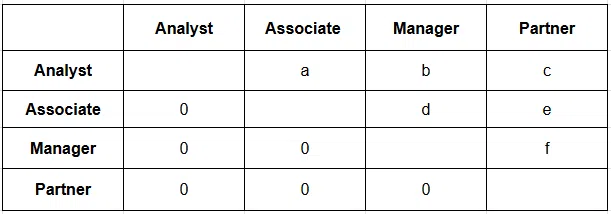
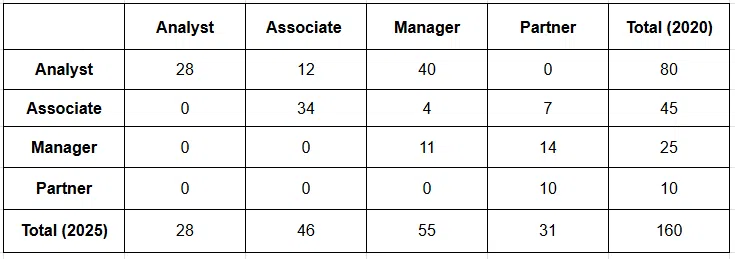
A company has four designations—Analyst, Associate, Manager, and Partner in increasing order of seniority. The company is tracking the number of employees across each designation from 2020 to 2025. No employee left the company, no new employees were hired and there was no demotion of any employee during this period. Any employee could be promoted from a lower seniority designation to a higher seniority designation only. The following additional information is available:
- The number of Analyst, Associate, Manager and Partner in 2020 were 80, 45, 25 and 10 respectively.
- No person who was an analyst in 2020 became a partner in 2025.
- The number of employees promoted from Manager to Partner is a non-zero multiple of 7 and it is twice the number of employees promoted from Associate to Partner from 2020 to 2025.
- The number of Analysts in 2025 were 28.
- The increase in the number of Managers from 2020 to 2025 was a multiple of 10.
- The number of employees promoted from Analyst to Associate from 2020 to 2025 were 12.
- The change in number of Associates was non-negative from 2020 to 2025.
Question 1
What is the total number of Associates in the company in 2025?
Question 2
What are the number of managers in the year 2025?
Question 3
What is the ratio of the number of people who are not Partners in 2025 to the number of people promoted to Manager during 2020 to 2025?
Question 4
What is the difference between the number of people promoted to Partner and the number of people promoted from Associate to any senior designation?
correct answer:- 10

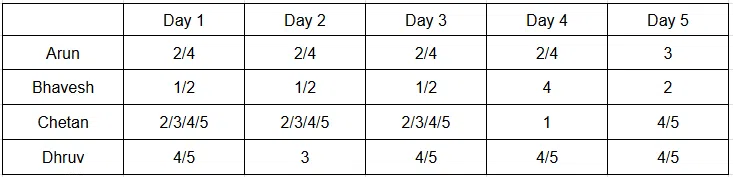
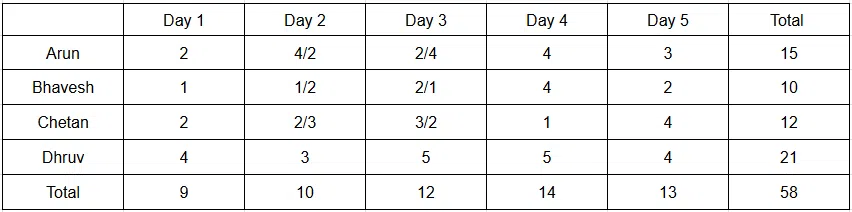
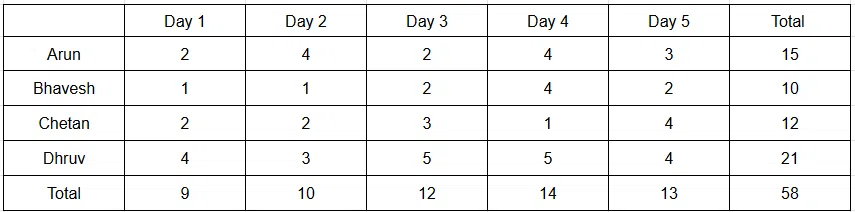
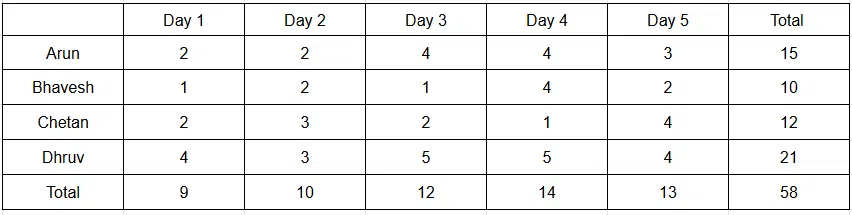
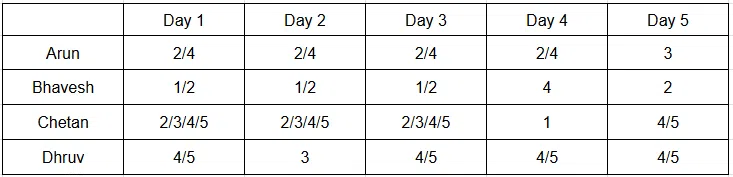
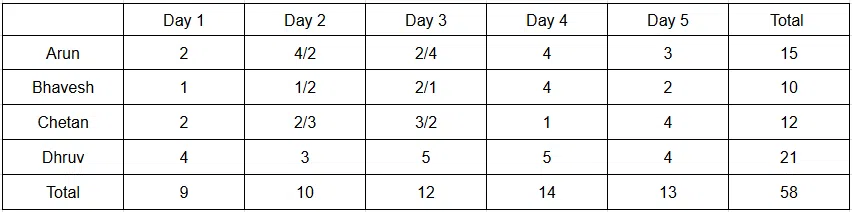
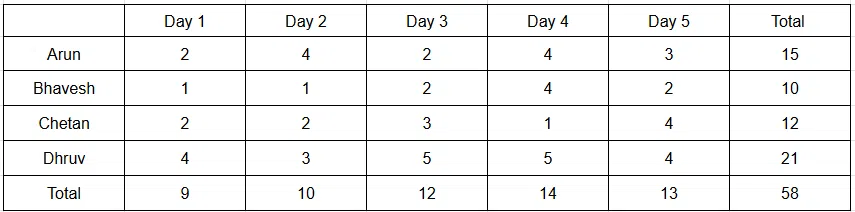
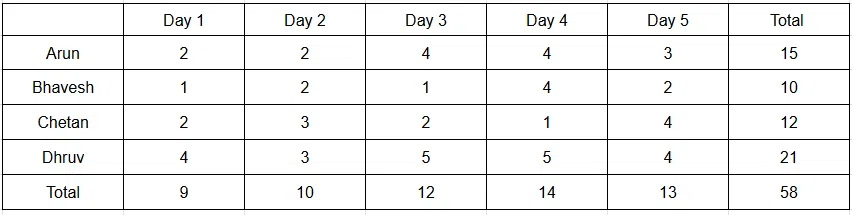
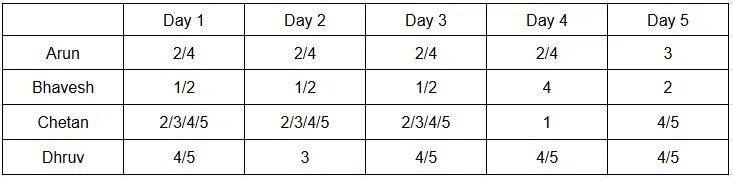
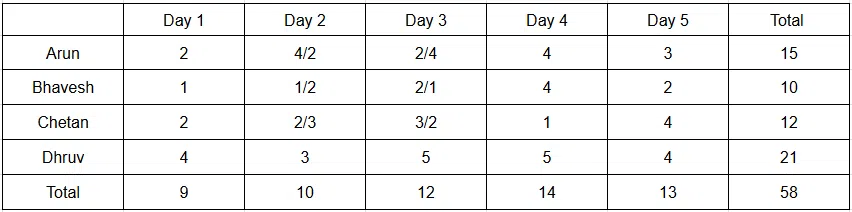
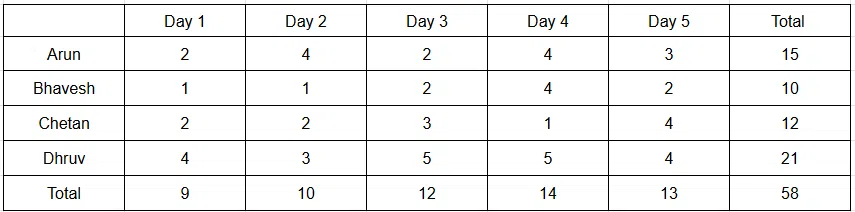
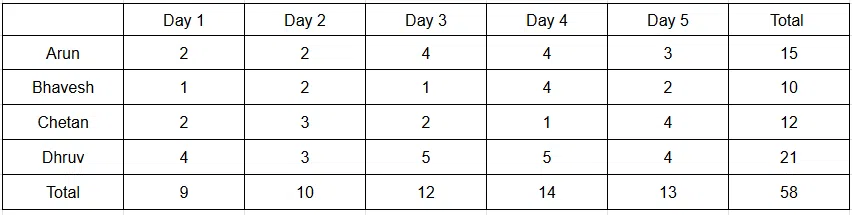
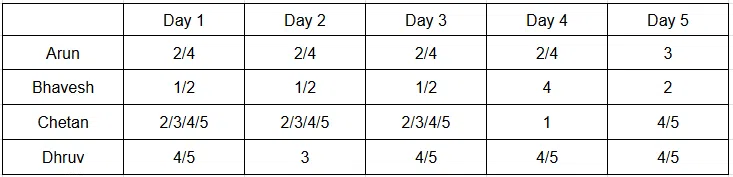
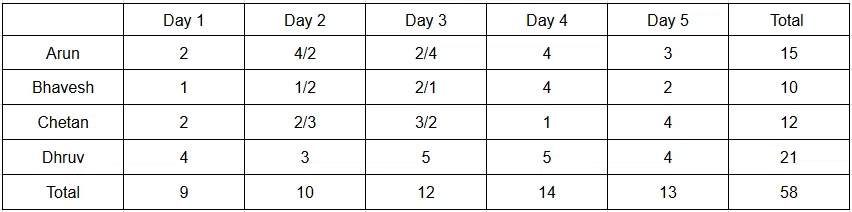
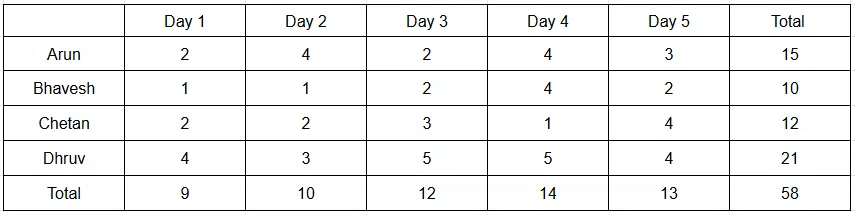
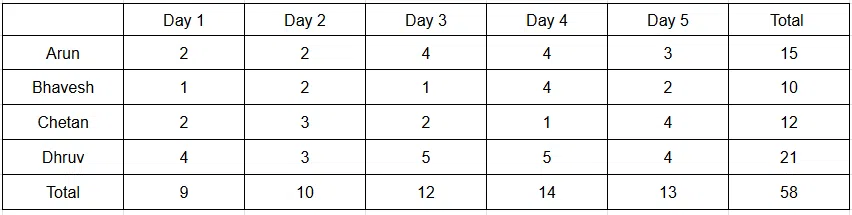
Four athletes, Arun, Bhavesh, Chetan and Dhruv, tracked their daily fitness scores using a smartwatch over a period of five days, from Day 1 to Day 5. The watch records a score ranging from 1 to 5 (both inclusive) each day. Each athlete received exactly one score per day.
The following additional information is provided:
1. Dhruv recorded his lowest score on Day 2, and it was one less than the score recorded by Bhavesh on Day 4.
2. The total score on Day 3 was two more than the total score on Day 2. Arun scored 3 on Day 5.
3. Arun never recorded the lowest possible or the highest possible score on any of the five days. Chetan and Dhruv recorded equal scores on Day 5.
4. The sum of scores of Arun, Bhavesh, Chetan and Dhruv across the five days was 15, 10, 12 and 21, respectively.
5. The sum of the scores of the four athletes on every day was distinct, and it kept increasing till Day 4 and then decreased.
6. Chetan recorded his lowest score on Day 4, and it only happened once during the five-day period.
7. No athlete recorded any particular score more than twice during the five-day period. Bhavesh did not score his lowest on Day 5.
Question 1
How many total possible unique combinations are there?
correct answer:- 1
Question 2
What is the sum of the scores of Arun on Day 4 and Dhruv on Day 3?
correct answer:- 3
Question 3
If Chetan did not score the same on any two consecutive days, then what is the sum of the scores of Arun on Day 2 and Bhavesh on Day 3?
correct answer:- 3
Question 4
Across all the five days, how many time did all the four athletes together record the score two?
correct answer:- 6
Free CAT 2026 Preparation Resources
Along with the CAT DILR Marathon, aspirants can use Cracku's free CAT preparation resources to practise regularly, revise important concepts and improve performance across all three CAT sections. Here's a quick overview of the key resources:
Resource | Overview |
Practise different DILR sets and improve logical thinking. | |
Understand actual CAT question patterns and difficulty levels. | |
Practise the complete exam and improve time management. | |
Focus on improving speed and accuracy in individual sections. | |
Strengthen concepts and practise CAT-level Quant questions. | |
Improve Reading Comprehension and Verbal Ability skills. | |
Follow a structured daily practice routine. | |
Quickly revise important formulas and concepts. | |
Access useful preparation material for overall CAT preparation. |
Using these resources consistently can help you build strong fundamentals, improve accuracy and prepare effectively for CAT 2026.