91- 6303239042


 Group


 Preferred Source

 Google Discover

CAT Mock Journey: Why Mock Analysis Beats Mocks Count
Every CAT aspirant hears the same advice: Take more mocks. But does taking more CAT mock tests actually lead to better scores?
Welcome to CAT Mock Journey, a series where we analyse the mock scores of DashCAT toppers, tracking their performance across multiple mocks and the number of practice tests they attempted between them.
In this edition, we analysed 50 CAT mocks attempted by two DashCAT toppers. One student started as low as 29 and eventually reached 131. The other overcame a long score plateau to reach 143.
Interestingly, both improved their average mock scores while practising less. Their journeys highlight an important CAT preparation lesson: Mock analysis matters more than simply increasing your mock count.
CAT Mock Test Analysis: Two Toppers, One Pattern
We compared the mock scores and practice test frequency of two DashCAT toppers to understand how their CAT preparation evolved.
Metric | Student 7 | Student 8 |
CAT Mocks Attempted | 28 | 22 |
Total Practice Tests | 525 | 436 |
Average Score (First 10 Mocks) | 64.2 | 92.5 |
Average Score (Last 10 Mocks) | 99.6 | 119.2 |
Improvement in Average Score | +35.4 | +26.7 |
Practice Tests (First 10 Mock Intervals) | 281 | 245 |
Practice Tests (Last 10 Mock Intervals) | 90 | 165 |
Highest Mock Score | 131 | 143 |
Scores increased while practice volume decreased.
Student 7 reduced practice volume by approximately 68%, while their average CAT mock score improved by 35.4 marks. Student 8 reduced practice by approximately 33%, while their average increased by 26.7 marks.
This doesn't mean practising less automatically improves scores. Instead, it highlights why targeted practice and effective CAT mock test analysis can be more valuable than solving more questions without a clear strategy.
Also Read: CAT Mock Journey of DashCAT Toppers: From 30s to 100+
Student 7 CAT Mock Journey: From 29 to 131
Student 7's journey shows that a low starting score doesn't determine your final CAT performance.
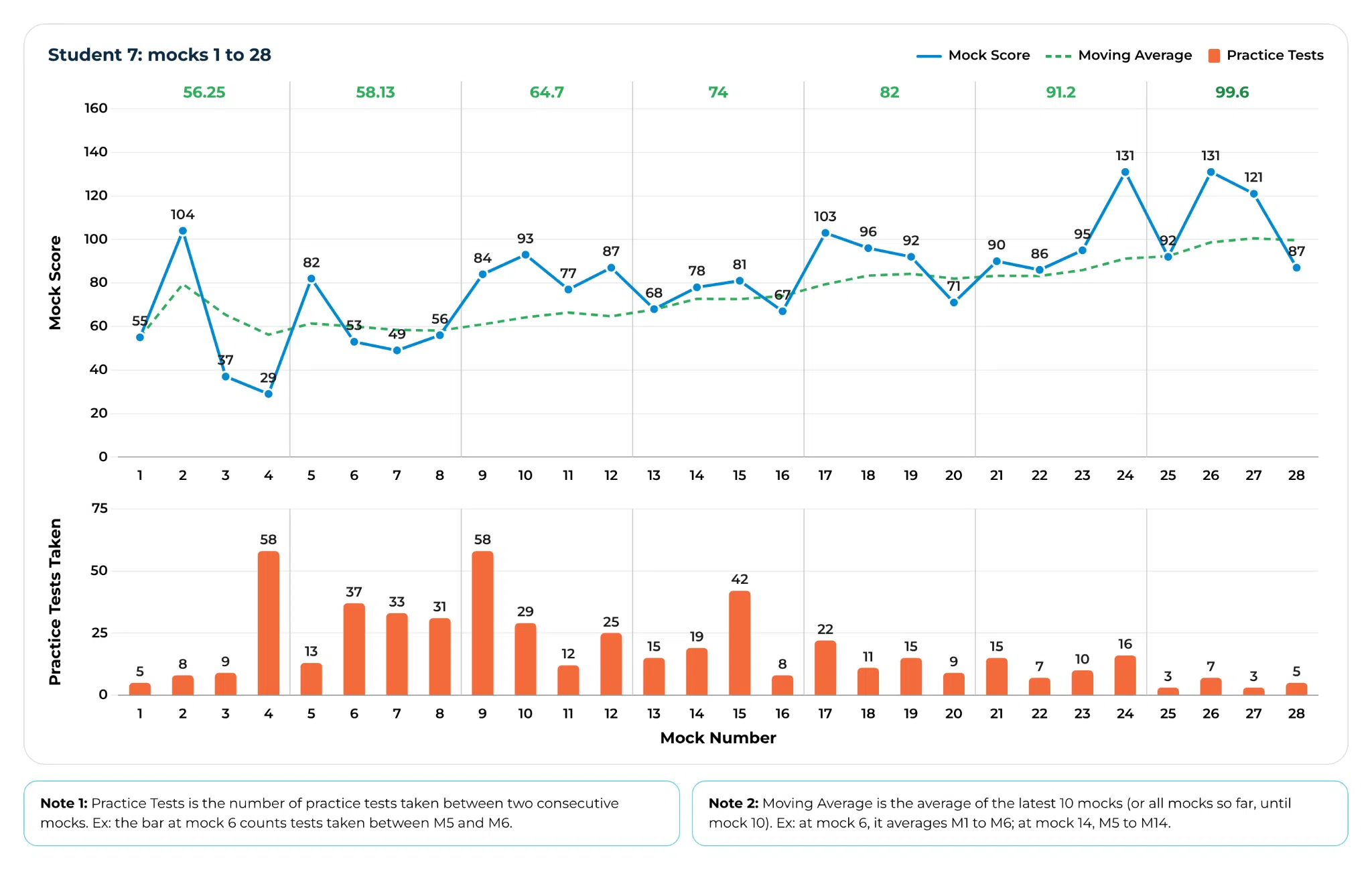
The student began with 55 in Mock 1 and jumped to 104 in Mock 2. However, the next two scores dropped to 37 and 29.
Before Mock 4, Student 7 attempted 58 practice tests, yet the score still fell to 29. Clearly, more practice wasn't producing immediate results.
Things gradually changed after Mock 10. Practice volume decreased, while mock scores became more consistent.
Here's what the CAT mock score analysis reveals:
- Fewer low scores: Six of the first eight mocks were below 60. After Mock 8, the student never scored below 60 again.
- Greater consistency: Scores crossed 90 only twice in the first 14 mocks but nine times in the last 14.
- Steady improvement: The moving average climbed through 56, 58, 65, 74, 82, 91 and finally 99.6.
- Stronger final performance: The lowest score in the final eight mocks was 86, with a highest score of 131.
The biggest improvement wasn't just the highest score. It was the student's ability to perform consistently.
Key takeaway: Improving CAT mock scores isn't only about solving more questions. Identifying repeated mistakes and strengthening weak areas can help raise your average performance.
Student 8 CAT Mock Journey: Breaking the Score Plateau
Student 8 faced a different challenge: a strong start followed by a prolonged plateau.
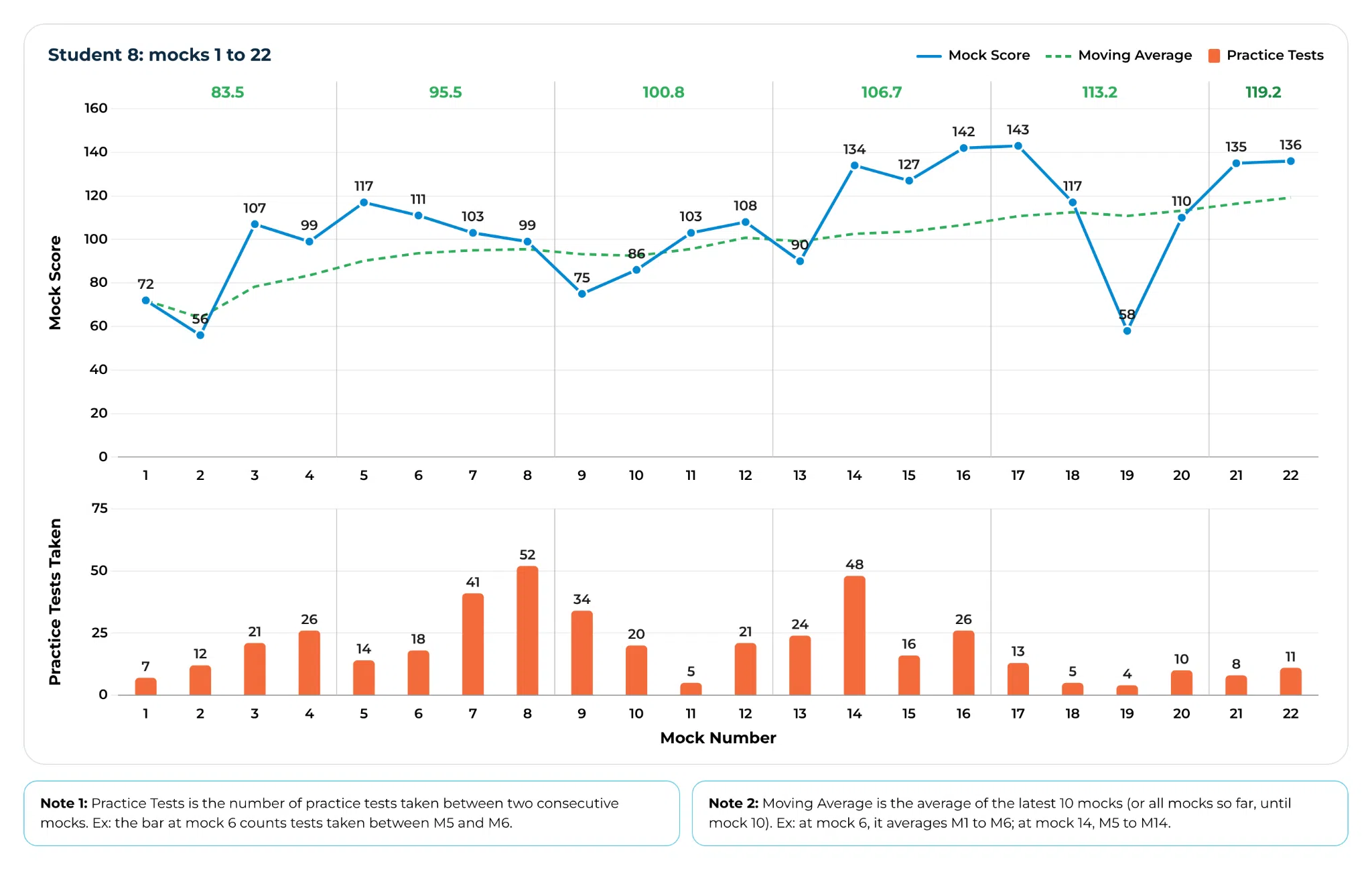
After scoring 72 and 56 in the first two mocks, the student reached 107 in Mock 3 and 117 in Mock 5.
However, from Mock 5 to Mock 13, scores remained around an average of 99.
Despite attempting 41 and 52 practice tests before Mocks 7 and 8, there was no significant breakthrough.
Then came Mock 14.
The next four scores were 134, 127, 142 and 143.
Student 8 had finally broken through the plateau. But in Mock 19, the score suddenly crashed to 58.
What happened next was even more interesting.
The student recovered immediately, averaging approximately 127 across the next three mocks while completing just 29 practice tests between them.
Here's what the numbers reveal:
- Four consecutive scores above 125 between Mocks 14 and 17.
- Scores above 100 in 10 of the final 12 mocks.
- A strong recovery after the unexpected score of 58.
- Higher average scores despite lower overall practice frequency.
Key takeaway: A disappointing CAT mock score doesn't necessarily mean your preparation is declining. Understanding what went wrong and adjusting your approach is more useful than panicking and attempting more tests.
The Analysis Dividend: Why CAT Mock Analysis Matters
The two DashCAT toppers improved their average scores while reducing practice volume.
This brings us to the Analysis Dividend: the value gained when every mock helps you identify what to improve before your next practice session.
A properly analysed CAT mock serves three purposes:
- Measures performance: Shows your score, accuracy and section-wise strengths.
- Identifies mistakes: Reveals conceptual gaps, poor question selection and time-management problems.
- Guides preparation: Helps you decide exactly what to practise before the next mock.
For example, if your DILR score is low because you're selecting difficult sets, solving more sets without improving your selection strategy may not help.
Similarly, if you're repeatedly losing QA marks because of calculation mistakes, targeted accuracy practice may be more useful than solving random questions.
The goal is not to practise less. It is to make every practice session more effective.
Note: The topper data shows an association between lower practice volume and improved scores. It does not directly measure analysis time or establish that mock analysis caused the improvement.
Also Read: CAT Journey of 2 Toppers: Talent leads But Consistency Wins
How to Analyse CAT Mock Tests: 5-Step Strategy
If you want to improve your CAT mock scores, follow this simple CAT mock test analysis strategy after every mock.
Step 1: Review the Mock Within 24 Hours
Analyse correct, incorrect and unattempted questions. Identify easy questions you missed and difficult questions that consumed unnecessary time.
Step 2: Categorise Your Mistakes
Classify errors into conceptual gaps, calculation mistakes, poor question selection, reading errors and time-management issues.
Step 3: Identify Repeated Patterns
Compare your mistakes across multiple mocks. If the same problem appears repeatedly, it deserves focused attention.
Step 4: Practise Based on Your Analysis
In VARC, focus on recurring RC mistakes. In DILR, improve set selection. In QA, revise concepts that repeatedly cost you marks.
Step 5: Reattempt Incorrect Questions
Return to your mistakes after a few days and try solving them without help. If you're still struggling, revisit the concept.
Golden Rule: Spend at least as much time analysing a CAT mock as you spent taking it.
Also Read: How to Analyse CAT Mock Test: Free Mock Analysis Excel Sheet
Is Your CAT Mock Analysis Working?
Compare your first 10 CAT mocks with your latest 10 to understand whether your preparation strategy is producing results.
Mock Score Trend | Practice Volume | What It Means |
Increasing | Decreasing | Preparation may be becoming more efficient |
Increasing | Increasing | Practice is supporting improvement |
Stagnant | Increasing | More practice isn't translating into better scores |
Stagnant | Decreasing | Reassess your preparation strategy |
Track your 10-mock moving average instead of focusing on individual scores. Also monitor your accuracy, sectional performance and repeated mistakes.
The objective is to improve consistently, not chase an occasional high score.
CAT Mock Test Strategy for the Last 30 Days
With CAT approaching, mock analysis becomes especially important. Instead of attempting random practice tests, focus on weaknesses identified through your previous mocks.
Phase | CAT Mocks | Preparation Focus |
Days 30–22 | 2–3 per week | Analyse every mock and maintain an error log |
Days 21–8 | 2 per week | Target repeated mistakes through focused practice |
Days 7–3 | 1–2 total | Simulate exam timing and revise mistakes |
Final 2 Days | None | Revise, rest and maintain confidence |
Three rules for the final month:
- Never take another mock before properly analysing the previous one.
- Focus on strengthening weak areas instead of unnecessarily starting new topics.
- Don't let one bad mock affect your confidence.
Remember, Student 8 recovered from a score of 58 to average around 127 in the next three mocks.
Conclusion: Practise Less, Score More Through CAT Mock Analysis
The biggest lesson from this edition of CAT Mock Journey is that improving CAT mock scores requires more than simply taking additional tests.
Student 7 improved from an average of 64.2 to 99.6, while Student 8 improved from 92.5 to 119.2. Both achieved these improvements while reducing their practice test volume.
Their journeys show why CAT aspirants should focus on consistent performance, identifying mistakes and making practice more purposeful.
Mocks Reveal, But Analysis Heals.