91- 6303239042


 Preferred Source

 Google Discover

Don't Wait to Be Ready: Take CAT Mocks to Become Ready
Two students. Two very different CAT preparation journeys. One lesson: you don't take mocks because you're ready. You take mocks to become ready.
Ask CAT aspirants why they haven't attempted their first CAT mock test yet, and one answer comes up again and again:
"I'm not ready yet."
But waiting until you feel completely prepared can mean losing one of the most useful parts of CAT preparation: learning through mocks.
A CAT mock isn't just a test of how much you already know. It tells you where you're losing marks, which sections are slowing you down, whether your question selection is working, and what you need to practise next.
The mock journeys of two students make this especially clear. Their scores fluctuated dramatically. They had great mocks, terrible mocks, sudden jumps and frustrating drops. Yet both eventually reached a much higher level than where they began.
More importantly, their 4-mock averages reveal something that individual mock scores don't: real CAT mock score improvement is rarely linear.
A single mock may be unusually good or bad. A series of mocks tells the real story.
Why You Should Start Taking CAT Mock Tests Before You Feel Ready
Many aspirants treat CAT mock tests as the final stage of preparation. They want to finish the CAT syllabus, solve enough questions and reach a certain level before attempting a full-length mock.
That approach misses one of the main purposes of a mock.
Your early CAT mock scores don't need to be impressive. They need to be useful.
An early mock can help you identify:
- Weak concepts and topics
- Poor question selection
- Time-management problems
- Sections where accuracy drops under pressure
- Questions on which you spend too much time
- Topics that need more practice
- Sections where your strategy is already working
Once you identify these gaps through proper CAT mock analysis, your preparation becomes more targeted.
The two student journeys below show exactly how this process can play out.
Student 1: From 34 to 89, With a Peak of 117
A difficult beginning
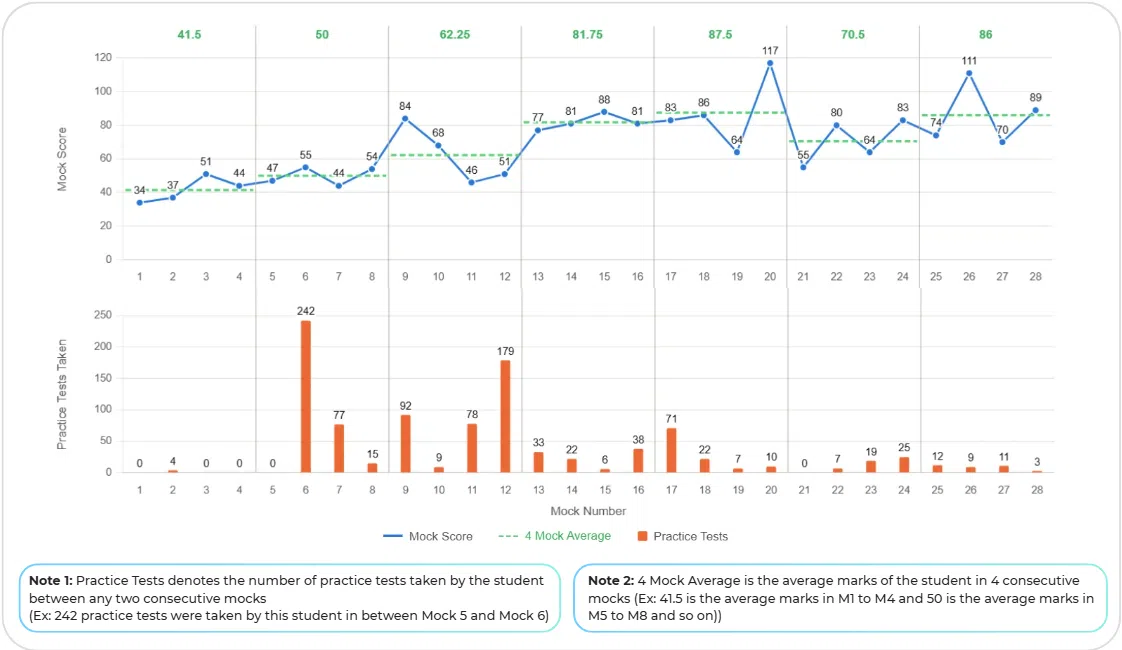
Student 1's first five CAT mock scores were:
34 → 37 → 51 → 44 → 47
He had also done very little practice between these mocks, completing only four practice tests across the first four intervals.
It wasn't an impressive beginning.
But it was a beginning.
Those initial mocks established a baseline and gave him something concrete to improve.
What happened when practice increased?
Before Mocks 6 and 7, his preparation became much more intensive.
After 242 practice tests, his score moved from 47 to 55.
An 8-mark improvement might not look dramatic considering the amount of practice involved. Then, after another 77 practice tests, his score actually fell to 44.
This is an important lesson for anyone wondering how to improve CAT mock scores:
Practice doesn't always show up in the very next mock.
You may improve your concepts without immediately improving your score. You may still be experimenting with question selection, attempting too many questions, struggling with time management or making avoidable errors.
Progress can take several mocks to become visible.
Then the scores started moving
Later, the payoff became much clearer.
After 92 practice tests, his score moved from 54 to 84 — a 30-mark jump.
There were still setbacks.
Despite completing 179 practice tests before Mock 12, he scored only 51. But Mock 13 brought a score of 77, a 26-mark improvement.
Once again, the improvement didn't necessarily appear immediately after the practice that produced it.
The 53-mark jump nobody could predict
Then came Mock 20.
Student 1 scored 64 in Mock 19.
His next score?
117.
That's a 53-mark jump in one mock.
Only 10 practice tests separated those two mocks. But it would be misleading to say those 10 tests alone produced the jump.
The result was more likely the accumulated outcome of everything that came before: mocks, mistakes, analysis, practice and repeated exposure to CAT-level questions.
This is why looking only at the number of questions solved immediately before a good mock can be misleading.
Preparation compounds.
A 117 didn't mean the bad mocks were over
After scoring 117, Student 1's next score dropped to 55.
Later, another strong score of 111 was followed by a fall to 70.
If he judged his preparation based on individual mocks, either drop could have looked disastrous.
But he kept going.
After the 70, he came back with 89.
His journey wasn't:
34 → 50 → 70 → 90 → 117
It was messy.
And that is precisely why the trend matters more than one score.
Student 1's 4-Mock Average Shows the Real Improvement
Student 1's 4-mock averages progressed as follows:
41.5 → 50 → 62.25 → 81.75 → 87.5 → 70.5 → 86
His average increased from 41.5 to 86, an improvement of 44.5 marks.
The trend is far more informative than any individual mock.
His average rose consistently through the first five blocks, reaching 87.5 around Mocks 17–20. It then fell to 70.5 before recovering to 86.
The 117 and 55 were dramatic individual results.
The average tells the more important story:
His overall level had moved up significantly.
Student 2: From 57 to 93, With a Peak of 127
Student 2's journey looked different, but it ultimately led to a remarkably similar conclusion.
Heavy practice didn't immediately produce high scores
Her first four CAT mock scores were:
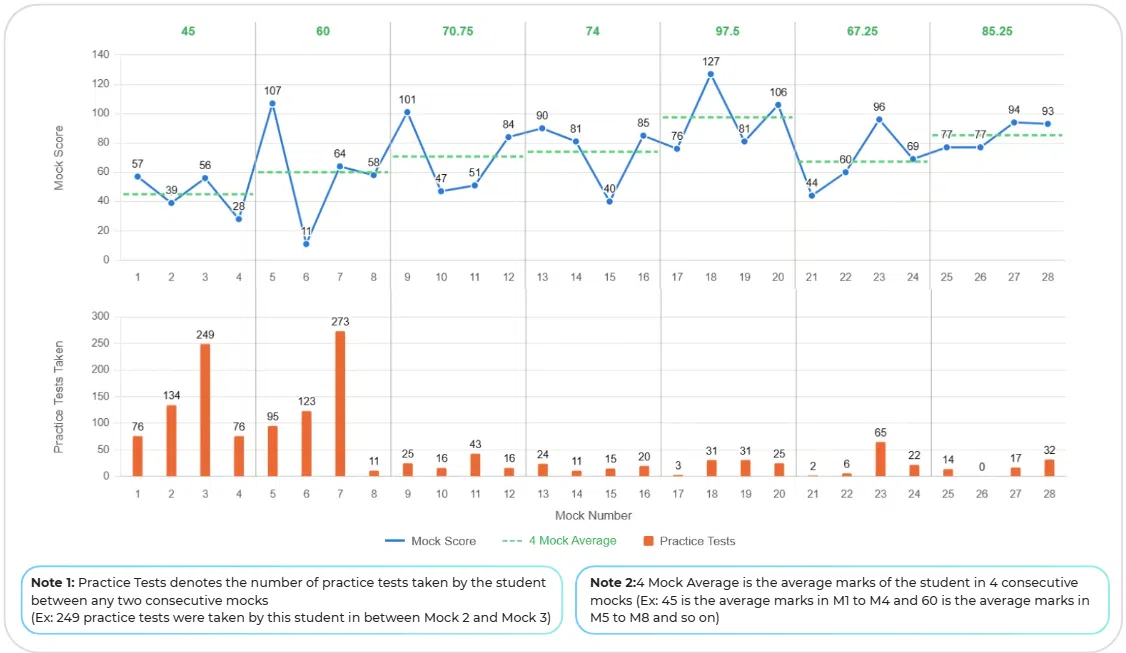
57 → 39 → 56 → 28
There was already substantial practice happening between mocks.
After 134 practice tests, Mock 2 was still only 39.
After another 76 practice tests, Mock 4 was just 28.
In total, she completed 535 practice tests before those four mocks, yet her first 4-mock average was only 45.
This reveals another important part of a good CAT preparation strategy:
Taking more tests isn't automatically the same as improving.
Practice works best when it is followed by analysis.
Instead of simply solving another test, ask:
- Why did I get this question wrong?
- Was it a conceptual error or a careless mistake?
- Did I choose the wrong question?
- Did I spend too much time on it?
- Was there a faster approach?
- Which topic should I revise before my next mock?
That's where practice turns into learning.
When Student 2's CAT Mock Scores Started Improving
Mock 5 changed the picture dramatically.
After 95 practice tests, her score jumped from 28 to 107.
That's an improvement of 79 marks in a single mock.
But the very next result demonstrates why one high mock score shouldn't be treated as proof that preparation is complete.
Her Mock 6 score fell to 11, the lowest score in her entire series.
After another 273 practice tests, she recovered to 64 in Mock 7, a 53-mark bounce.
Later, she moved from:
58 → 101 around Mock 9.
And across Mocks 11 to 13, her scores moved from:
51 → 84 → 90
The same pattern appeared repeatedly: practice, fluctuation, adjustment and eventually improvement.
From a Low of 11 to a Peak of 127
By Mock 18, Student 2 reached her highest score of the entire series:
127.
The contrast is striking.
At one point, she had scored 11.
Later, she scored 127.
If she had treated her lowest CAT mock score as a verdict on her ability, she might never have reached the score at the other end of the journey.
Mock 20 brought another excellent score of 106.
But perhaps the most useful development came after the peaks.
Her final five mocks were:
69 → 77 → 77 → 94 → 93
She still had difficult mocks along the way, including a 44 in Mock 21. But towards the end, the lower end of her score range had improved considerably.
Practice didn't make every mock better than the previous one. It raised her floor.
And for a CAT aspirant, raising your floor can matter as much as raising your ceiling.
CAT Mock Scores vs 4-Mock Average: What Really Shows Progress?
Looking at one CAT mock score can produce the wrong conclusion.
Score 110 and you may think you're suddenly fully prepared.
Score 50 the following week and you may think your preparation has collapsed.
Neither conclusion is necessarily correct.
Tracking a group of recent mocks helps smooth out unusually good and unusually bad performances.
Here's how the two students' broader trends compare:
Mock Block | Student 1 | Student 2 |
Mocks 1–4 | 41.5 | 45 |
Mocks 5–8 | 50 | 60 |
Mocks 9–12 | 62.25 | 70.75 |
Mocks 13–16 | 81.75 | 74 |
Mocks 17–20 | 87.5 | 97.5 |
Mocks 21–24 | 70.5 | 67.25 |
Final 4-Mock Block | 86 | 85.25 |
Despite two very different preparation journeys, the overall pattern is strikingly similar.
Both students:
- Started with relatively low averages
- Improved substantially over multiple mock blocks
- Experienced major individual score fluctuations
- Reached their strongest phase later in the series
- Went through a noticeable dip
- Recovered strongly afterward
Student 1's tracked average moved from 41.5 to 86.
Student 2's moved from 45 to 85.25.
The takeaway isn't that every CAT aspirant will follow this exact pattern. They won't.
The takeaway is that individual mock scores are noisy, while sustained trends can reveal whether your preparation is actually improving.
Why CAT Mock Scores Can Go Down Even When You're Improving
One of the most frustrating parts of CAT preparation is practising hard and then scoring lower in the next mock.
But a lower score doesn't automatically mean your preparation has gone backwards.
CAT mock performance can fluctuate because of:
- The difficulty of the mock
- An unusually difficult DILR set selection
- A tough VARC passage
- Poor question selection in QA
- Time-management errors
- Over-attempting
- Low accuracy
- Fatigue or lack of concentration
- Experimenting with a new test-taking strategy
This is why every mock should be followed by detailed analysis rather than an emotional reaction to the score.
Use CAT Previous Year Papers alongside mocks to understand the level and style of actual CAT questions. You can also use CAT sectional tests when your mock analysis identifies a particular section that needs focused work.
What These Two CAT Mock Journeys Actually Teach Us
There are five useful lessons hidden inside all these numbers.
A low starting CAT mock score doesn't decide your final level.
Student 1 started at 34. Student 2 had a 28 within her first four mocks. Those scores established where they were at that moment, not where they had to finish.
Practice may not pay off in the very next mock.
Sometimes improvement appears immediately. Sometimes it takes several mocks. The work you do today may show up in your scores later.
One bad CAT mock doesn't erase previous progress.
Both students experienced major drops after strong performances. Both recovered.
Your baseline matters more than your best-ever score.
A 117 or 127 is exciting. But consistently operating at a much higher level than where you started is more meaningful.
Mock analysis matters as much as mock-taking.
Taking test after test without understanding your mistakes can limit improvement. Each mock should tell you what to practise next.
The CAT Mock Analysis Cycle You Should Follow
The process doesn't have to be complicated:
Take a CAT mock → Analyse your mistakes → Identify weak areas → Practise those topics → Take another mock → Compare the trend → Repeat
Suppose your mock analysis shows that you repeatedly lose marks on Arithmetic. Don't simply take another full mock and hope the problem disappears.
Go back to the concept. Solve targeted CAT-level questions. Review relevant CAT previous year questions. Then test yourself again.
Similarly, if your concepts are strong but your scores remain inconsistent, investigate your test-taking decisions: attempts, accuracy, question selection and time allocation.
Mocks should create the feedback loop that guides the rest of your CAT preparation.
When Should You Start Taking CAT Mocks?
You don't have to wait until you've completed 100% of the CAT syllabus.
Your first few mocks can simply establish a baseline.
As preparation progresses, mocks become increasingly useful for refining strategy, improving time management, testing question selection and identifying weaknesses under exam conditions.
The goal of an early mock isn't to prove that you're ready for CAT.
It's to discover what you need to do to become ready.
If you're still building your preparation from the ground up, follow a structured CAT study plan alongside mocks so that your concept learning, practice and testing continue together.
You can use the CAT Study Planner tool to generate a customized plan that suits your needs and schedule and prepare in a more structured manner.
How to Use Your Next CAT Mock Properly
Don't finish a mock, look at the percentile and immediately move on to the next one.
After every CAT mock test, analyse three things:
Concepts: Which questions did you miss because you didn't know the concept?
Strategy: Which questions should you have attempted or skipped?
Execution: Where did calculation errors, poor time management or avoidable mistakes cost you marks?
Then turn those observations into specific tasks before your next mock.
For example:
"Improve Quant" is vague.
"Revise percentages and solve 30 CAT-level percentage questions before the next mock" is actionable.
Your mock score tells you what happened.
Your mock analysis should tell you what to do next.
Don't Wait to Be Ready for Your First CAT Mock
The most important lesson from these two journeys isn't the 117 or the 127.
It's everything that happened before those scores.
There were 30s, 40s and 50s. There was even an 11. There were hundreds of practice tests, improvements that arrived late, dramatic crashes and strong recoveries.
Yet when we zoom out from individual mocks and look at the overall trend, both students finished at a substantially higher level than where they began.
That's what CAT mocks are supposed to do.
They expose your weaknesses while you still have time to fix them.
So don't make your first mock a reward for completing your preparation.
Make it part of your preparation.
Take the mock. Analyse it. Practice what went wrong. Take another.
Your first score doesn't need to be good.
It just needs to give you somewhere to start.
Don't wait to become ready. Take mocks to become ready.
CAT Mock Tests: Conclusion
CAT mock tests should not be treated as something you attempt only after completing your preparation. They are an essential part of the preparation itself. Your early scores may be low, and your performance may fluctuate significantly, but every well-analysed mock can reveal weaknesses in concepts, question selection, accuracy and time management.
Instead of judging yourself by one unusually good or bad CAT mock score, focus on the broader trend. Take a mock, analyse your mistakes, practise the identified weak areas and test yourself again. You do not need to become ready before taking CAT mocks rather use CAT mock tests to become ready.