CAT WhatsApp Group


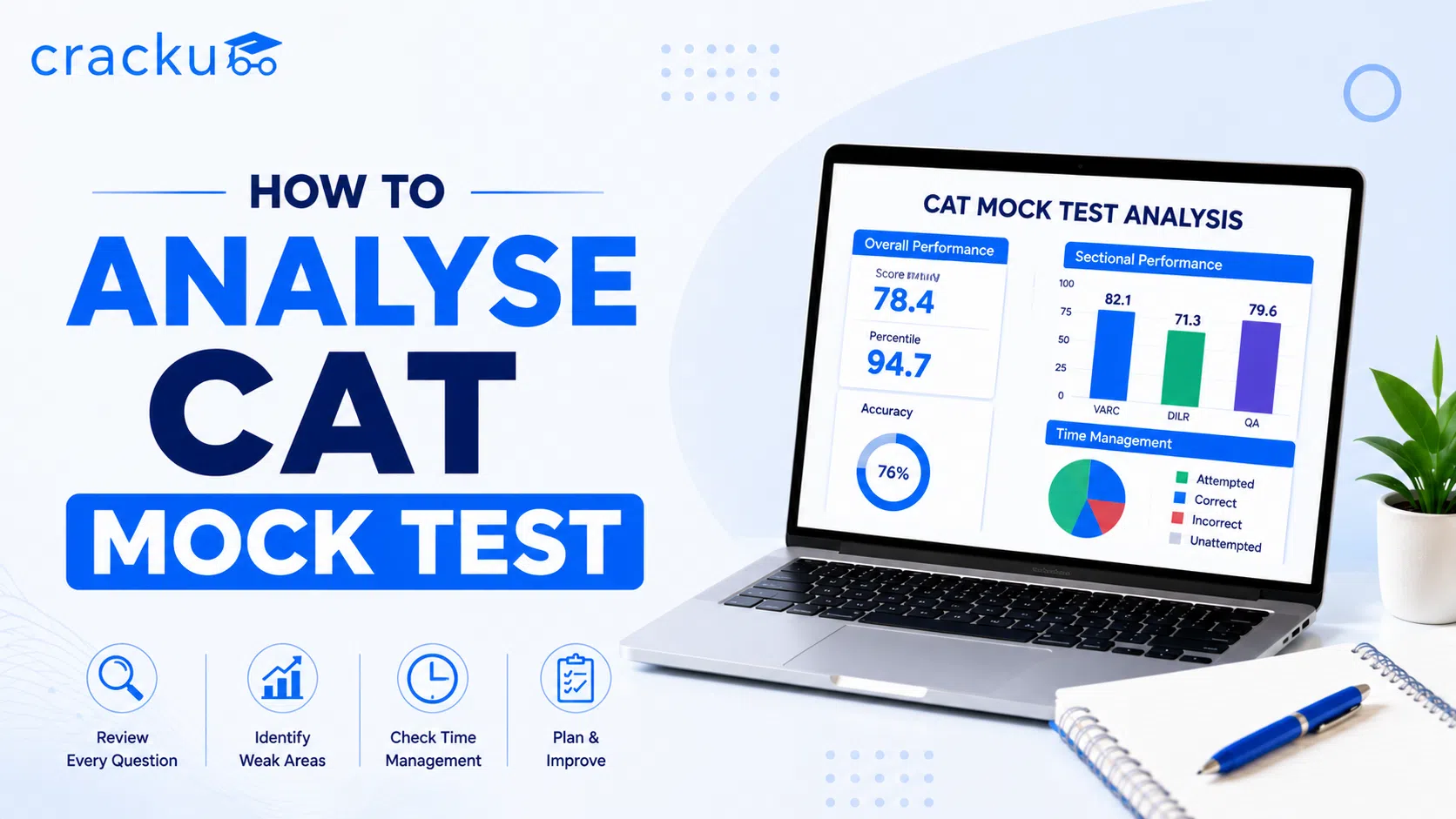
CAT Mock Test Analysis: Preparing for CAT exam involves far more than just taking mock tests - it requires learning from them. A thorough CAT mock analysis helps you identify weak areas, understand recurring mistakes, and build a smarter preparation strategy. Analyzing your performance section-wise and question-wise is what separates aspirants who struggle from those who keep improving.
This guide covers how to analyze a CAT Mock effectively, what metrics matter most, and how to turn every test into a concrete action plan.
How to Analyze a CAT Mock Test
Don't attempt the next mock before properly reviewing the previous one. Here's a structured approach:
Step | What to Do | Why It Matters |
Review overall performance | Check percentile, accuracy, and total wrong answers | Gives you a baseline to track improvement |
Analyze section-wise scores | Break down VARC, DILR, and QA separately | Reveals your strongest and weakest sections |
Categorize all questions | Sort into 4 groups (see below) | Shows where knowledge or decision-making needs work |
Find the root cause of errors | Identify why each wrong answer happened | Prevents the same mistakes in future mocks |
Assess time management | Check time spent per question and section | Highlights where you're losing time unnecessarily |
Revisit unattempted questions | Solve them after the mock without a timer | Identifies missed scoring opportunities |
Build an action plan | Prioritize weak areas before the next mock | Converts analysis into targeted improvement |
Question Categorization Framework
After every mock, sort all questions into these four groups:
- Correct (Confident) - Your Strong Zone, don’t over invest time here
- Correct (Guessed) - Risky answers that could go wrong, build concept clarity
- Incorrect - Pinpoint whether the error was conceptual, careless, or time-based
- Unattempted - Check if these were genuinely hard or simply skipped due to poor time management
Root Causes of Wrong Answers
Each wrong answer usually falls into one of these categories. Logging them consistently builds pattern awareness:
- Conceptual gap - The underlying topic needs revision
- Careless mistake - Calculation or reading error under pressure
- Misread question - The question was understood incorrectly
- Time pressure - Rushed into a wrong answer or a blind guess
Maintain an error log after every mock. Over time, patterns become clear and fixable.
How CAT Mock Tests Strengthen your Preparation
Mock tests do more than measure your score - they build the mindset and test-taking skills needed on exam day.
What Mocks Develop | How It Helps in the Real Exam |
Question selection instinct | Quickly identify easy, moderate, and hard questions to attempt in the right order |
Decision-making under pressure | Regular timed practice builds composure when difficult questions appear |
Sectional balance | CAT Sectional tests target VARC, DILR, or QA individually to close skill gaps |
Speed with accuracy | Repeated practice trains you to attempt more questions without sacrificing correctness |
Exam-day simulation | Attempting mocks helps you build the stamina needed for a 2-hour exam |
Handling unexpected patterns | CAT regularly features unfamiliar question types; mock exposure reduces panic |
One non-negotiable rule: Always attempt mocks under real exam conditions - no breaks, no pausing, no referring to notes.
How to Build an Action Plan After Every CAT Mock
A mock without an action plan is a missed opportunity. Follow this seven-step cycle:
- List your top 3 weak areas - Focus on topics or question types that hurt your score the most
- Set specific improvement goals - For example, "Improve RC accuracy from 60% to 75% in two weeks"
- Prioritize topics for revision - Tackle the hardest or highest-impact topics first
- Schedule focused practice sessions - Include topic-wise questions, sectional tests, and concept revision in your weekly plan
- Track progress before the next mock - Monitor whether targeted practice is actually moving the needle
- Adjust your strategy - Keep what worked from the previous cycle; drop what didn't
- Evaluate in the next mock - Measure if the action plan improved your score, accuracy, or time management
How to Improve Your CAT Score Through Mock Analysis
Every mock test reveals what's holding you back. Analyzing your performance helps you eliminate recurring mistakes, improve time management, and focus on the areas that will have the biggest impact on your CAT score.
Focus Area | What to Do |
High-impact weak areas | Identify topics where you make the most mistakes and miss the most scoring opportunities |
Repeated errors | Maintain an error log; revisit the underlying concept every time a mistake recurs |
Question selection | Practice spotting easy questions first to maximize your score within the time limit |
Accuracy over attempts | Prioritize getting answers right over answering more questions |
Weak sections | Dedicate extra practice time to your consistently low-scoring section |
Time allocation | Use mock data to fine-tune how long you spend on each section |
High-frequency topics | Revise topics that appear repeatedly across mocks - these carry the most weight in CAT |
How Toppers Analyze CAT Mocks
The biggest difference between average and top-scoring aspirants isn't how many mocks they take - it's how deeply they analyze each one.
What Toppers Do | What Most Aspirants Do |
Spend 2-3 hours on analysis per mock | Move to the next mock quickly |
Study correct, incorrect, and unattempted questions | Only review wrong answers |
Diagnose error type - conceptual, strategic, or careless | Note the answer and move on |
Look for shorter methods and smarter approaches | Stick to familiar techniques |
Track accuracy and attempts across multiple mocks | Judge performance test by test |
Maintain a revision document of key mistakes and shortcuts | Rely on memory |
End every analysis with a clear action plan | Start the next mock without a strategy |
Measure improvement over time, not just raw score | Focus only on percentile |
The underlying principle is simple: one well-analyzed mock is worth more than five mocks attempted without review.
CAT Mock Analysis: Conclusion
Mock analysis is not a step you fit in between tests - it is the preparation. The quality of your analysis directly determines the quality of your improvement. Track your errors, categorize your mistakes, build an action plan, and execute it before the next mock. Done consistently, this process is what turns mock test performance into CAT success.