91- 6303239042


 Preferred Source

 Google Discover
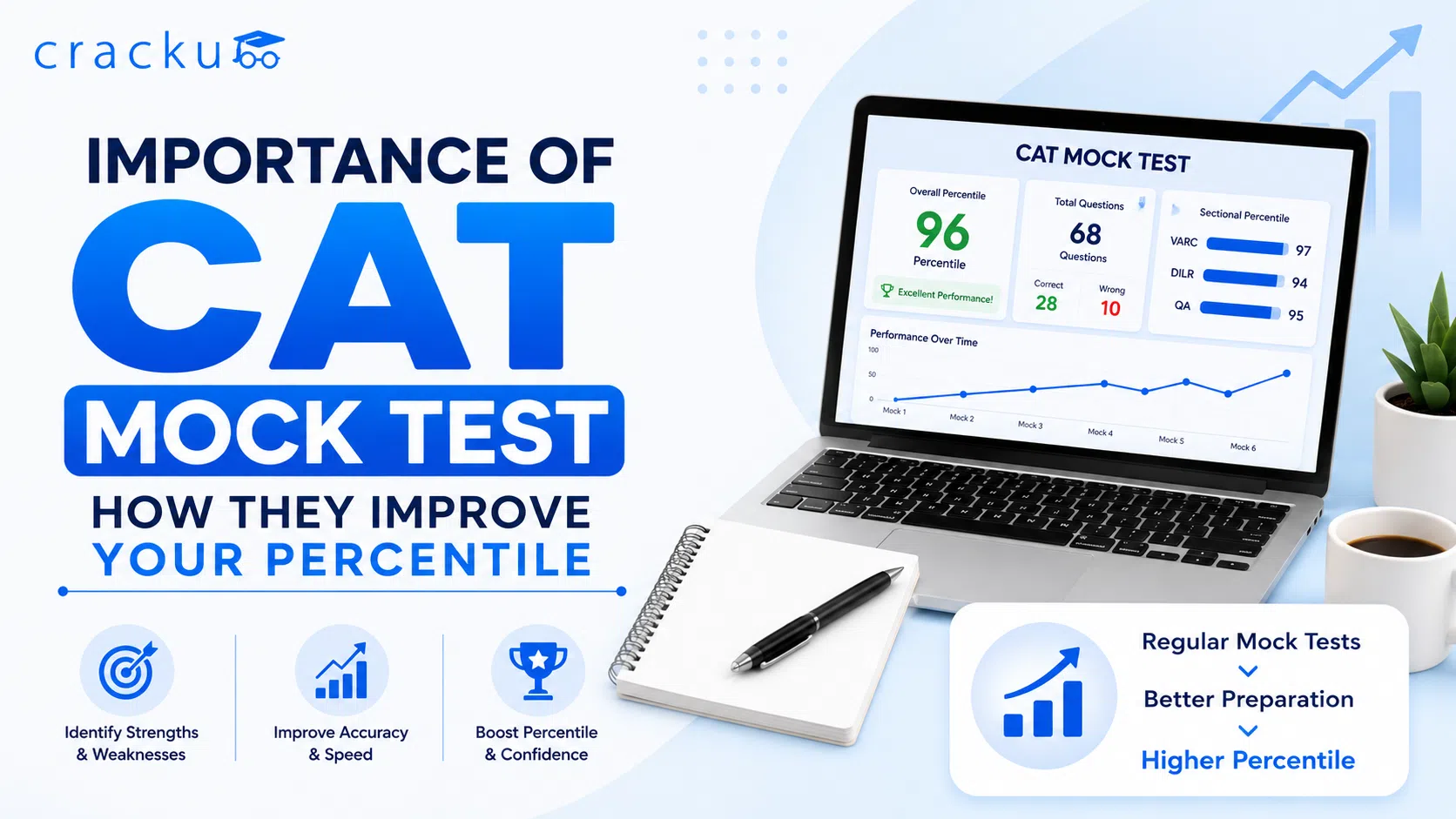
Importance of CAT Mock Tests: CAT preparation without mock tests is like training for a marathon without ever running the actual race. While learning concepts and solving practice questions are important, mock tests help you understand how well you can apply those concepts under exam conditions . Here's everything you need to know about why mocks matter - and how to use them right.
Why Mock Tests Are Important for CAT Preparation
Think about it this way: just because you close your eyes, the problem doesn't disappear.
Many students avoid mock tests because of a quiet fear - "What if I find out how bad I am?" But that fear is exactly why you should be taking mocks. You write mocks to find out where you stand right now, so you can improve.
The CAT exam has three sections - VARC, DILR, and QA - each with its own challenges, all packed into 120 minutes. Mock tests help you in several critical ways:
- You get familiar with the exact exam format and question types
- You practice managing time across three very different sections
- You reduce exam-day anxiety because the environment feels familiar
- You build the mental stamina needed to stay focused for two hours
The real purpose of a mock test is not to judge you. It's to help you understand yourself - your strengths, your blind spots, and how you behave under pressure.
How CAT Mock Tests Improve Your Percentile
Scoring high on CAT is not just about knowing the concepts. It's about making smart decisions under time pressure - and that's a skill you can only develop through repeated practice.
Here's how mocks directly translate into a better percentile:
You learn to pace yourself: With 40 minutes for each of the three sections, you need to instinctively know how long to spend on each question. Students who have written 20+ mocks develop this sense naturally - those who haven't often run out of time in the actual exam.
You stop wasting time on hard questions: One of the biggest score killers in CAT is spending too long on one question. Mock tests teach you when to move on.
You refine your section strategy: Should you attempt RCs or VA first? How many DILR sets should you target? These decisions depend on your preparation strategy and difficulty level of the exam and can only be figured out through experimentation across multiple mocks.
You learn from your mistakes: After every mock, reviewing incorrect answers is where the real growth happens. Was it a conceptual gap? A careless error? Time pressure? Each mistake is a lesson.
Here's a comparison of what happens with and without regular mock practice:
Area | Without Regular Mocks | With Regular Mocks |
Time management | Panic during the exam | Confident and steady pacing |
Weak areas | Hidden until exam day | Identified and worked on early |
Attempt strategy | Guesswork | Data-driven, refined over time |
Exam-day nerves | High anxiety | Familiar environment, low stress |
Accuracy | Careless errors are common | Fewer mistakes due to habit |
Percentile trend | Unpredictable | Consistently improving |
How Many CAT Mock Tests Are Enough Before the Exam?
There is no fixed number, but there are clear benchmarks based on serious CAT aspirants and mentors.
Phase | Timeframe | Recommended Mocks | Focus |
Early preparation | 6+ months before CAT | 1 mock per 2 weeks | Get comfortable, no pressure |
Mid preparation | 3-5 months before CAT | 1 mocks per week | Build speed and accuracy |
Intensive phase | 1-2 months before CAT | 2 mocks per week | Full-length, timed, serious |
Final 2 weeks | Just before CAT | 1-2, Focus more on revision and practice | Maintain rhythm, don't burn out |
Most serious aspirants aim for 25-30 full-length mocks before the exam. Quality matters as much as quantity - a mock you analyse properly is worth more that you just attempt and move on from.
When Should I Start Taking CAT Mock Tests?
The short answer: earlier than you think.
Many students make the mistake of waiting until they've "finished the syllabus" before starting mocks. This is a trap. You should start taking mocks while you're still learning.
Start with sectional mocks: As soon as you've covered 30-40% of the syllabus. These shorter tests (40 minutes, one section only) help you apply concepts and identify gaps quickly.
Move to full-length mocks: Once you have a basic understanding of all three sections - ideally around 4-5 months before the exam.
The key mindset shift is this: your first mock will probably go badly. That's fine. The purpose of that mock is not to perform well - it's to find out what you need to work on. Write it anyway.
How to Analyze CAT Mock Tests Effectively?
Taking a mock without analysing it is just a mock wasted - you're putting in effort but not getting the full benefit.
Here's a structured way to analyse every mock you take:
Step 1 - Score review: Look at your total score and section-wise breakdown. Where did you gain marks? Where did you lose them? Note your accuracy and attempt rate for each section separately.
Step 2 - Classify your errors: Not all mistakes are equal. Separate them into three buckets: conceptual errors (you didn't know the concept), careless errors (you knew but made a silly mistake), and time-pressure errors (you rushed because the clock was running). Each type needs a different fix.
Step 3 - Time audit: Roughly how much time did you spend per question and per section? Were you spending too long on hard questions? Did you run out of time in one section while finishing another too early?
Step 4 - Update your attempt strategy: Based on what you found, should you change the order in which you attempt sections? Should you set a stricter per-question time limit? Small adjustments here compound massively over 25+ mocks.
Step 5 - Build a targeted action plan: Before your next mock, list the specific topics or question types you need to work on. Don't try to fix everything at once - focus on two or three areas per cycle.
Error Type | Root Cause | What to Do |
Wrong answer, knew the concept | Careless mistake | Slow down, double-check calculations |
Wrong answer, didn't understand | Conceptual gap | Go back to study material, resolve the concept |
Left blank, ran out of time | Poor time allocation | Practice moving on faster, revise attempt strategy |
Right answer, lucky guess | Unclear concept | Still revise - guesses won't save you in the real exam |
Remember - the second, third, and fourth mocks you take will be harder to sit through than the first - because now you know what it feels like to struggle. But by the seventh or eighth mock, something shifts. You start handling pressure naturally. You start knowing when to skip a question without second-guessing yourself. That self-awareness can't be taught. It can only be earned - one mock at a time.
Conclusion
Mock tests are not a measure of where you are. They're the vehicle that gets you to where you want to be. Stop avoiding them. Start writing them. And most importantly - analyse every single one.