91- 6303239042


 Group


 Preferred Source

 Google Discover
Most Important Vocabulary Words for CAT 2026 VARC
With CAT 2026 scheduled for November 29, 2026, aspirants should focus on revising important vocabulary words that can help them improve their performance in the Verbal Ability and Reading Comprehension (VARC) section. Although CAT does not usually ask direct vocabulary-based questions, understanding word meanings, contextual usage and tone can help students solve Reading Comprehension (RC), Para Summary and other verbal questions more accurately.
The most important vocabulary words for CAT 2026 VARC include commonly used academic words, contextual expressions and terms frequently encountered in CAT Reading Comprehension passages. Students can use the CAT Vocabulary PDF, practise important VARC questions and revise previous year papers to strengthen their vocabulary before the exam.
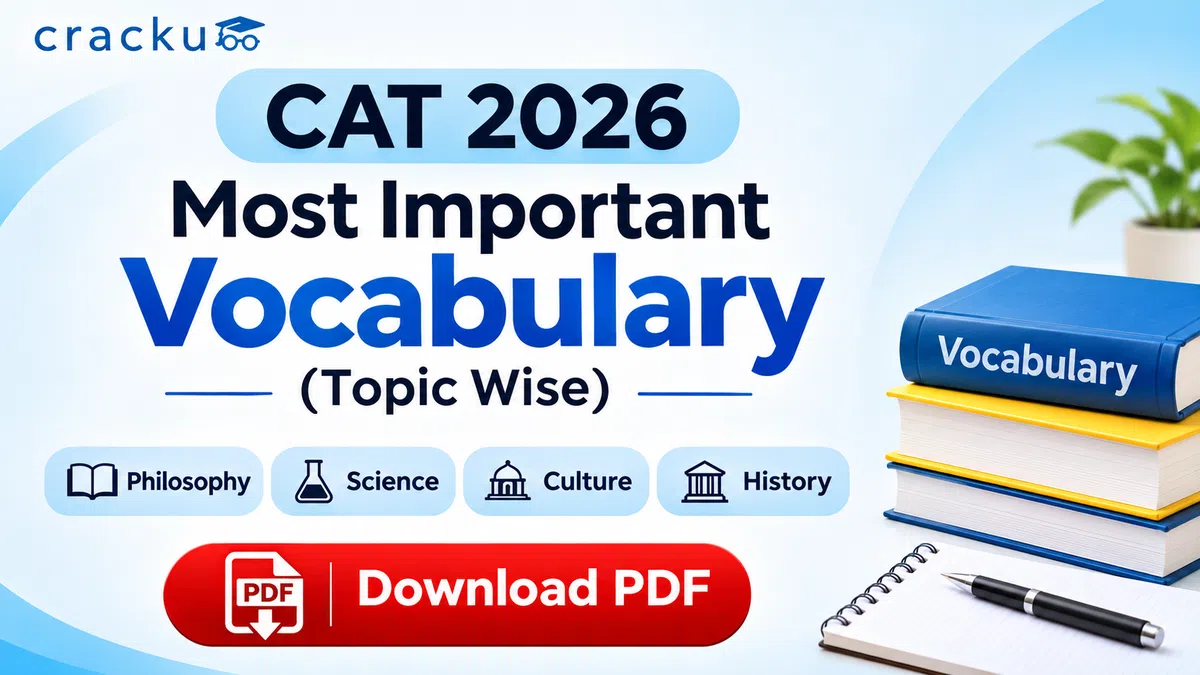
Download CAT 2026 Vocabulary PDF
The CAT 2026 Vocabulary PDF is a useful revision resource for aspirants who want to strengthen their vocabulary before the examination. It allows students to revise important words, their meanings and contextual usage in one place without spending too much time searching for different resources.
The PDF can be used to revise:
- Important vocabulary words and their meanings.
- Common synonyms and antonyms.
- Words frequently encountered in academic passages.
- Vocabulary useful for identifying the author's tone.
- Contextual word meanings and common confusing words.
- Important words related to philosophy, economics and social sciences.
Download CAT 2026 Most Important Vocabulary PDF:
Students should ideally revise 15 to 20 words at a time and practise using them in sentences. This approach improves retention and helps connect vocabulary knowledge with actual Reading Comprehension performance.
Most Important Vocabulary Words for CAT 2026 VARC
Vocabulary plays an important role in understanding complex Reading Comprehension passages. CAT often includes passages from philosophy, economics, psychology, sociology, science and history. These passages may contain unfamiliar words that affect the meaning of an argument or the author's opinion.
Instead of memorising hundreds of difficult words, CAT 2026 aspirants should concentrate on vocabulary that helps them understand arguments, identify the author's tone and interpret sentences correctly.
Here are some important CAT vocabulary words to revise before the examination.
Vocabulary Word | Meaning |
Ambiguous | Having more than one possible meaning |
Pragmatic | Practical and realistic |
Empirical | Based on observation or evidence |
Skeptical | Doubtful or questioning |
Paradox | A seemingly contradictory statement |
Implicit | Suggested without being directly stated |
Explicit | Clearly and directly expressed |
Nuance | A subtle difference in meaning |
Inference | A conclusion drawn from evidence |
Conundrum | A difficult or confusing problem |
Dogmatic | Unwilling to consider other opinions |
Ubiquitous | Present or found everywhere |
Mitigate | To reduce the severity of something |
Exacerbate | To make a problem worse |
Anomaly | Something different from what is expected |
Precarious | Uncertain or unstable |
Eloquent | Fluent and persuasive in expression |
Disparity | A significant difference or inequality |
Substantiate | To support a claim with evidence |
Dichotomy | A division between two contrasting things |
These words are useful because they frequently appear in academic writing and argumentative passages similar to those used in CAT VARC.
For example, consider the sentence:
The author's pragmatic approach mitigates the risks associated with an otherwise precarious economic situation.
Understanding the words pragmatic, mitigates and precarious makes it easier to interpret the sentence without getting confused by its structure.
Important: CAT primarily tests contextual understanding rather than isolated word meanings. Therefore, aspirants should practise identifying meanings within sentences instead of simply memorising definitions.
Also Read: CAT VARC Cheat Sheet PDF by Sayali Mam, Download Now
Practice Important CAT VARC Questions with Solutions
Practising CAT VARC questions is one of the most effective ways to improve vocabulary and reading comprehension together. Unlike traditional vocabulary tests, CAT requires students to understand the meaning of words within the context of a passage or paragraph.
Aspirants should focus on practising different types of VARC questions, including Reading Comprehension, Para Summary, Para Jumbles and Odd Sentence Out.
CAT VARC Question Type | How Vocabulary Helps |
Reading Comprehension | Understanding complex passages and arguments |
RC Inference Questions | Identifying implied meanings and conclusions |
Author's Tone Questions | Recognising critical, skeptical or analytical language |
Para Summary | Understanding the central idea accurately |
Para Jumbles | Identifying logical connections between sentences |
Odd Sentence Out | Understanding the context and flow of a paragraph |
For example, a Reading Comprehension question may ask whether the author's attitude towards an argument is skeptical, optimistic, dismissive or neutral.
Understanding the differences between these words can help students eliminate incorrect options and select the most appropriate answer.
Students can practise CAT Reading Comprehension questions and review detailed solutions to understand how vocabulary affects interpretation.
While analysing solutions, pay attention to why incorrect options are eliminated. Often, the difference between two closely related options depends on the precise meaning of a word or phrase.
Also Read: CAT VARC Marathon Questions 2026 PDF & Solutions
Revise CAT Vocabulary Using Previous Year Papers
Solving CAT previous year papers is an effective way to understand how vocabulary is tested indirectly in the VARC section.
Previous year questions expose students to different writing styles, complex arguments and unfamiliar vocabulary. They also help aspirants understand how CAT uses context to test reading ability rather than direct word memorisation.
When practising CAT VARC previous year questions, students should follow a structured revision method.
- Read the passage carefully and identify unfamiliar words.
- Try to understand their meanings using surrounding sentences.
- Check the actual meanings after completing the passage.
- Identify how those words influence the author's argument or tone.
- Maintain a short vocabulary revision notebook for repeated mistakes.
For instance, the word critical can mean important or express disapproval, depending on the context. Understanding this distinction is more useful than memorising a single definition.
Aspirants should prioritise CAT VARC previous year papers from 2021 to 2025 to familiarise themselves with recent question styles.
It is also useful to revisit previously attempted RC passages and check whether unfamiliar vocabulary contributed to incorrect answers. This helps distinguish vocabulary-related errors from problems involving inference, reasoning or comprehension.
Also Read: CAT VARC Study Material 2026, Cheat Sheet, Questions PDF
CAT 2026 VARC Last-Minute Preparation Tips and Mock Tests
With less than two weeks remaining before CAT 2026, students should avoid spending excessive time memorising new vocabulary. The focus should be on revising familiar words, practising Reading Comprehension and improving accuracy through mock test analysis.
Here are some practical last-minute CAT VARC preparation tips:
- Revise vocabulary daily: Spend 15 to 20 minutes reviewing important words and contextual meanings.
- Practise Reading Comprehension: Solve two to three RC passages regularly, depending on your available preparation time.
- Analyse incorrect answers: Understand whether mistakes were caused by vocabulary, inference, interpretation or poor question selection.
- Revise author's tone words: Focus on words such as analytical, critical, sarcastic, skeptical, optimistic and neutral.
- Practise Verbal Ability: Continue revising Para Summary, Para Jumbles and Odd Sentence Out questions.
- Take sectional mock tests: Use timed practice to improve accuracy, reading speed and question selection.
Students can attempt CAT mock tests to evaluate their VARC performance under exam-like conditions.
After each mock, identify passages where unfamiliar words affected comprehension. Instead of learning every unknown word, prioritise those that influenced the passage's main argument or the correct answer.
A useful final-week strategy is to maintain a one-page vocabulary revision sheet containing 30 to 50 important words, confusing expressions and author's tone terms.
This provides a manageable revision resource without taking time away from mock analysis and previous year question practice.
Also Read: How to Attempt a VARC Sectional Test Effectively, Check Now
Most Important Vocabulary Words for CAT 2026 VARC: Conclusion
Revising the most important vocabulary words for CAT 2026 VARC can improve reading comprehension, contextual understanding and accuracy in verbal questions. However, CAT does not primarily test vocabulary through direct definitions. Students should therefore focus on understanding words within passages, identifying the author's tone and interpreting arguments correctly.
With CAT 2026 approaching, aspirants should use the CAT Vocabulary PDF, practise important VARC questions, revise previous year papers and analyse mock tests regularly. A focused revision strategy that combines vocabulary knowledge with Reading Comprehension practice can help students approach the VARC section with greater confidence on exam day.