91- 6303239042
 CAT WhatsApp Group



 Preferred Source

 Google Discover
CAT 2026 VARC Important Topics
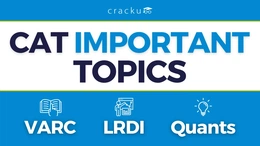
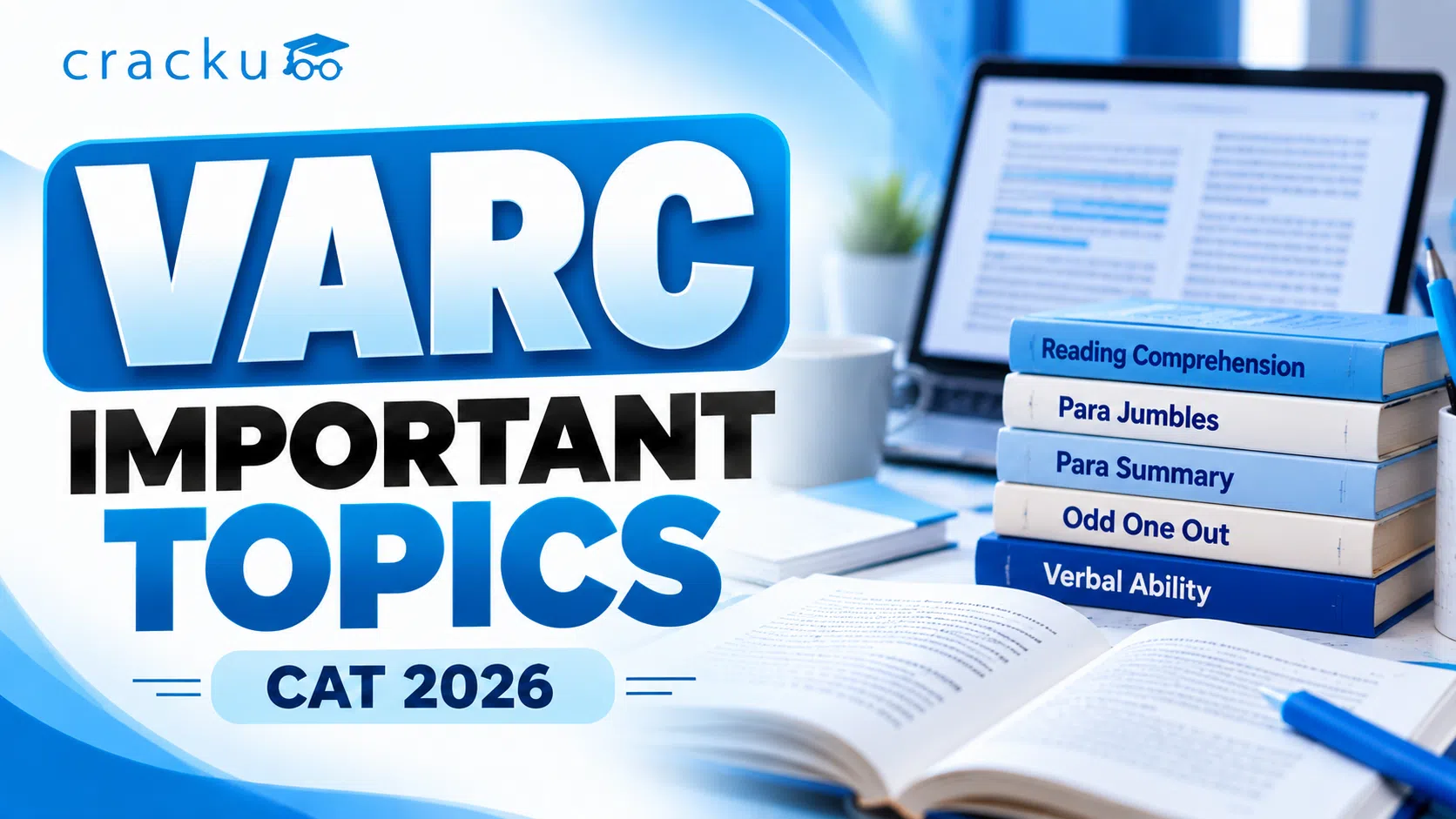
Preparing the right topics is essential for candidates aiming to perform well in the VARC section of CAT 2026. The CAT VARC Important Topics 2026 primarily include Reading Comprehension, Para Summary, Para Jumbles, Odd Sentence Out and Para Completion/Sentence Placement.
Along with topic-wise practice, aspirants should work on reading speed, accuracy, inference and time management. Analysing CAT Previous Year Papers can help candidates understand the nature of questions and changes in the VARC section over the years.
A structured preparation strategy combining regular reading, RC and VA practice, sectional tests and mock-test analysis can help improve VARC performance.
CAT VARC Section Overview 2026
The CAT VARC section evaluates reading comprehension, verbal reasoning and the ability to interpret written information. It consists primarily of Reading Comprehension (RC) and Verbal Ability (VA).
Based on the latest CAT exam pattern, candidates should prepare for a 40-minute sectional time limit. The exact number and distribution of questions in CAT 2026 should be treated as subject to the actual exam.
Particulars | Details |
Section | Verbal Ability and Reading Comprehension (VARC) |
Sectional Time | 40 minutes based on the recent CAT pattern |
Main Areas | Reading Comprehension (RC) and Verbal Ability (VA) |
RC Focus | Main idea, inference, author's viewpoint, tone, purpose and argument |
VA Focus | Para Summary, Para Jumbles, Odd Sentence Out and Para Completion/Sentence Placement |
Question Types | MCQs and Non-MCQs/TITA, depending on the question type |
Negative Marking | Incorrect MCQs generally carry negative marks; TITA questions generally do not |
Key Skills | Comprehension, inference, logical reasoning, contextual interpretation and option elimination |
Preparation Focus | RC practice, VA practice, previous papers, sectional tests and mock analysis |
Candidates can refer to the CAT Exam Syllabus 2026 to understand the broader section-wise topics before planning their preparation.
Important Reading Comprehension Topics for CAT 2026
Reading Comprehension is the most important area within VARC based on recent CAT papers. CAT RC passages can come from a wide variety of subjects, and prior knowledge of the subject is generally less important than the ability to understand and analyse the passage.
Candidates preparing CAT Reading Comprehension should practise passages from diverse areas instead of becoming comfortable with only one or two familiar subjects.
RC Topic/Theme | What to Prepare |
Philosophy | Arguments, beliefs, ethics, schools of thought and abstract concepts |
History | Historical events, interpretations, movements and cultures |
Economics | Markets, development, trade, inequality and economic ideas |
Science & Technology | Scientific ideas, discoveries, technological developments and their implications |
Environment | Ecology, conservation, climate, sustainability and environmental debates |
Society & Culture | Social structures, identity, cultural practices and social change |
Politics & Governance | Institutions, public policy, democracy and governance-related arguments |
Literature & Arts | Literary criticism, artistic movements, aesthetics and cultural expression |
Psychology | Human behaviour, cognition, decision-making and social behaviour |
Business & Management | Organisations, markets, innovation and management-related ideas |
The objective is not to memorise information from these subjects. Instead, practise identifying the author's central argument, purpose, assumptions, tone and the relationships between different ideas.
Also Read: CAT RC Types 2026: Genres, Strategies & Cheat Sheet PDF
CAT Reading Comprehension Trends from Previous Years
Previous CAT papers show that Reading Comprehension has consistently occupied a major share of VARC. In CAT 2025, for example, each slot contained 16 RC questions within a 24-question VARC section.
The subject matter of passages can vary considerably across slots and years. Therefore, treating particular themes as guaranteed "important topics" can be misleading. A better strategy is to analyse CAT VARC PYQs for the skills repeatedly tested.
Common RC question areas include:
- Main idea or central argument
- Inference
- Author's viewpoint
- Author's tone and purpose
- Application of an argument
- Strengthening or weakening an idea
- Meaning of a statement in context
- Function of a paragraph or example
- Logical implications of the passage
Candidates should also expose themselves to passages from philosophy, science, economics, history, literature, society, culture and other unfamiliar subjects. This helps reduce dependence on prior knowledge and improves adaptability.
Also Read: CAT VARC PYQ Analysis 2026, Difficulty, Repeated Topics
Verbal Ability Topics for CAT 2026
Verbal Ability forms the other major component of VARC. CAT 2025 had 8 VA questions in each slot, although candidates should not assume that CAT 2026 will necessarily repeat exactly the same topic-wise distribution.
The important CAT Verbal Ability topics to prepare are:
Verbal Ability Topic | What It Tests |
Para Jumbles | Logical sequencing and progression of ideas |
Para Summary | Identifying the central argument and the most accurate summary |
Odd Sentence Out | Identifying the sentence that disrupts paragraph coherence |
Para Completion | Determining how an argument or paragraph logically continues |
Sentence Placement/Insertion | Identifying where a sentence fits logically within a paragraph |
Logical Flow & Cohesion | Understanding references, transitions, chronology and relationships between ideas |
Instead of memorising fixed techniques, candidates should learn to identify logical connections between sentences. Pronouns, transition words, chronology, cause-and-effect relationships and shifts in argument can provide useful clues.
Also Read: How To Master CAT 2026 VARC? Check Tips And Tricks Now
CAT VARC Topic-Wise Weightage
CAT does not publish a predetermined topic-wise weightage for CAT 2026. Therefore, any weightage used for preparation should be based on previous-year papers rather than treated as a guaranteed future pattern.
CAT 2025 provides a useful recent reference:
VARC Area | CAT 2025 Questions per Slot | Approx. Share of VARC |
Reading Comprehension | 16 | 66.7% |
Verbal Ability | 8 | 33.3% |
Total | 24 | 100% |
Within Verbal Ability, CAT 2025 included Para Jumbles, Para Summary, Para Completion and Odd Sentence Out questions. The distribution of individual VA formats can change from year to year.
This is why candidates should avoid skipping a VA question type merely because it appeared less frequently in a particular CAT previous paper.
Also Read: CAT RC Sources 2026, PYQ RC Analysis & Important Topics
CAT 2025 Reading Comprehension Weightage
CAT 2025 provides the most recent completed-paper reference for understanding the role of Reading Comprehension in VARC.
Across the three slots, RC accounted for 16 of the 24 VARC questions. Each slot contained four RC passages with four questions per passage.
Particulars | CAT 2025 Details |
Total VARC Questions | 24 |
RC Questions | 16 |
Approx. RC Share | 66.7% |
RC Passages | 4 |
Questions per RC | 4 |
VA Questions | 8 |
RC : VA | 16 : 8 |
The key takeaway is not that CAT 2026 must repeat this exact structure. Instead, the recent pattern shows why RC deserves a substantial share of a candidate's VARC preparation time.
Candidates can use CAT Mock Tests to experiment with RC selection, question order and time allocation before finalising their exam strategy.
Also Read: CAT VARC PYQ Analysis 2026, Difficulty, Repeated Topics
Important Para Summary and Para Completion Topics for CAT 2026
Para Summary and Para Completion test a candidate's ability to identify the central idea and understand how arguments develop.
Although the formats differ, both require careful attention to scope, tone, logical flow and the relationship between ideas.
Area | What to Focus On |
Central Idea | Identify the paragraph's primary message |
Main Argument | Separate the core argument from examples and supporting details |
Logical Flow | Understand how one idea leads to another |
Supporting Arguments | Identify evidence and explanations supporting the main point |
Cause and Effect | Track causal relationships accurately |
Contrast & Comparison | Identify opposing or contrasting viewpoints |
Author's Tone | Understand the writer's attitude without over-interpreting it |
Inference | Select conclusions logically supported by the paragraph |
Context & Coherence | Check whether an option fits the paragraph as a whole |
Scope | Reject options that broaden or narrow the author's argument incorrectly |
Option Elimination | Remove choices that distort, exaggerate or introduce unsupported ideas |
Para Summary Preparation
In Para Summary questions, candidates should identify the central message before evaluating the options. A good summary should represent the author's main argument without introducing new information or overemphasizing a minor example.
Watch out for options that are:
- Too broad
- Too narrow
- Focused only on an example
- Factually inconsistent with the paragraph
- More extreme than the author's actual position
- Introducing an idea absent from the paragraph
Para Completion Preparation
For Para Completion Questions, determine the direction in which the argument is developing before looking at the options.
Ask:
- What is the paragraph mainly discussing?
- Is the author building, contrasting or concluding an argument?
- What should logically follow from the final sentence?
- Which option maintains the same scope and tone?
Candidates can supplement topic-wise practice with CAT VARC Sectional Tests to practise these question types under the 40-minute sectional constraint.
How to Prepare for CAT VARC Important Topics 2026
Knowing the important topics is useful, but VARC improvement depends more on the quality and consistency of practice than on simply completing a topic list.
A strong CAT 2026 VARC preparation strategy should combine reading, question-solving and detailed analysis.
Read Consistently
Read long-form articles, essays and editorials across unfamiliar subjects. Philosophy, economics, science, sociology, psychology, history and culture are useful areas for building reading versatility. The goal should be active comprehension rather than simply increasing words per minute.
To make daily reading more structured and CAT-focused, aspirants can use CAT Daily Articles to practise reading regularly across diverse topics and genres. Consistent exposure to such articles can help candidates become more comfortable with unfamiliar subjects, complex arguments and different writing styles skills that are particularly useful while tackling Reading Comprehension passages in CAT VARC.
Practise Reading Comprehension Regularly
Solve RC passages across different difficulty levels and themes. After every passage, check whether errors occurred because of:
- Misreading the passage
- Missing the author's argument
- Incorrect inference
- Confusion between two options
- Outside knowledge influencing the answer
- Poor time management
Focus on the Author's Argument
While reading an RC, identify:
- What is the author discussing?
- What is the author's main claim?
- Why was the passage written?
- What role does each paragraph play?
- Does the author's position change anywhere?
This makes inference and main-idea questions easier to approach.
Practise Every Major VA Format
Do not prepare only Para Summary or Para Jumbles. Practise Para Summary, Para Jumbles, Odd Sentence Out, Para Completion and Sentence Placement so that a change in the actual CAT distribution does not leave a gap in your preparation.
Use Option Elimination
VARC is often as much about rejecting incorrect options as identifying the correct one.
In RC and Para Summary, be cautious of options containing extreme claims, distorted comparisons, unsupported assumptions or ideas that go beyond the scope of the passage.
Analyse Previous-Year Questions
Use previous CAT papers to understand how the exam frames inference, main idea, tone, summary and logical-flow questions.
Do not simply check whether your answer was correct. Understand why every incorrect option is wrong.
Take Sectional Tests
Once your fundamentals are reasonably strong, attempt timed CAT Sectional Tests. Sectionals help evaluate question selection, reading speed, accuracy and time allocation under exam-like constraints.
Maintain an Error Log
Record recurring mistakes after RCs, sectionals and mocks. Classify them into categories such as inference errors, close-option confusion, missed keywords, incorrect passage interpretation or time-management problems.
Patterns in your error log can reveal what actually needs improvement.
Also Read: CAT VARC Cheat Sheet PDF by Sayali Mam, Download Now
Best Resources for CAT VARC Preparation 2026
Candidates do not need to depend on a single resource for VARC. A combination of concept learning, previous papers, reading practice and timed testing works better.
Useful preparation resources include:
- CAT VARC Course 2026 for structured concept and strategy preparation
- CAT Previous Year Papers to understand actual CAT-level questions
- CAT VARC Sectional Tests for timed section-level practice
- Free CAT Preparation for mocks, sectionals and preparation resources
- CAT Study Material for topic-wise practice and preparation resources
The important point is to analyse performance rather than simply accumulate practice. Twenty carefully reviewed RC passages can be more useful than solving a much larger number without understanding why errors occurred.
Also Read: CAT RC Sources 2026, PYQ RC Analysis & Important Topics
Key Takeaways for CAT VARC 2026
The most important CAT VARC topics for 2026 include Reading Comprehension, Para Summary, Para Jumbles, Odd Sentence Out, Para Completion and Sentence Placement. Among these, RC deserves significant preparation time because it has historically accounted for the largest share of VARC.
However, candidates should avoid treating previous-year weightage as a guaranteed CAT 2026 pattern. The exact question mix can change.
For RC, focus on main idea, inference, author's viewpoint, tone, purpose and argument structure. For VA, build skills in logical sequencing, paragraph coherence, summarisation and contextual interpretation.
Most importantly, combine regular reading and topic-wise practice with previous-year papers, sectional tests and detailed mock analysis. A strong VARC strategy is not about attempting the maximum number of questions; it is about selecting questions intelligently and answering them with consistently high accuracy.