91- 6303239042


 Group
Group


 Preferred Source

 Google Discover
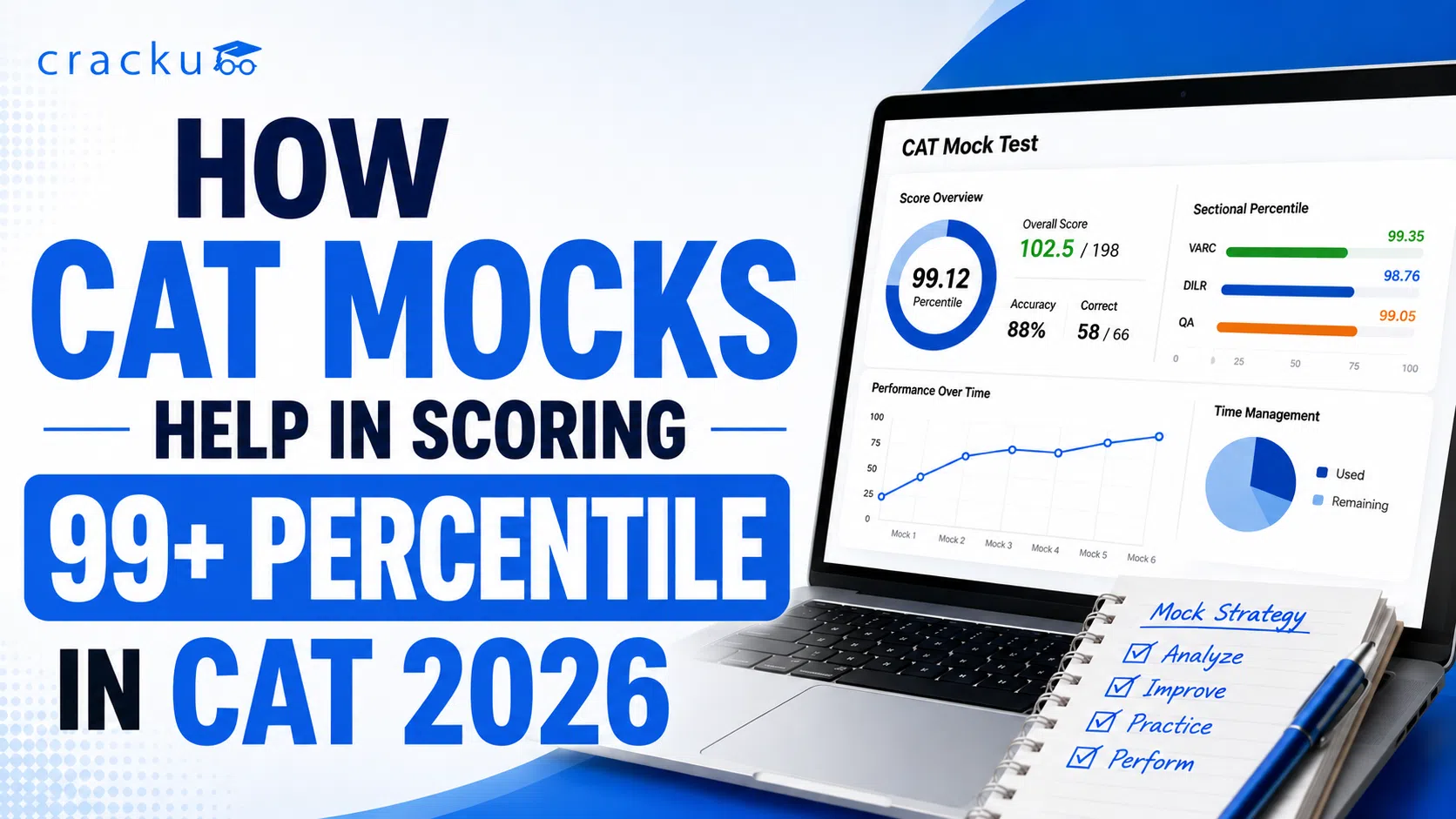
CAT preparation is often treated as a syllabus-completion exercise. Aspirants finish Arithmetic, Algebra, RCs and DILR sets and assume that stronger concepts will automatically translate into a higher percentile.
CAT does not work that way.
The exam also tests whether you can identify the right questions, leave difficult ones early enough, manage pressure and maintain accuracy when the clock is running. These skills are difficult to develop through topic-wise practice alone. This is where CAT mocks become one of the most important parts of CAT 2026 preparation.
Why CAT Mocks Are Essential for CAT 2026 Preparation
A CAT mock is not simply another set of questions. It is a simulation of the decisions you will have to make during the actual exam.
While practising individual topics, you usually know what concept is being tested. In a full-length mock, questions from different topics and difficulty levels appear together. You have to decide which questions deserve your time.
Mocks help you gradually answer questions such as:
- Which VARC questions should I attempt first?
- How quickly should I reject a difficult DILR set?
- How much time should I spend before leaving a QA question?
- What should I do if one section goes badly?
- How many attempts can I realistically maintain without sacrificing accuracy?
This makes mocks a bridge between knowing CAT concepts and actually performing well in CAT.
Cracku's CAT 2026 preparation ecosystem currently includes full-length DashCAT mocks, sectional tests, previous CAT papers and detailed performance analysis. The CAT 2026 test series lists 25 full-length mocks with video solutions and analysis.
How CAT Mocks Improve Question Selection and Time Management
One of the biggest differences between regular practice and CAT is that you should not try to solve every question.
Suppose you spend six minutes on a difficult QA question before eventually skipping it. The problem is not merely that you failed to solve one question. You may also have lost the opportunity to attempt two easier questions later in the section.
Mocks expose these hidden opportunity costs.
After several tests, you begin recognising patterns in your own behaviour. You may discover that you spend too long on difficult Arithmetic questions, repeatedly choose the wrong DILR set first or attempt doubtful VARC questions that reduce your accuracy.
A useful strategy is to classify questions during mock analysis into three categories:
Question Type | What to Learn |
Should have attempted | Improve recognition and speed |
Correctly skipped | Continue using the same selection logic |
Should have skipped | Identify why you spent unnecessary time |
This turns time management from a vague goal such as "solve faster" into a measurable process of improving decisions.
Why Repeated Mocks Make the Actual CAT Exam Feel Familiar
Exam pressure often comes from uncertainty.
If you have rarely attempted a complete paper under timed conditions, the actual CAT can feel unusually fast. A difficult opening RC, unfamiliar DILR set or lengthy QA question can affect your confidence.
Repeated mock attempts reduce this novelty.
You become familiar with:
- Moving between questions without panic
- Watching the timer without constantly checking it
- Recovering after a difficult set or passage
- Maintaining concentration across all three sections
- Working with an exam-style interface
- Making quick skip-or-attempt decisions
This familiarity matters because CAT is not necessarily difficult in the same way every year. What remains constant is the need to respond calmly when the paper is different from what you expected.
Cracku states that its CAT mock tests use an exam-like interface and provide analysis of time taken, strengths, weaknesses and percentile performance.
What CAT 99+ Percentilers Say About Cracku DashCATs
Feedback from previous CAT high scorers shows that mocks are valuable not simply because of their scores, but because they help candidates develop an exam strategy.
- Adhiraj Joshi, who scored 99.99 percentile in CAT 2025, said he aimed to attempt two DashCATs every weekend and then solve the questions he had left during the test while analysing the mock.
- Vivek, a 99.88 percentiler in CAT 2025, highlighted that DashCATs were close to the actual CAT in difficulty and interface. He also credited detailed analysis videos and faculty attempts with helping him improve his decision-making under pressure.
- Similarly, CAT 2024 toppers including Vedant Bang and Rohit Mohta mentioned that regular mocks helped them finalise their attempt strategy and become conditioned for the actual examination.
This is an important lesson for CAT 2026 aspirants. The objective of a mock should not be to prove that you are already prepared. It should help reveal what needs to change before exam day.
Why Mock Analysis Is Critical for Score Improvement in CAT
Taking more mocks without analysing them can create an illusion of preparation.
Suppose you score 70 marks in three consecutive mocks. Simply attempting a fourth mock may not change much. You first need to understand why those marks are being lost.
After every CAT mock, analyse:
- Questions you got wrong.
- Easy questions you failed to attempt.
- Questions where you spent excessive time.
- DILR sets you selected incorrectly.
- VARC questions where your reasoning differed from the solution.
- QA concepts that repeatedly caused difficulty.
- Questions you solved correctly but inefficiently.
One particularly useful metric is avoidable marks lost.
If you skipped four easy questions worth 12 marks while spending ten minutes on two difficult questions, your problem may not be conceptual knowledge. It may be question selection.
Cracku's analysis of CAT 2025 DashCAT takers also provides useful perspective on mock scores. Students who eventually scored 99+ percentile had an average DashCAT score of around 76 across their attempts, while their average best mock score was around 98. This shows why individual mock scores should be treated as diagnostic feedback rather than final predictions.
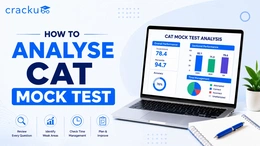
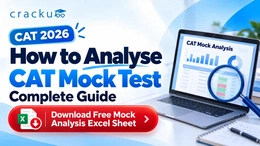
Also Read: How to Analyse CAT Mock Test, Check Complete Guide
When Should You Start Taking CAT Mocks for CAT 2026?
You do not need to complete the entire CAT syllabus before attempting your first mock.
Starting earlier gives you more time to discover weaknesses in exam strategy.
A practical progression could look like this:
Preparation Stage | Suggested Approach |
Early preparation | Take occasional mocks to establish a baseline |
Syllabus-building phase | Combine mocks with topic-wise improvement |
Final 3 to 4 months | Increase mock frequency and analysis |
Final weeks | Focus heavily on strategy, revision and exam simulation |
Cracku's analysis of students who scored 99 percentile in CAT 2025 found that successful candidates commonly attempted around 18 to 20 mocks, although the ideal number will vary from student to student.
The more important rule is simple: never take mocks faster than you can properly analyse them.
Also Read: When is the Right Time to Start Taking CAT Mocks?
How Cracku DashCATs Help You Prepare for the Real CAT Exam
DashCATs are designed to move preparation beyond isolated concept practice and into full-paper decision-making.
The CAT 2026 test series currently includes 25 full-length CAT mocks, along with video solutions, detailed analysis, sectional tests and previous CAT papers.
Their value becomes highest when you follow a repeated cycle:
Attempt → Analyse → Identify weakness → Practise → Attempt again
For example, if one DashCAT reveals poor DILR set selection, your next few days should not simply involve another full mock. Practise several mixed DILR sets and focus specifically on identifying which ones are worth attempting.
If your VARC score falls because of low accuracy, analyse the reasoning behind incorrect RC options rather than merely solving additional passages.
If QA performance suffers because you spend too long on difficult questions, practise timed question selection.
This is how mocks produce improvement.
For CAT 2026 aspirants targeting a 99+ percentile, the objective is therefore not to achieve brilliant scores in every mock. The objective is to use each mock to make slightly better decisions than you made in the previous one.
By the time CAT arrives, solving questions should not be the only thing that feels familiar. Knowing when to solve, when to skip and when to move on should feel familiar too.
Also Read: How DashCATs Help You Score Higher in CAT 2026
How CAT Mocks Help in Scoring 99 Percentile in CAT 2026: Conclusion
CAT mocks are not just tests of how much syllabus you have completed. They train you to manage time, select the right questions, maintain accuracy and recover from difficult sections. Consistent CAT mock practice combined with detailed analysis can help turn conceptual preparation into an effective exam-day strategy.
For CAT 2026 aspirants, the goal should not be to chase a perfect score in every mock. Instead, use every test to identify one or two decisions that can be improved before the next attempt. With enough practice, knowing when to attempt, when to skip and when to move on can become as natural as solving the questions themselves.