91- 6303239042
 CAT WhatsApp Group


 Preferred Source

 Google Discover

Every CAT aspirant wonders: "Am I scoring enough in mocks?" Cracku tracked the DashCAT performance and actual CAT 2025 results of thousands of students to give you a data-backed answer. What the numbers reveal may surprise you - and should reassure you.
What Scores Do CAT 99 Percentilers Usually Get in Mocks?
The most common assumption is that CAT 99 percentilers must be crushing every mock. The data tells a very different story. Among DashCAT students who eventually scored 99+ percentile in CAT 2025, the average DashCAT score across all their attempts was only around 76. Their best single mock averaged around 98.

Here's a more detailed look: what DashCAT percentile bands did eventual 99 percentile scorers belong to?
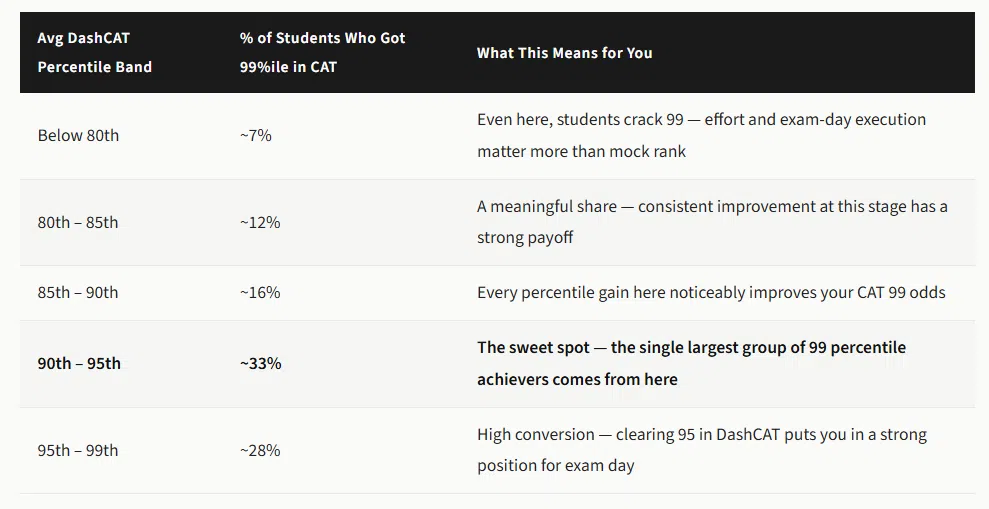
The biggest single group - 33% of all 99 percentile scorers - averaged only in the 90th-95th DashCAT percentile band. You do not necessarily need to be a mock topper to become a CAT topper.
Mock Percentile vs Actual CAT Percentile: Is There a Difference?
Yes - and almost always in your favour. Across thousands of DashCAT students, over 63% scored higher percentile in the actual CAT than their average DashCAT mock percentile. Among students who eventually crossed 99 percentile in CAT, this number was even higher - close to 99% of them outperformed their mock average on exam day.
Why? DashCAT attracts highly motivated, well-prepared students - a pool much tougher than the full CAT candidate base of 2.5+ lakh aspirants. When you score in the 90th percentile against serious DashCAT takers, you are already ahead of a much larger share of the actual CAT takers.
The table below shows how each DashCAT percentile band converts into actual CAT outcomes:
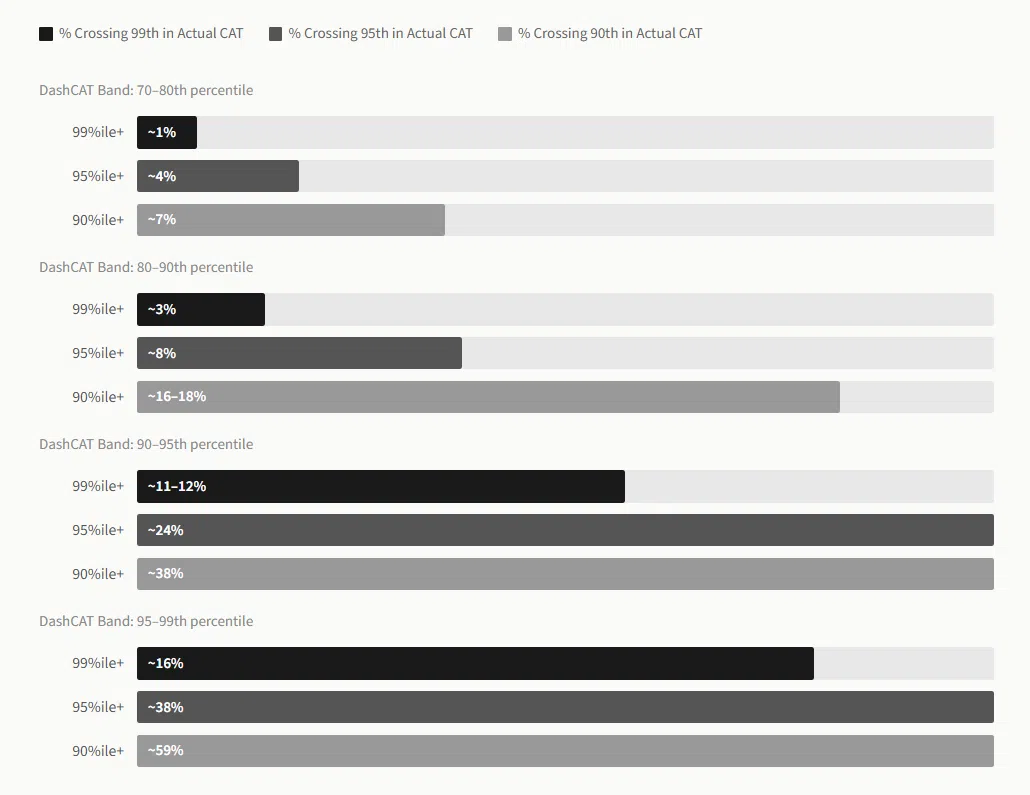
Note: Cracku DashCAT vs CAT 2025 data
If you're consistently hitting the 90th-95th percentile in DashCAT, roughly 1 in 8 students in your position go on to score 99+ in actual CAT - and nearly 2 in 5 cross the 90 percentile mark. The upward shift on exam day is real and consistent.
How Many Marks Are Needed in CAT Mocks for a 99 Percentile?
Based on DashCAT student outcomes, here is a realistic picture of what mock score you should be targeting to reach each percentile band in actual CAT.
Actual CAT Percentile | Avg DashCAT Score | Typical DashCAT Score to aim for |
85th percentile | 50 - 52 | 48 - 55 |
90th percentile | 56 - 58 | 52 - 57 |
95th percentile | 68 - 70 | 67 - 72 |
98th percentile | 80 - 82 | 77 - 83 |
99th percentile | 90 - 92 | 88 - 93 |
A crucial insight from the data: among 99 percentile achievers, the average best DashCAT score was around 98 - while their average across all mocks was only 76. This means what matters is not just your average, but whether your peak performance is trending toward 90+ in DashCAT. A single 95+ DashCAT score signals you have the ability; consistent 90s means you have the readiness.
Why CAT 99 Percentilers Sometimes Score Low in Mocks
If you've looked at your DashCAT scores and felt discouraged, the data says you shouldn't be. Here are the five real reasons why low mock scores are both common and completely normal among eventual toppers:
- DashCAT uses a tougher pool. The students attempting DashCAT are self-selected, motivated aspirants - far more competitive than the average CAT candidate pool. A 90th percentile in DashCAT translates to a significantly higher standing in actual CAT.
- Early mocks are for learning, not scoring. Most students experiment with strategies, section orders, and time budgets in early mocks. These experiments intentionally hurt scores. The score trend over your last 6-8 mocks matters far more than your first 4.
- DashCAT is calibrated harder. Mock difficulty is intentionally kept closer to or slightly above actual CAT difficulty. Scoring 76 in a harder DashCAT is often equivalent to scoring higher in the real exam.
- Mock anxiety is real but temporary. Most students report higher focus and confidence on actual CAT day, having already experienced exam pressure through mocks. This translates directly to better performance.
- Accuracy compounds over time. Students who attempt fewer questions at higher accuracy in later mocks may show lower raw scores early on. But this discipline - attempt less, get more right - is exactly what drives 99 percentile results on exam day.
Section-Wise Mock Scores of CAT 99 Percentilers
CAT has three sections - VARC, DILR, and QA. Based on score distribution analysis of DashCAT students who achieved 99+ in CAT 2025, here is a realistic section-wise breakdown of their performance across mocks and in the actual exam:
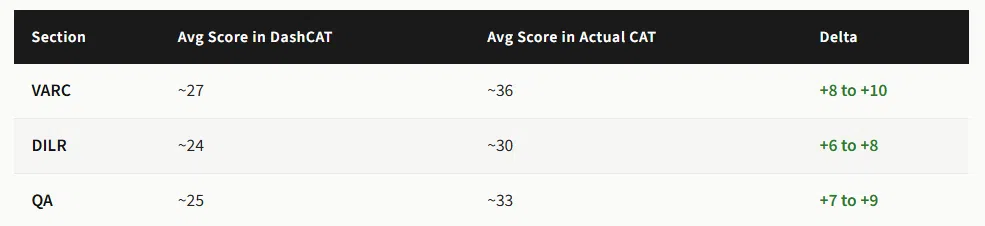
DILR shows the highest variance in mocks. Students often struggle with set selection and waste time on difficult sets during DashCAT. On actual CAT day - with better set selection judgement built through mocks - DILR recovery is consistently strong. VARC gains are the most reliable across the transition from DashCAT to actual CAT. QA improvement tends to depend most on how well a candidate has covered the syllabus by exam day.
Note that you do not need to dominate all three sections. A combination of balanced performance across the three sections can help you reach the 99 percentile zone.
How to Use Mock Scores to Reach 99 Percentile in CAT
The DashCAT data from thousands of students points to a clear set of behaviours that separate those who convert good mock preparation into a great CAT result:
- Track your best score trend, not your average: The 99 percentile achievers had an average mock score of ~76 but a best score of ~98. Your peak represents your capability. Focus on closing the gap between your average and your best - that gap is where your preparation effort should live.
- Target 90th percentile in DashCAT as your consistent floor: Once you stabilise at 90th percentile in DashCAT, your probability of crossing 90 percentile in actual CAT rises to nearly 1 in 2.5. Make 90 your baseline - not your ceiling. From 90, you push for 95. From 95, you have a genuine shot at 99.
- Take more mocks, not fewer: Among DashCAT students who attempted 15+ mocks, the 99 percentile conversion rate was higher. More attempts build strategy, reduce anxiety, and sharpen time management. The first 5 mocks are for orientation. The next 10 are where real improvement happens.
- Analyse DILR very deeply: DILR has the widest variation and the highest recovery potential on CAT day. Each DashCAT gives you a new set to practise set selection - the single most important skill for DILR. Use it.
- Review mocks the same day or the next morning. Context fades fast. Understanding why you chose a wrong answer - not just what the right answer was - is what produces improvement. The average 99 percentile achiever improved by over 30 marks from mock average to actual CAT. That gap closes only through disciplined, honest review.
- In the final 10 days before CAT, switch from taking to reviewing. Revisit 2-3 older DashCATs analytically. Focus on your strongest sections to build confidence and identify any last-minute weaknesses worth addressing. Stability and peak form on exam day matter more than new data at this stage.
Conclusion
The data from thousands of Cracku DashCAT students is unambiguous: you do not need to be a mock topper to score 99 percentile in CAT. The majority of 99 percentile achievers were averaging in the 90th-95th DashCAT percentile band - and improved by over 30 marks on exam day. DashCAT isn't a report card. It's a training tool. Use every mock to learn, every analysis session to improve, and trust that consistent effort on a tougher test translates directly to your best performance when it counts.