91- 6303239042
 CAT WhatsApp Group



 Preferred Source

 Google Discover
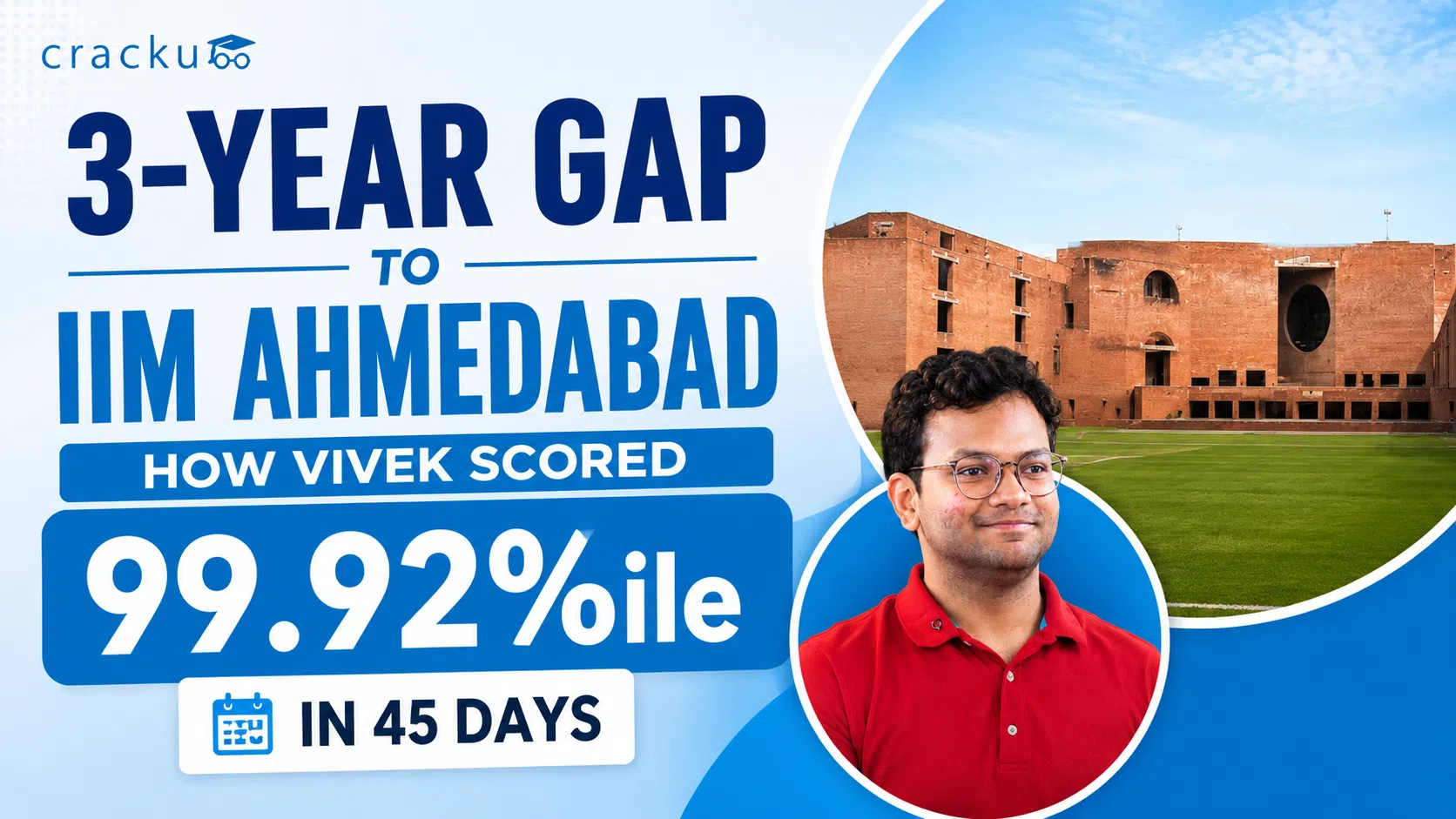
Vivek’s Journey from UPSC to IIM Ahmedabad
In today’s world, where youngsters are chasing the IT field and using Amazon offers as success cards, we’re sharing an inspiring story of Vivekananda, who turned down an Amazon offer and started his UPSC preparation journey. However, we all know how easily one can fall into the sunk cost fallacy during UPSC preparation. Vivek realised this early, took a different path, and started preparing for CAT 2025. No preparation journey is easy, and not every successful person was lucky.
Vivek’s CAT 2025 Journey at a Glance
Particular | Details |
|---|---|
CAT Exam | CAT 2025 |
CAT Preparation Time | 45 Days |
CAT Percentile | 99.92 Percentile |
CAT Mocks Attempted | Around 35 |
UPSC Attempts | 3 |
UPSC Prelims | Cleared 3 Times |
IIM Conversion | IIM Ahmedabad |
Strongest VARC Area | Reading Comprehension |
Weakest CAT Section | DILR |
From UPSC Setbacks to a New CAT Journey
“Sometimes, taking a step back is the first step forward.” Vivek, during his interview with Cracku, said that he was confident of clearing UPSC Mains during his second attempt in 2023. However, when the results came out, his name was not on the list. That became the first major setback he faced.
Vivek attempted UPSC three times and qualified for the prelims every time. Yet, he remained stuck at the Mains descriptive papers. This is not an unusual scenario in UPSC, as a few candidates also struggle during the interview stage. Unlike other competitive exams, the UPSC evaluation system remains relatively opaque.
Vivek also stated that an MBA was not part of his backup plan. However, his roommate during UPSC preparation suggested that he consider CAT. After the UPSC Mains answer sheet evaluation in October 2025, Vivek decided to take a different path.
The CAT 2025 exam was only 45 days away, leaving little time for preparation. It was like changing tracks while the train was already moving, but Vivek decided to take the challenge.
He then opted for Cracku’s CAT online coaching and began preparing for the exam. During the interview, he told Maruti Sir, “A person who has achieved 100 percentile 5 times in CAT, there must be something which I can learn from.” His CAT preparation started soon after, beginning with a mock test.
A Difficult 2025 Before the CAT Breakthrough
Vivek’s profile had always been strong, but the three-year gap remained a concern for him. Meanwhile, CAT preparation was now on his plate, and he was determined not to turn away from the opportunity.
Before CAT, Vivek had already experienced another difficult phase in 2025. After facing three UPSC Mains setbacks, he appeared for XAT in January 2025. However, he could not clear the DM sectional cut-off.
This was followed by the State Group-1 Mains examination, adding another challenge to an already difficult year. Overall, Vivek described 2025 as a rough year from his perspective.
But every night is followed by a morning. In November 2025, Vivek appeared for CAT and turned those setbacks into a remarkable result. He scored an impressive 99.92 percentile and successfully secured admission to IIM Ahmedabad.
How Vivek Prepared for CAT 2025 in Just 45 Days
When Vivek returned to Delhi in October 2025, he had only 45 days before the CAT examination. With limited time available, he decided against studying the entire syllabus and instead used mock tests to identify his actual preparation gaps.
Vivek’s Section-Wise CAT Preparation Strategy:
CAT Section | Vivek’s Strategy |
|---|---|
VARC | Focused on RCs, his strongest area |
DILR | Scanned sets first and selected comfortable ones |
Quant | Focused on specific gaps such as Geometry |
Mocks | Used mocks to identify preparation gaps |
Revision | Revised mistakes, formulas and useful questions |
Identifying His Strengths and Weaknesses Through Mocks
Vivek realised that DILR was not only about solving sets but also about choosing the right set. With limited sectional time, spending 10–15 minutes on a difficult set could leave too little time for the remaining questions.
Therefore, he developed a simple strategy: scan all the sets first, identify the comfortable ones, and avoid unnecessary risks. Instead of forcing himself to solve a difficult set because it contained more questions, he focused on sets where he had a better chance of getting answers correct.
This approach became particularly important because he considered DILR his weakest section. Rather than spending most of his 45 days studying the complete syllabus, Vivek used mocks to identify specific areas requiring attention.
For Quant, he did not revisit topics he already knew well. Instead, he focused on areas such as Geometry, which he had not practised for a long time. Similarly, in VARC, he recognised that RC was his strength while parajumbles were less comfortable.
He therefore planned to attempt all four RCs first and leave the weaker question types for later. His preparation was built around maximising his existing strengths instead of following a standard strategy.
Around 35 Mocks Became the Core of His Preparation
Vivek attempted almost everything available on the platform, including 20 DashCATs, five additional mocks and previous-year CAT papers from 2021 onwards. Overall, he attempted approximately 35 mocks during his preparation.
His routine was straightforward. He would take a mock during the morning and spend the evening and night analysing his performance.
Instead of simply checking his score, Vivek maintained online notes containing the mistakes he made during each mock. He also saved useful questions and formulas so that he could revise them repeatedly.
For him, mock analysis became more important than repeatedly reading the entire syllabus. Since he came from an engineering background, he already knew a large portion of the Quant syllabus.
The mocks helped him identify the smaller gaps that needed attention. He then studied the theory behind those specific topics instead of spending valuable time revising everything.
Vivek’s Mock Strategy: Take a mock → analyse mistakes → identify weak areas → revise only those areas → repeat.
Also Read: How to Analyse CAT Mock Test, Check Complete Guide
Vivek's DILR Strategy for CAT 2025
The real test of his preparation came during the CAT examination. Vivek appeared in Slot 1, which he found particularly difficult.
After struggling with the initial DILR sets, he started feeling that his CAT attempt was slipping away. He managed to solve only around 1.5 sets, which initially made him believe that his DILR score would be too low.
However, one strategy from his preparation proved extremely useful: not leaving TITA questions unanswered.
Vivek’s DILR Performance in CAT 2025
DILR Performance | Result |
|---|---|
Sets Solved | Around 1.5 |
TITA Questions Attempted Over Solved Sets | 5 |
TITA Questions Correct | 3 |
Raw DILR Score | 30 |
Scaled DILR Score | 35 |
Vivek attempted five additional TITA questions over his solved 1.5 sets and eventually got three correct. These additional correct answers became crucial because DILR gives relatively few opportunities to score compared with the other sections.
He also used educated guesses when he could narrow down the possible answers. Rather than spending several minutes trying to completely solve a difficult set, he used the available information to make an informed choice.
His raw DILR score eventually reached 30 marks, which scaled up to 35. The section he initially believed had gone badly ended up contributing significantly to his final percentile.
Staying Composed When DILR Did Not Go as Planned
After leaving the examination hall, Vivek believed that his DILR performance had cost him the CAT result he wanted. However, he decided not to carry that disappointment into the remaining sections.
He remembered a lesson from one of Maruti Sir’s earlier discussions about continuing to fight even when one section does not go according to plan.
That mindset helped him approach Quant with the intention of maximising whatever score was still possible. Although he made two or three calculation errors, he continued attempting questions instead of mentally giving up.
This mental composure mattered because Vivek knew that he needed an exceptionally high overall percentile. A score around 99.5 would not necessarily give him the calls he wanted, given his profile and career gap.
How Vivek Scored 99.92 Percentile in CAT 2025
Vivek’s strategy eventually produced the result he was aiming for. His response sheet and score calculations initially gave him uncertainty, but the final result confirmed the effectiveness of his preparation.
He scored in the 99.92nd percentile in CAT 2025, despite beginning his preparation only 45 days before the examination.
His preparation was not based on completing every chapter or spending months studying theory. Instead, he used mocks as a diagnostic tool, identified his weak areas, revised only what required attention, and built strategies around his strengths.
And perhaps most importantly, his DILR experience shows that one difficult section does not have to decide the entire CAT attempt. Vivek walked out believing that his DILR performance had gone badly, yet his final score of 99.92 percentile proved that the rest of the paper was still his to fight for.
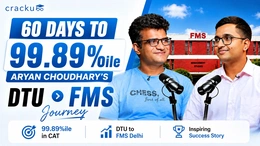
Also Read: 60 Days to 99.89%ile: Aryan Choudhary’s DTU to FMS Journey
Vivek's IIM Interview Preparation After CAT 2025
Getting a 99.92 percentile was a major achievement, but Vivek knew that the journey was not over. His three-year gap and UPSC preparation would naturally invite questions during MBA interviews.
Rather than treating the gap as a weakness, he focused on explaining the decisions behind his journey. Vivek admitted that he was initially not very confident about converting the top IIM calls like Ahmedabad, Bangalore and Calcutta.
His concern mainly came from the belief that gap years could become a negative factor during MBA admissions. Therefore, his focus shifted from celebrating his CAT result to preparing thoroughly for the next stage.
Vivek joined GDPI coaching because he had little understanding of the MBA admission process. He identified three important areas requiring preparation: graduation subjects, UPSC-related knowledge, and general awareness.
Since he had studied Computer Science, Vivek revised important topics such as Data Structures and Algorithms, Operating Systems and DBMS. He also revisited important UPSC subjects because interviewers could question him about his preparation.
Alongside these areas, he worked on general awareness, economics and current affairs. This preparation helped him approach the interviews with greater awareness about what the panels could ask.
Vivek’s MBA Interview Preparation
Interview Area | How Vivek Prepared |
Graduation Subjects | Revised Computer Science fundamentals |
Data Structures & Algorithms | Revised important concepts |
Operating Systems | Revised core topics |
DBMS | Revised core concepts |
UPSC Knowledge | Revisited subjects studied during UPSC preparation |
Economics | Prepared important concepts |
Current Affairs | Worked on general awareness and current affairs |
Career Gap | Prepared an explanation connecting his UPSC journey with his MBA goals |
How Vivek Explained His UPSC Gap During MBA Interviews
One of the most important questions Vivek faced was why he decided to leave UPSC preparation and pursue an MBA. Rather than presenting his UPSC journey as a failure, he explained what the experience had taught him.
He highlighted that clearing UPSC prelims three consecutive times showed consistent progress in a highly competitive examination. He also explained how UPSC preparation exposed him to politics, economics, international relations and ethics.
These subjects gave him knowledge beyond his engineering background and helped him develop a broader understanding of public affairs.
During the IIM Ahmedabad interview, when the panel member asked Vivek why he didn’t exhaust all his UPSC attempts, he explained that a good manager should know when to move on from a project. This helped him present his career shift as a conscious decision rather than an escape from failure.
Vivek also connected his UPSC experience with an MBA. He explained that UPSC involves managing government resources, while management involves handling resources within organisations. Therefore, the skills and knowledge gained during his UPSC preparation could still contribute to his future management career.
Key Points from Vivek’s Career-Gap Explanation
- Present your career transition as a conscious decision.
- Explain what you learned from your previous journey.
- Highlight the skills and knowledge gained during your preparation.
- Connect your previous experience with your future MBA goals.
- Be prepared to explain why you decided to change direction.
- Show how your previous experience can contribute to your management journey.
Facing Difficult MBA Interviews Despite the Gap
Vivek’s interview journey was challenging; his first interview at SPJIMR involved questions about his unemployment period and technical concepts from his Computer Science background.
The interview became stressful, with questions ranging from compression to matrix multiplication and FLOPs. He was eventually rejected at the first stage, making the experience more difficult after travelling to Bengaluru specifically for the interview.
His next interview also did not go as expected. He described the experience as particularly difficult because one panel member questioned his understanding of mathematics in a highly challenging manner.
However, these experiences did not determine the outcome of his entire admission journey. Vivek continued appearing for interviews and remained focused on presenting his profile more confidently.
His experience also reinforced an important lesson: a difficult interview does not necessarily mean that the entire admission journey is over.
The Final Result: A Long-Awaited Breakthrough
After these setbacks, Vivek finally received the result he had been working toward. He converted to IIM Ahmedabad, marking a significant turning point in his life.
The achievement became even more meaningful because he had started preparing for CAT with only 45 days remaining before the examination.
His journey shows that a career gap does not automatically define an applicant’s potential. What matters is how clearly a candidate can explain their decisions, learning and growth.
Vivek’s CAT Preparation Lessons for Future Aspirants
Vivek identified mock tests and mock analysis as the most important parts of his CAT preparation. According to him, mistakes become more memorable when students understand the solution instead of simply reading theoretical concepts.
He stressed that analysing mocks is essential because mistakes have little value unless students learn from them. Solution videos also helped him discover alternative approaches, particularly in Quant, despite considering it one of his stronger areas.
Another important lesson was to build a strategy around individual strengths rather than blindly following conventional approaches. RC was Vivek’s strongest area in VARC, so he attempted all four RCs instead of following the common strategy of alternating between RC and VA.
His one major mistake was inconsistent preparation timings. He occasionally studied or took tests at different times of the day, which affected his readiness when his actual CAT slot was scheduled in the morning.
Vivek therefore believes aspirants should develop a routine that prepares both the mind and body for the actual examination timing. His experience shows that preparation is not only about studying concepts but also about creating the right examination-day rhythm.
Key Takeaways from Vivek’s CAT Journey
- Use mocks to identify gaps, not just to measure your score.
- Analyse your mistakes after every mock.
- Focus on your strengths as well as weaknesses.
- In DILR, set selection matters.
- Don’t let one difficult section affect the rest of your CAT attempt.
- Focus on targeted revision when preparation time is limited.
- Build your strategy around your individual strengths.
- Align your preparation routine with your expected CAT exam timing.
- A career gap does not automatically prevent admission to a top IIM.
- Be prepared to clearly communicate your decisions, learning and growth.
Vivek’s CAT Success Formula
45 Days + ~35 Mocks + Targeted Revision + Mock Analysis + Sectional Strategy + Mental Composure = 99.92 Percentile
Vivek’s journey from three UPSC Mains setbacks to a 99.92 percentile in CAT 2025 and admission to IIM Ahmedabad shows that a setback can change your direction without deciding your destination.
His story is a reminder that you don’t always need years of preparation to achieve a high CAT percentile. With limited time, the right strategy, consistent mock analysis, and the ability to make smart decisions during the exam can make a significant difference.
Conclusion
Vivek's CAT 2025 success story shows how focused preparation can sometimes matter more than simply having several months available. With only 45 days before CAT, he relied on around 35 mocks, detailed mock analysis, targeted revision and strategies built around his individual strengths. Instead of attempting to master every topic, he concentrated on areas that could make the biggest difference to his overall score.
His journey from UPSC setbacks to a 99.92 percentile in CAT 2025 and admission to IIM Ahmedabad also highlights the importance of staying composed after setbacks. For CAT aspirants, the strongest lesson is simple: use mocks intelligently, understand your mistakes, play to your strengths and keep improving your exam-day strategy until the final attempt.