91- 6303239042
 CAT WhatsApp Group


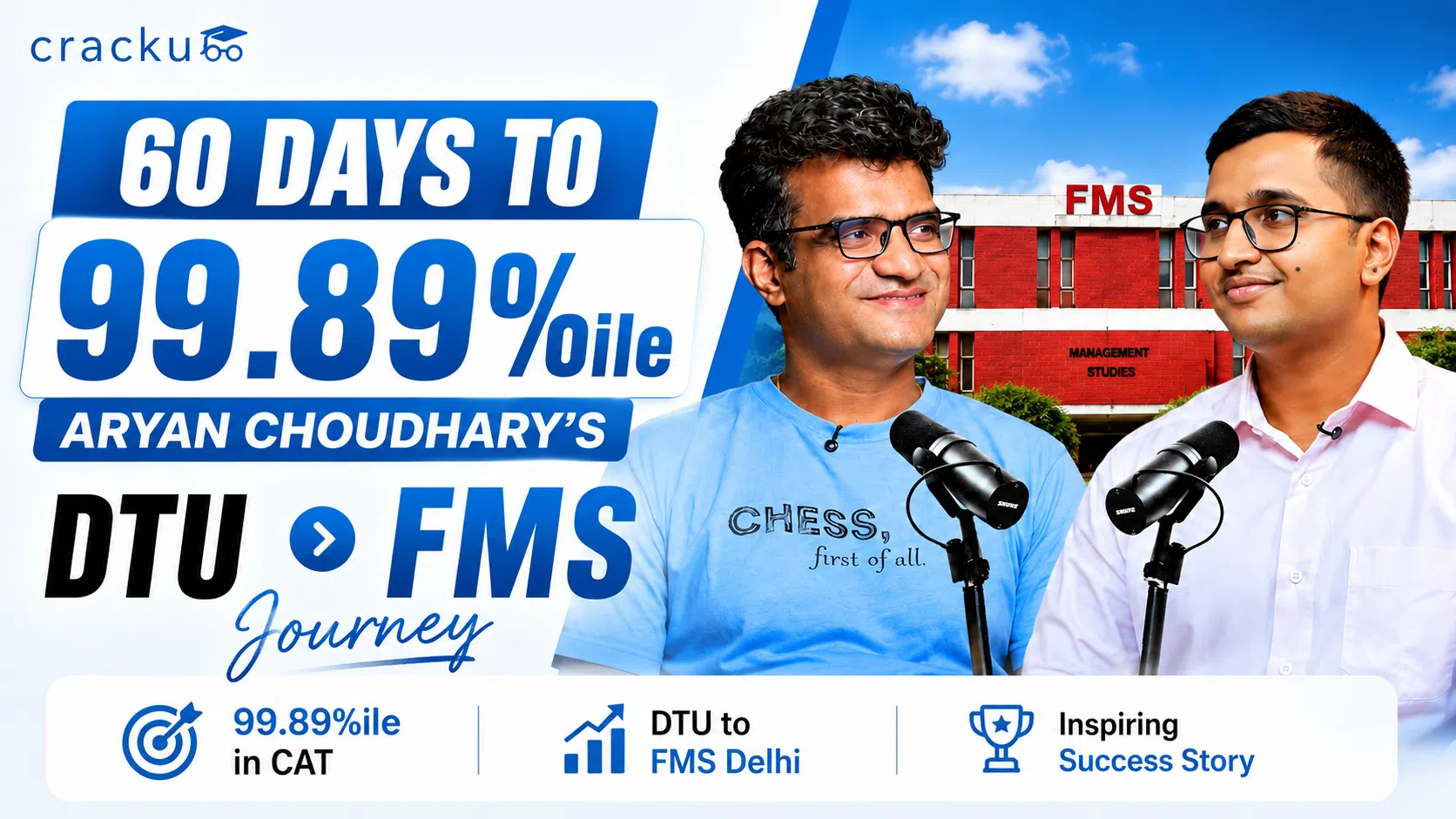
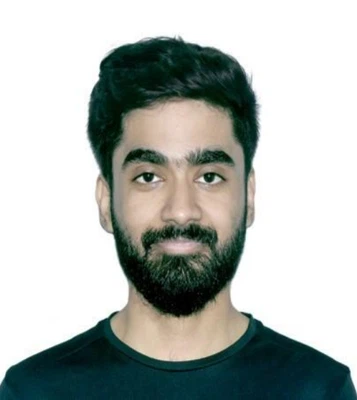
Aryan choudhary CAT 99.89 Percentile Success Story
If you are a fresher preparing for CAT, Aryan choudhary’s journey can give you a completely different perspective on CAT preparation.
Coming from a Computer Science background at Delhi Technological University (DTU), Aryan started preparing for CAT only around 60 days before the exam. Despite the short preparation window, he secured an impressive 99.89 percentile in CAT 2025 and converted multiple top B-school calls.
So, how did he manage to do it?
Was it his strong academic profile, his mock-test strategy, his reading habit, or simply his ability to stay calm during the exam?
Let’s look at Aryan’s CAT journey, preparation strategy, interview experiences and why he eventually chose FMS Delhi.
Aryan choudhary CAT 99.89 Percentile: Profile at a Glance
Particular | Details |
CAT Exam | CAT 2025 |
CAT Percentile | 99.89 |
Preparation Time | Around 60 Days |
College | Delhi Technological University (DTU) |
Degree | B.Tech in Computer Science |
Profile | GEM Fresher |
Class 10 | 96% |
Class 12 | 87% |
Graduation | 93% |
CAT Slot | Slot 1 |
Final Choice | FMS Delhi |
Aryan had a strong academic profile, but his CAT preparation was far from a conventional long-term preparation journey.
How Did Aryan Start Preparing for CAT?
Aryan started thinking seriously about CAT only around mid-September and began his preparation in October.
His first mock was on October 2 through Cracku's DashCAT.
Instead of worrying about the fact that he had started late, Aryan focused on understanding the exam. He wanted to know how CAT worked, what kind of questions appeared and where he was actually losing marks.
This approach was important because Aryan did not have months to slowly complete the syllabus.
He also had a semester examination during the final week before CAT, which made his already short preparation window even more challenging.
But rather than allowing the limited time to create panic, he focused on what he could control.
And that approach eventually helped him score 99.89 percentile in CAT 2025.
How Did Aryan Prepare for CAT in Just 60 Days?
Aryan's biggest challenge was obviously the limited preparation time.
His first Quant mock score was only around 6–7 marks. But instead of getting discouraged, he treated the mock as feedback.
This became an important part of his preparation philosophy.
Aryan's CAT Preparation Strategy
Section | Aryan's Approach |
VARC | Used his reading habit and focused on comprehension |
DILR | Practised set selection and different attempt scenarios |
Quant | Learnt through mocks and followed a two-minute rule |
Mocks | Used them to understand the exam and identify mistakes |
Overall | Focused on selection, accuracy and staying composed |
For Aryan, CAT was not about trying to study everything.
It was about understanding what to attempt, what to leave and how to improve after every mock.
He later admitted that, as a GEM fresher, he did not fully understand how competitive the profile-based selection process could be. In a way, that helped him because he did not spend too much time worrying about academic profiles, work experience or institute-specific expectations.
Instead, he concentrated on the one thing directly in front of him — CAT.
His approach was simple:
Understand the exam → Take mocks → Analyse mistakes → Identify weaknesses → Improve → Repeat.
Aryan choudhary's CAT Preparation Strategy for VARC, DILR and Quant
Aryan gradually realised that CAT is not simply a test of how much you know.
It is also a test of decision-making, question selection and time management.
His final section-wise scores were:
CAT Section | Score |
VARC | 37 |
DILR | 32 |
QA | 42 |
VARC: Using His Reading Habit
Reading was one of Aryan's natural strengths.
During his time at DTU, he explored topics such as geopolitics, philosophy, economics, political science and history. This helped him develop a broad reading habit, which eventually became useful for CAT VARC.
However, VARC did not go exactly as planned on exam day.
Aryan appeared in CAT Slot 1, and the beginning of the VARC section was particularly distracting. Announcements and invigilator conversations affected his concentration, while one RC took much longer than expected.
He eventually realised that three questions were incorrect.
As a result, he scored 37 in VARC, considerably lower than the 50-plus score he had expected.
But he did not allow one section to affect the rest of his paper.
DILR: Don't Let One Difficult Set Decide Your Section
DILR presented another challenge.
After solving one data interpretation set, Aryan struggled to make progress with the remaining sets.
Instead of panicking, he changed his approach.
He started looking for easier questions across different sets and focused on collecting marks wherever possible.
His mindset was simple:
Don't let the moment decide your results.
That decision helped him finish DILR with 32 marks, despite the section not going according to his initial plan.
Quant: The Two-Minute Rule
Quant was where Aryan's preparation and exam-day decision-making came together.
He followed a strict two-minute rule.
If a question did not appear immediately solvable, he did not want to spend several minutes fighting with it.
This helped him avoid one of the biggest CAT traps — allowing one difficult question to consume time that could have been used on easier questions.
The strategy worked well, and he eventually scored 42 marks in Quant.
CAT Lesson: You don't need to solve every question. You need to identify the questions worth solving.
Aryan's CAT Strategy: What Can Aspirants Learn?
Aryan's preparation offers a few important lessons for CAT aspirants:
- Don't let a late start convince you that CAT is impossible.
- Use mocks to understand your actual preparation level.
- Analyse your mistakes instead of simply looking at your percentile.
- Practice question selection, especially in DILR.
- Don't spend too much time on a single difficult Quant question.
- Use your existing strengths to your advantage.
- Most importantly, don't let one bad section affect the rest of your exam.
His journey also shows why mock analysis can be more useful than simply increasing the number of questions you solve.
Aryan choudhary IIM Interview Experience
A 99.89 percentile gave Aryan calls from several leading B-schools, including:
- IIM Ahmedabad
- IIM Lucknow
- IIM Calcutta
- ISB Hyderabad
However, his experience also shows that a high CAT percentile does not automatically guarantee every conversion.
Interview performance, academics, current affairs, technical knowledge and personality can all influence the final result.
Institute | Interview Focus | Outcome |
FMS Delhi | Overall profile and interview | Converted & Chosen |
IIM Ahmedabad | Computer Science and cybersecurity | Not Converted |
IIM Lucknow | Current affairs, Economics, CSE, Academics & HR | Converted |
IIM Calcutta | Puzzle, Academics & General Discussion | Waitlisted |
ISB | Personality, Essays, Decision-making & Situations | Converted |
IIM Lucknow Interview Experience
Aryan's IIM Lucknow interview started on a relatively comfortable note.
A finance professor noticed that he was from Delhi Technological University and began by asking about his college.
The discussion then moved across several areas, including:
- Current affairs
- Economics
- Computer Science
- Undergraduate academics
- HR questions
Aryan felt comfortable handling the different topics and walked out of the interview feeling confident.
His preparation across academics, current affairs, technical subjects and personal questions helped him handle the wide range of questions.
ISB Interview Experience
Aryan described his ISB interview as one of his most enjoyable interview experiences.
The interview lasted approximately an hour and was conducted virtually.
Unlike a purely academic interview, the panel focused heavily on his:
- Personality
- Decision-making ability
- Experiences
- Responses to changing situations
- Essays
The conversation began in a relaxed manner and gradually moved into more complex situations.
One of the important aspects of the interview was Aryan's honesty. He felt that the panel was genuinely engaging with his answers rather than simply testing memorised responses.
His essays also received positive feedback, with one panellist specifically complimenting him on how well they were written.
IIM Ahmedabad Interview Experience
The IIM Ahmedabad interview was a very different experience.
Aryan faced a professor with an information-management background who focused heavily on cybersecurity.
As a final-year Computer Science student, Aryan knew the basics but had not studied cybersecurity in depth as part of his formal curriculum.
The discussion continued for around 25 minutes.
The interview became emotionally difficult because the questions focused heavily on an area where Aryan did not have deep academic exposure.
He later admitted that he cried after the interview because IIM Ahmedabad was such an important opportunity for him.
However, this experience highlights an important lesson for MBA aspirants:
Even a strong candidate can be asked questions they are not expecting.
The ability to stay composed when an interview suddenly moves outside your comfort zone is extremely important.
IIM Calcutta Interview Experience
IIM Calcutta was another interesting experience for Aryan.
He expected the interview to result in a conversion, and the atmosphere itself was relatively relaxed.
At one point, the panel gave him a puzzle. When Aryan asked for 30 seconds to solve it, the interviewer jokingly said they would give him 35 seconds.
Despite the comfortable interaction, Aryan eventually received a waitlist instead of a direct conversion.
The experience showed him that interview outcomes are not always easy to predict.
You can walk out of an interview feeling confident and still receive an unexpected result.
Does Appearing First in an MBA Interview Put You at a Disadvantage?
Aryan appeared first in interviews at several institutes, including IIM Ahmedabad, IIM Calcutta and IIT Bombay.
According to him, being the first candidate is not necessarily a disadvantage.
Different interview panels can behave very differently. One panel may be relaxed and conversational, while another may challenge you intensely.
Maruti Sir also offered another perspective: interviewers may still be settling into their rhythm when the first candidate enters.
Candidates themselves can also feel more nervous because they have no opportunity to observe the interview environment beforehand.
So, rather than worrying about whether you are first, third or tenth, focus on what you can control:
Preparation + Awareness + Composure
Why Did Aryan Choose FMS Delhi Over IIM Lucknow?
After converting both FMS Delhi and IIM Lucknow, Aryan had an important decision to make.
His decision was not based simply on rankings.
Instead, he considered his interests, learning style, career goals and the kind of MBA experience he wanted.
Why Did Aryan Choose FMS Delhi?
One factor was his connection with Delhi Technological University.
Aryan felt that the DTU brand carried significant respect within FMS, including among student committees and placement activities.
He was also particularly interested in:
- Case competitions
- Live projects
- Strategy-related work
- Practical exposure
FMS offered opportunities such as Strategy Labs, where students could work on live projects even before summer internships.
The academic structure also influenced his decision.
FMS follows a semester system, whereas IIM Lucknow follows a trimester-based structure. Aryan wanted enough academic space to explore projects and competitions alongside classroom learning.
As someone who genuinely enjoys academics, he was not looking to escape studies. He wanted a balance between academics and practical exposure.
Finally, ROI played an important role.
FMS Delhi's comparatively lower fees made it particularly attractive from a return-on-investment perspective.
So, Aryan's decision was not about saying that one institute is universally better than the other.
It was about choosing the institute that matched his goals, interests and preferred way of learning.
Aryan Choudhary's Advice to CAT Aspirants
Looking back at his CAT journey, Aryan identified one decision that made a major difference:
Take a Leap of Faith
Aryan started CAT preparation only around 50–60 days before the examination and still secured a 99.89 percentile.
However, he does not suggest that every CAT aspirant should copy his timeline.
In fact, he openly acknowledged that his preparation could have been better planned, particularly for DILR.
His advice is therefore quite practical:
If you are serious about CAT, start early.
A six-month preparation window gives you enough time to:
- Strengthen weak areas
- Take multiple mocks
- Analyse your mistakes
- Develop question-selection skills
- Experiment with different strategies
- Recover from setbacks
At the same time, Aryan believes aspirants should not spend too much time worrying about their profile, academic background or predicted cutoffs.
Excessive focus on these factors can create a defensive mindset before you have even taken CAT.
His preparation philosophy can be summed up by an idea he mentioned during the conversation: as long as the CAT is catching the mice, it does not matter whether they are black or white.
In simple terms, your preparation method does not have to look perfect as long as it helps you perform when it matters.
Key Takeaways from Aryan's CAT 99.89 Percentile Journey
- Start early if you have the option.
- Don't let your profile discourage you before the CAT exam.
- Use mocks to understand where you stand.
- Analyse mistakes instead of only checking scores.
- Learn the art of question selection.
- In DILR, don't let one difficult set decide your performance.
- In Quant, avoid spending too much time on one question.
- Build on your natural strengths.
- Stay composed when the actual CAT does not go according to plan.
- Prepare for MBA interviews beyond academics.
- Don't assume that a good interview will always result in a conversion.
- Choose your B-school based on your goals, interests, learning style and ROI.
Aryan's journey also carries a quieter lesson.
Hard work and strategy matter enormously, but outcomes can sometimes depend on factors beyond preparation.
As Aryan admitted, “God was kind that day.”
That honesty makes his advice even more relatable.
You don't need to copy Aryan's 60-day preparation timeline. Instead, learn from what worked for him, understand the risks of starting late, and build a preparation strategy that gives you enough time to make mistakes and improve.
Start early. Take mocks. Learn from your mistakes. Trust your preparation. And when the opportunity comes, take the leap.
60 Days to 99.89%ile: Aryan Choudhary’s DTU to FMS Journey: Conclusion
Aryan Choudhary's CAT 99.89 percentile success story shows that the quality of preparation can matter as much as the length of preparation. Despite starting seriously only around 60 days before CAT, he used mocks to understand his weaknesses, improved question selection and stayed composed when individual sections did not go according to plan.
His journey should not be treated as a reason to delay CAT preparation. Instead, it highlights the importance of starting wherever you are and using your available time effectively. Begin early when possible, take quality CAT mock tests, analyse every mistake and develop an exam strategy that works for you. Consistency, selection and composure can ultimately make the difference on CAT day.