91- 6303239042
 CAT WhatsApp Group


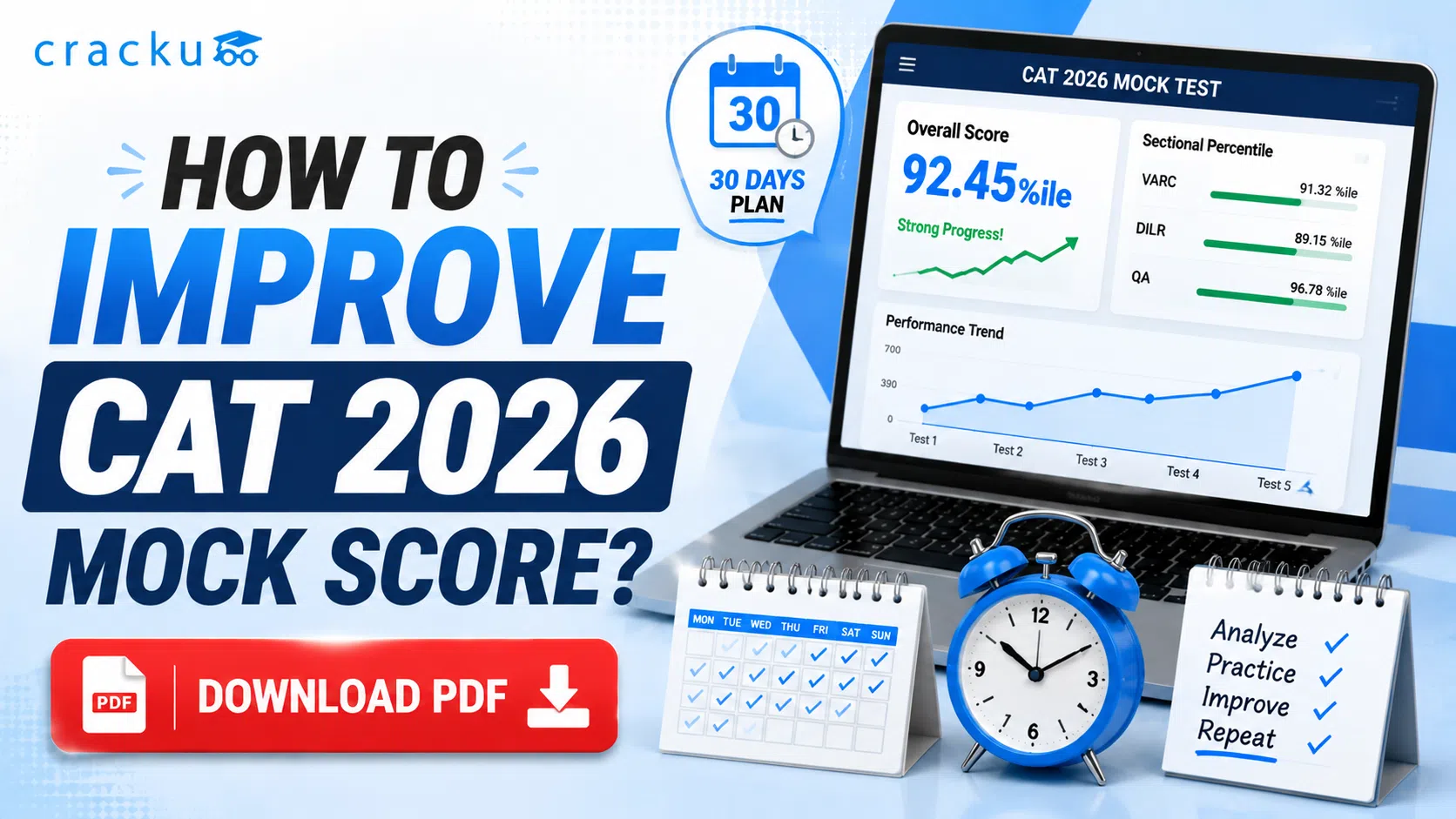
How to Improve CAT 2026 Mock Score?
As a CAT 2026 aspirant, it's quite common to see ups and downs in your mock tests. The first thing you want to achieve is stability across sectional CAT mock tests, and then gradually improve your overall percentile. But is it really possible to jump from 70 to 90 in less than a week? It is not impossible, but it takes more practice, backed by consistency. Yet you have 95 days; your percentile might even touch 99+. Start focusing on your weaker sections, note your mistakes, and analyse your mock tests.
Why Are Your CAT Mock Scores Not Improving?
A stagnant CAT mock score does not always mean your concepts are weak. Your strategy, accuracy, question selection, and timing could be limiting your performance.
Problem | What You May Notice | What You Should Do |
Low accuracy | Several attempted questions become incorrect | Reduce doubtful attempts and verify calculations |
Poor question selection | Difficult questions consume excessive time | Scan the section before starting serious attempts |
Weak concepts | Easy questions remain unsolved | Revise the specific chapter and practise basic questions |
Time pressure | Easy questions remain unanswered | Set an average of 1 minute time limit to scan the question |
Random attempts | Attempts increase without score improvement | Track accuracy after every mock |
Repeated mistakes | Similar errors appear repeatedly | Maintain an error notebook |
Weak reading ability | RC passages take excessive time | Read editorials and opinion articles daily |
DILR difficulty | Sets appear confusing initially | Practise set selection before solving techniques |
CAT is not only a test of knowledge, but also a test of strategy.
In Quant and DILR, question selection can decide your final score. A difficult question can become a time trap.
Treat every question consuming more than 45 seconds as a time investment. Track these questions during mock analysis for better awareness.
Improve VARC Through Daily Reading
VARC questions can get easier with consistent reading and vocabulary practice.
Read quality editorials, scientific discussions from prominent newspapers like The Hindu, along with opinion articles to speed your reading ability and strengthen comprehension practice. For complex writing styles, you can check Aeon, Frontline and The Economist. But don’t stick where you are comfortable; come out of the bubble and improve your concepts.
Keep a vocabulary application on your phone for quick revision during travel. Even ten minutes of vocabulary practice can gradually strengthen your reading confidence.
The objective is not memorising difficult words without context. Instead, understand how unfamiliar words function inside complete sentences.
How to Analyse CAT Mock Tests the Right Way?
Checking CAT solutions immediately after a mock can hide important performance problems. Your first task should be to analyse mock test and evaluate your strategy before checking individual solutions.
Ask yourself:
- Which section felt strongest during the test?
- Which questions consumed excessive time during solving?
- Did difficult sets create panic or hesitation?
- Did you leave easy questions unanswered?
- Was your question selection effective?
- Did you change answers without sufficient reason?
Analysis Area | What to Record | Why It Matters |
Attempts | Questions attempted per section | Shows your selection pattern |
Accuracy | Correct answers divided by attempts | Reveals scoring efficiency |
Easy questions missed | Count of missed easy questions | Shows lost scoring opportunities |
Time traps | Questions consuming excessive time | Identifies poor decisions |
Concept gaps | Topics causing incorrect answers | Guides revision |
Careless errors | Calculation or reading mistakes | Improves checking habits |
Guessed answers | Low-confidence attempts | Controls unnecessary negatives |
Correct solutions | Questions solved slowly | Helps discover faster methods |
Identify Weak Areas Systematically
Saying “Quant is weak” does not provide enough information for effective improvement.
Break your performance into smaller topics and record the exact difficulty.
VARC: Reading comprehension, para jumbles, para summary, Para Completion and odd-sentence out questions.
DILR: Arrangements, caselets, charts, tables, percentages and logical puzzles.
Quant: Arithmetic, algebra, geometry, number systems, and modern mathematics.
After every mock, identify three weak areas requiring immediate attention. Then practice easy and medium questions from those areas before attempting difficult problems.
Don't abandon a topic just because difficult questions feel uncomfortable. You should handle easy and medium questions across the CAT syllabus.
Analyse CAT Questions Accuracy Against Speed
Attempts alone cannot explain whether your CAT mock test score is improving.
Situation | Likely Problem | Correction |
Serious attempts, low accuracy | Guessing or rushed solving | Slow down during question reading |
Fewer attempts, high accuracy | Excessive caution | Increase solving speed gradually |
Fewer attempts, low accuracy | Conceptual weakness | Revise concepts before more mocks |
Serious attempts, high accuracy | Strong performance | Maintain the current strategy |
Easy questions missed | Poor selection | Improve scanning during the first round |
A few extra attempts cannot compensate for repeated negative marks. Make accuracy your first priority before aggressive attempts.
How Many CAT Mocks Should You Attempt Before CAT 2026?
The ideal number depends on your current CAT mock test score, preparation level, and available time.
However, attempting mocks without detailed analysis provides little improvement.
Preparation Stage | Mocks Per Week | Analysis Time Per Mock | Main Target |
First phase | 1 | 3–4 hours | Understand strategy |
Middle phase | 2 | 3 hours each | Improve selection |
Final month | 2–3 | 2.5–3 hours each | Build consistency |
Final week | 1–2 | 2–3 hours each | Maintain confidence |
For the final 30 days, around 8 to 10 full-length mocks can provide sufficient testing.
You should not chase 15 or 20 mocks if detailed analysis becomes impossible. One properly analysed mock can teach more than three casually attempted tests.
Your mock frequency should increase only when analysis quality remains strong.
How to Improve CAT Mock Score Section-Wise?
VARC
Read the entire passage carefully before rushing toward the questions. Focus on the author's argument, tone, structure, and central idea.
Do not spend excessive time decoding one difficult paragraph. Mark difficult questions and return after securing easier marks.
For RC questions, eliminate options using evidence from the passage instead of personal assumptions.
Also Read: CAT RC Types 2026: Genres, Strategies & Cheat Sheet PDF
DILR
DILR requires strong set selection before serious calculation begins.
Spend the opening 1 to 2 minutes scanning every set carefully. Identify sets with familiar structures and manageable information.
Charts and straightforward tables can offer faster opportunities than complicated data arrangements. However, your personal strengths should guide final selection.
Practise converting percentages into fractions for faster calculations. Avoid the calculator during current practice sessions and build approximation skills.
Use the calculator during mocks only when your preparation stage requires it. Before October, practise without it to strengthen mental calculations.
Also Read: CAT DILR PYQ Analysis 2026, Difficulty, Repeated Topics
Quant
Use a two-round approach during Quant whenever the section allows it.
Round | Approach | Time Rule |
Round 1 | Attempt easy and familiar questions | Move quickly after uncertainty |
Round 2 | Return to moderate questions | Use remaining section time |
Final review | Check marked questions | Avoid unnecessary answer changes |
If you feel around 80% confident about solving a question, begin working immediately. If you make no progress after roughly 90 seconds, check your approach carefully. Within two minutes, either solve the question or move forward. This prevents one difficult question from becoming a bouncer that steals valuable minutes.
In Round 2, return to your strongest topics first. For example, select geometry before logarithms if geometry feels more comfortable.
Also Read: CAT Quants PYQ Analysis 2026, Difficulty, Repeated Topics
CAT Mock Score Improvement Plan for the Next 30 Days
A fixed 30-day routine can convert mock analysis into measurable improvement.
Following is a 30 day CAT mock test score improvement plan:
Days | Primary Work | Daily Practice | Expected Outcome |
1–7 | Analyse your every mock | Practice for 2–3 hours | Identify major weaknesses |
8–14 | Strengthen weak topics | 3 hours focused solving | Improve accuracy |
15–21 | Attempt two mocks | 3 hours analysis per mock | Improve selection |
22–26 | Mixed practice | Timed sectional sets | Improve speed |
27–30 | Final mock revision | Light revision and analysis | Build consistency |
Days 1–7: Find Your Performance Leaks
Analyse your previous two or three mocks before taking another test.
Count easy questions missed, careless errors, conceptual gaps, and excessive-time questions.
Create a simple notebook with four columns: question, mistake, reason, and correction.
Days 8–14: Repair Weak Concepts
Revise chapters responsible for repeated mistakes. Solve easy and medium questions before touching difficult problems.
Spend additional time on Arithmetic, Algebra, RC, and frequently appearing DILR structures.
Days 15–21: Strengthen Decision-Making
Attempt two full mocks during this period with complete analysis afterwards.
Track which questions you selected during the first scan. Compare those decisions against the eventual solutions.
Days 22–30: Reproduce Exam Conditions
Attempt mocks at your actual preferred examination time whenever possible.
Follow the same section order, timing discipline, and question-selection rules consistently.
Avoid introducing completely new study resources during the final days.
CAT Mock Test Mistakes That Reduce Your Final Percentile
Common CAT mock test mistakes can negatively impact your final percentile despite strong preparation. Avoiding poor question selection, ignoring mock analysis, chasing attempts, and repeating errors can help you build better accuracy, strategy, and exam confidence.
Mistake | Why It Hurts | Better Approach |
Chasing attempts | Accuracy falls under pressure | Prioritise reliable questions |
Ignoring analysis | Mistakes repeat | Analyse every mock carefully |
Spending four minutes on one question | Easy marks disappear elsewhere | Move after your time limit |
Avoiding weak topics | Preparation remains incomplete | Repair basic and medium-level gaps |
Using calculators early | Mental calculation remains weak | Practise approximation manually |
Checking only percentile | Root problems remain hidden | Track accuracy and time patterns |
Ignoring correct answers | Faster methods remain undiscovered | Review slow correct solutions |
Emotional comparison | Confidence drops unnecessarily | Compare your own mock trends |
The questions without negative marking deserve particular attention. Check the instructions before CAT and attempt such questions when permitted.
Do not assume more attempts automatically mean a higher percentile. Your accuracy and selection quality should lead your score improvement.
No matter which type of CAT mock test you are attempting, analysing it is a must. This is the best way to understand your topic gaps and mistakes. Once you start doing it, you can see the change in your thinking while attempting the next mock tests. Also, don’t miss the CAT PYQs; they give you the pattern of previous years and could boost your confidence. This is how you improve your CAT low percentile to 90+.
How to Improve CAT 2026 Mock Score: Conclusion
Improving your CAT mock score is not only about attempting more tests but learning from every attempt. A detailed mock analysis helps you identify accuracy issues, weak concepts, poor question selection, and time management problems. With consistent practice and targeted improvement, your mock performance can steadily move towards a higher percentile.
The right approach is to treat every CAT mock test as a learning opportunity. Focus on improving accuracy, strengthening weak areas, and building a reliable exam strategy instead of chasing attempts. With disciplined preparation and regular analysis, you can significantly improve your CAT mock score and move closer to your target percentile in CAT 2026.