91- 6303239042
 CAT WhatsApp Group


 Preferred Source

 Google Discover
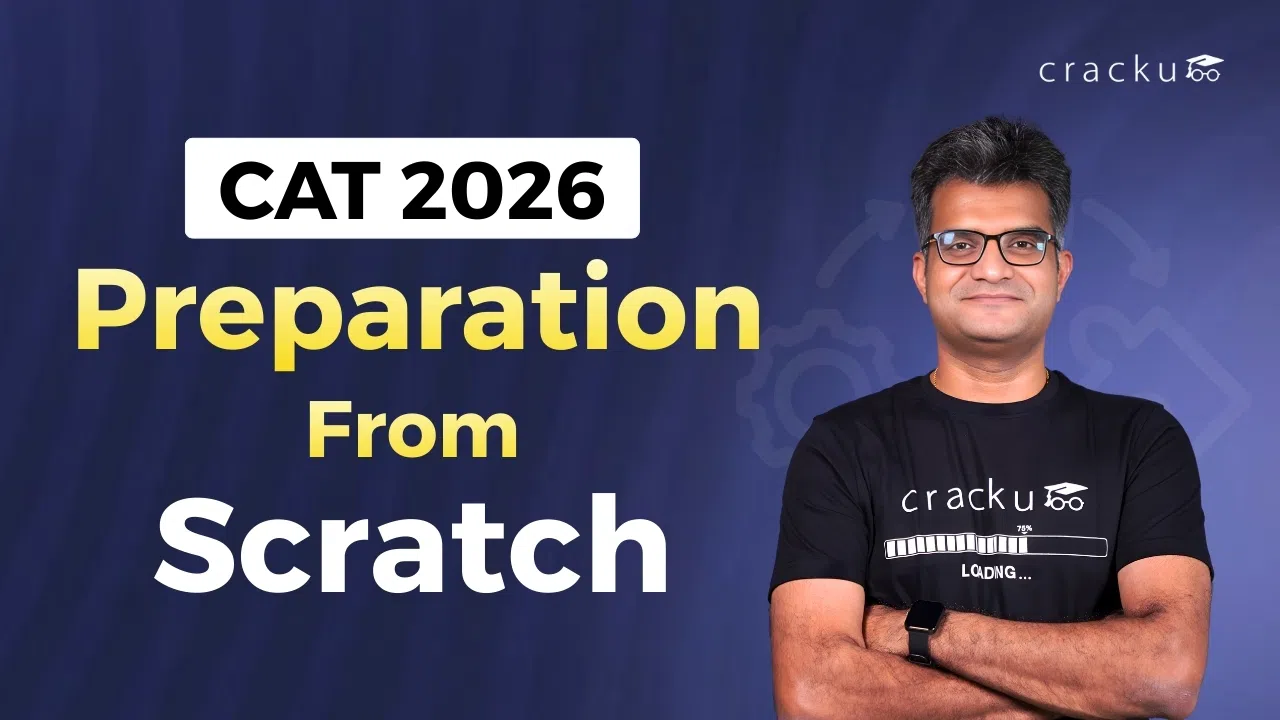
CAT 2026 Preparation from Scratch: CAT 2026 is a once-a-year opportunity for management aspirants to secure admission to top IIM colleges and other leading B-schools such as FMS Delhi, IIFT, SPJIMR, and MDI through a single, high-stakes examination conducted by the IIMs. The exam is tentatively scheduled for November 29, 2026. For beginners starting from scratch, we offer a structured 10–11 month preparation plan focused on building skills from the fundamentals, mastering the syllabus, and targeting 99+ percentiles, opening doors to life-changing careers in consulting, finance, marketing, and leadership roles.
Starting CAT 2026 preparation from scratch becomes easier when you follow the right approach: first, assess your starting point through a diagnostic test (Cracku's free CAT mock); next, gather the required resources, such as CAT books, online courses, and mock tests; and finally, build daily habits that help you balance college or work with consistent preparation.
The month-by-month study plan outlines the CAT 2026 syllabus, the exam structure, section-wise time limits, and the strategies required for each section. The Month-Wise CAT 2026 Study Plan from Scratch, Section-Wise Strategy for CAT 2026, and Daily Study Plan & Required Hours for CAT Beginners contain timelines, and steps that can be taken which are made for full-timers (6-8 hours/day) and professionals (2-4 hours/day on weekdays plus weekends).
Download CAT 2026 Study Plan PDF
How to Start CAT 2026 Preparation from Scratch
It is possible to begin CAT 2026 preparation from scratch with a methodical approach, especially considering that the exam is tentatively scheduled for November 29, 2026, giving aspirants approximately 10-11 months to prepare. The first step is to take a diagnostic mock test which will help pinpoint strengths and weaknesses in the areas of the VARC, DILR, and QA sections.
Assess Your Baseline
Take a full-length CAT mock test right away, like those from Cracku or the official series of IIM, without any preparation to see your current preparation level - usually 25-40 marks for total newcomers. Do section-wise analysis: check the timing for each question, accuracy, and the weak topics such as RC passages in VARC or Arithmetic in QA. This benchmark will help your mentors in preparing a personalized plan for you with a target set for 99+ percentile and then taking measured steps through rigorous drills.
Gather Essential Resources
Acquire all the beginner-friendly resources: Cracku concept books for QA/DILR/VARC, Norman Lewis for vocabulary, Previous year questions (PYQs) from 2017-2025, and online platforms such as Cracku for daily targets, video lessons, and 5000+ CAT questions in study room. The publications of The Hindu editorials for reading practice and Khan Academy for math basics are the free resources; Cracku’s CAT 2026 batches for organized learning is the preferred option.
Resource Type | Recommendations | Purpose |
Books | Cracku Concept Books (QA, VARC, DILR), How to Prepare for DI & LR. | Concept building and Practice. |
Online Platforms | Cracku, Rodha, Career Launcher. | Advanced Concepts, Mocks, Sectional tests, Analysis and Strategies. |
Free Tools | PYQs, Cracku YouTube Channel and Daily Targets, Newspapers. | Daily reading habit and timed manner practice. |
Build Daily Habits First
Devote 2-3 hours daily: 45 minutes of reading editorials for VARC, 45 minutes of revising Class 9-10 math concepts and formulas for QA, and 30 minutes of solving 2-3 easy DILR sets. Keep an error notebook to record mistakes, review it weekly, and measure progress by means of weekly sectional quizzes. These habits embrace day after day, month after month, which creates a pool of energy for the 120-minute exam.
Initial 1-Month Focus
The first month is for building the basics: Arithmetic (Percentages and Ratios specifically) in QA, Reading habit and working on Comprehension in VARC, and understanding of graphs in DILR Can build a habit of reading 2-3 articles for VARC, 15-25 Quant questions and 2-3 DILR sets daily. Can avoid full length mocks but timed manner practice and tests should be done. College students or working professionals can adjust their routines accordingly, for example, utilizing commuting time for flashcards or early morning reading habit.
Can Beginners Prepare for CAT 2026 from Scratch?
Certainly, it is possible that total beginners, who start preparing for CAT 2026, can reach 99+ percentile, as shown by the large number of success stories of first-attempt achievers without prior coaching or with a very weak base.
Discipline trumps talent - beginners succeed by building habits early: diagnostic mocks reveal baselines (often 20-40 percentile), followed by foundation focus on high-weightage topics like RC (VARC) and Arithmetic (QA). Abundant resources (PYQs, free YouTube, Cracku courses) level the playing field, with 10-11 months to exam day allowing steady progress.
Factor | Beginner Challenge | Success Strategy |
No Prior Basics | Weak math/verbal | Class 9-10 level revision (for Quants) + 30-40 daily questions. |
Time Constraints | College/work | 2-3 hrs on weekdays and 6 hrs on weekends via flexible platforms. |
Motivation Dips | Slow initial gains | Regular tests + peer groups for a competitive environment. |
If you start in January 2025, have a goal of say the 60th percentile by April 2026 (after the foundation), 85th by August (mid-practice), and 95+ by October with 2-3 weekly mocks. Use analysis on the Cracku dashboard to track and work on your weaknesses, and focus on accuracy (85%+) before speed.
Common Pitfalls to Avoid
Attempting advanced subjects without having a grasp of the basic concepts leads to a lot of annoyance - a whopping 80% of the starters fall in this category; the better option is to have a complete understanding of only 70% of the syllabus deeply. Skipping mock analysis (2x time spent on the test) or getting tired from 10+ hour study days are things that slow the progress down; thus, combining it with sleep and taking short breaks is the way to go.
CAT 2026 Syllabus & Exam Pattern Explained (Tentative)
The exam lasts 120 minutes across three sections: VARC (24 questions), DILR (22 questions), QA (22 questions), each with 40 minutes, featuring MCQs (+3/-1) and TITA (no negative).
Section | Questions | Key Topics | Difficulty Level |
VARC | 24 | RC (4 sets with 4 ques each), Para Jumbles, Para Summary, Odd One Out, Para Insertion. | Moderate |
DILR | 22 | Puzzles, Tables, Graphs, Arrangements, Charts, Games & Tournament. | Moderate-Difficult |
QA | 22 | Arithmetic, Algebra, Geometry, Numbers, Modern Maths. | Moderate |
Syllabus draws from Class 9-10 math for QA, Critical Reasoning skills + Verbal for VARC, and Logical & Data sets for DILR, with no fixed topic weightage but emphasis on RC in VARC and Arithmetic in QA.
Month-Wise CAT 2026 Study Plan from Scratch
This plan builds foundations, intensifies practice, and peaks with mocks before the November exam. Adjust for working professionals by condensing phases.
Months (2026) | Focus Areas | Key Activities | Mocks/Tests |
Jan-Mar (Foundation) | Basics: QA (Concepts + Formulas), VARC (Comprehension), DILR easy sets. | Daily concepts + 30-40 questions + Reading. | 1 diagnostic mock/month |
Apr-Jun (Strengthening) | Topic mastery, Advance concepts, Sectional tests | Cover all syllabus, revise weak areas | 1-2 sectionals/week |
Jul-Sep (Practice) | Full syllabus integration | 2 mocks/week + Analysis + Revision of topics already covered. | 2 full mocks/week |
Oct-Nov (Peak) | Revision + advanced mocks | 3-4 mocks/week, formula sheets | Daily mocks + light revision |
Track progress weekly, prioritizing high-weightage topics like Arithmetic (QA) and RC (VARC).
Section-Wise Strategy for CAT 2026
CAT 2026 VARC Strategy
Prioritize RC (70% weightage) by reading editorials daily; build reasoning, vocab via books like Norman Lewis. Practice summary, para jumbles and sentence insertion through 20-30 questions daily, aiming for 85% accuracy before speed.
CAT 2026 DILR Strategy
Start with very commonly asked topics like arrangement, charts, missing data tables, venn diagram etc. Start to keep track of time you are taking to solve sets and practice 3-4 sets daily from mix topics. Focus on complete sets over partial attempts to build confidence.
CAT 2026 QA Strategy
Master Arithmetic/Algebra first (highest weightage); drill 20-40 problems daily with formula sheets. Use timed sessions for speed, error logs for patterns and regular revision.
Daily Study Plan & Hours Required for CAT Beginners
Beginners need 2-3 hours daily initially, scaling to 4-5 hours; working professionals can put 1-2 hours on weekdays plus weekends.
Time Slot | Activity | Duration | Tips |
Morning (1 hr) | VARC: Reading + Vocab/Grammar | 60 min | Newspapers, 2 RC passages |
Afternoon (1 hr) | QA: Concepts + 30 problems | 60 min | Focus onArithmetic (Initially) |
Evening (1 hr) | DILR: 3-4 sets | 60 min | Time each set |
Night (30 min) | Revision + weak area drill | 30 min | Error notebook |
Weekends: 4-6 hours with full mock + 2-hour analysis. Consistency trumps marathon sessions.
CAT 2026 Preparation from Scratch: Conclusion
Consider this CAT 2026 preparation trip as your ticket to an elite B-School that offers fast career growth, large salary increase from 6-12 LPA to 25-35 LPA packages, and connections with the best leaders of India. Measure your growth every week by watching how your percentile in mocks goes up, changing the plan according to your speed- starting with 2 hours daily in Month 1 and going to 8+ hours in the last weeks- and use free materials like CAT mocks, YouTube channels (Cracku), and PYQs along with paid DashCATs for your advantage.
Be consistent, scrutinize every mistake, and try to get at least 7-8 hours of sleep plus regular exercise to top up your health, and visualize your call to the IIM interview - the good fortune is for those who take the first step and keep on walking until they reach the end of November 2026. Your hard work today counts tomorrow’s successes; so, without further delay start putting this CAT 2026 plan into practice.