91- 6303239042




 Preferred Source

 Google Discover
CAT 2026 Eligibility Criteria
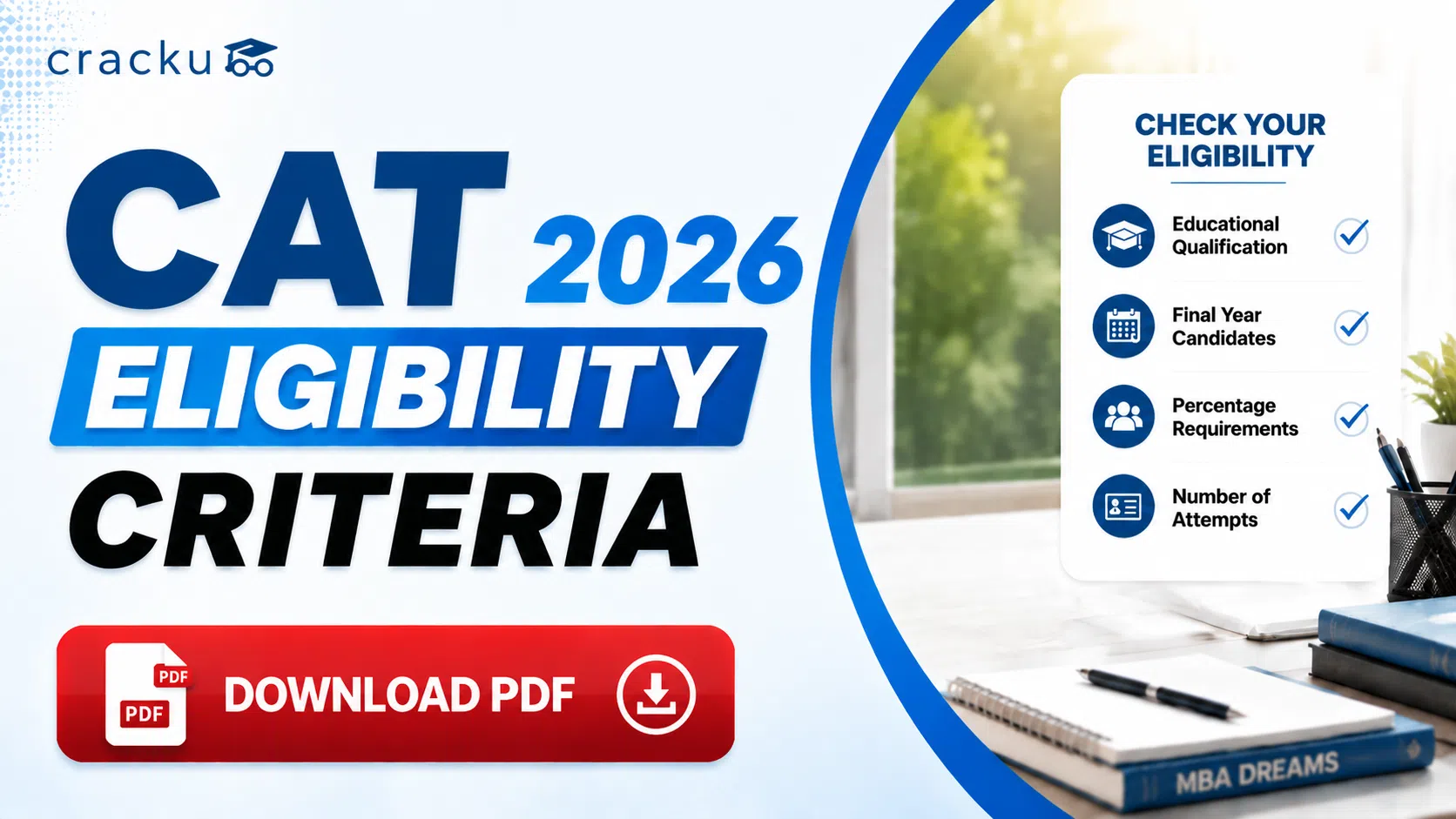
As the CAT 2026 registration form is now open, you must know the eligibility criteria so that your application filling can be smooth and easy. You need a recognised bachelor’s degree with 50% marks for General, EWS, and NC-OBC categories. SC, ST, and PwBD candidates need at least 45% marks. Final-year candidates can also apply, subject to specific completion requirements. There is no prescribed age limit for CAT 2026. However, meeting CAT eligibility does not guarantee an IIM interview call or admission.
CAT 2026 Educational Qualification
The CAT 2026 educational qualification requires a recognised bachelor’s degree or equivalent qualification. Your degree must come from an eligible university or educational institution recognised under applicable rules.
You can apply after completing your graduation or while pursuing the final year. Candidates awaiting their graduation results can also register for CAT 2026.
Eligibility route | Requirement for CAT 2026 |
Completed bachelor’s degree | Minimum 50% marks for General, EWS, and NC-OBC |
SC/ ST/ PwBD bachelor’s degree | Minimum 45% marks |
Final-year bachelor’s degree | Eligible with the required percentage |
Degree requirements completed, results awaited | Eligible, subject to certificate requirements |
CA/CS/CMA/FIAI | Eligible with the required percentage |
Age requirement | No prescribed age limit |
Your university must award the degree under a recognised legal or regulatory framework. Equivalent qualifications recognised by the Ministry of Education are also accepted.
The CAT syllabus and examination pattern are separate from eligibility requirements. Therefore, check your academic status before starting preparation.
CAT 2026 Minimum Percentage Required
The minimum percentage required for iims in graduation depends on your category. General, EWS, and NC-OBC candidates need 50% marks or equivalent CGPA.
SC, ST, and PwBD candidates receive a lower minimum requirement of 45%. This percentage applies to the qualifying bachelor’s degree or equivalent qualification.
Category | Minimum graduation marks |
General | 50% |
EWS | 50% |
NC-OBC | 50% |
SC | 45% |
ST | 45% |
PwBD | 45% |
Your university decides how graduation marks are calculated for eligibility purposes. Therefore, use the percentage calculation method followed by your institution.
If your marks appear as grades or CGPA, follow your university’s certified conversion process. In case no conversion method exists, CAT provides a specific calculation method.
The equivalent percentage is calculated by dividing your CGPA by the maximum possible CGPA. You then multiply that figure by 100 to determine the percentage.
For example, a 7.5 CGPA out of 10 becomes 75% using this prescribed calculation. However, use your university’s certified conversion method whenever one officially exists.
CAT 2026 Age Limit
There is no prescribed age limit for CAT 2026. You can apply as long as you satisfy the required educational qualification.
This makes CAT different from examinations that impose a fixed upper age boundary. Your graduation status and qualifying marks matter more than your age.
You should still check the CAT registration form carefully before submitting your application. Verifying your academic details can prevent avoidable issues during later admission stages.
The CAT registration last date is especially important because category or application changes may become restricted. Always rely on the official CAT notification for the applicable registration schedule.
CAT 2026 Eligibility for Final-Year Students
Final-year bachelor’s degree candidates can apply for CAT 2026. Candidates who have completed degree requirements but await results can also apply.
However, admission remains provisional until the required graduation documents required for CAT 2026 are submitted. You must provide a certificate from your university’s Principal or Registrar.
The certificate must confirm that you completed all requirements for receiving your bachelor’s degree. It must also follow the deadline specified by the respective IIM.
Your academic status | Can you apply? | What happens later? |
Graduation completed | Yes | Submit required academic documents |
Final year of graduation | Yes | Complete degree requirements before joining |
Degree completed, results awaited | Yes | Provide the required completion certificate |
Graduation marks Below requirement (50%) | No | Minimum percentage requirement remains applicable |
Therefore, final-year candidates should keep their academic records organised. Missing a university certificate could affect provisional admission after selection.
CAT Eligibility vs IIM Admission Eligibility
CAT eligibility only determines whether you can appear for the examination. IIM admission eligibility can involve additional academic and selection requirements.
Every IIM independently decides its admission process and selection criteria. Therefore, the same CAT percentile can produce different outcomes across institutes.
For example, IIM Ahmedabad, IIM Bangalore, and IIM Calcutta use different selection frameworks. Academic records, CAT performance, interviews, written assessments, and other factors can receive different weights.
Factor | CAT Eligibility | IIM admission process |
Graduation qualification | Mandatory | Considered according to institute rules |
Minimum marks | 50% or 45% by category | Institute-specific academic requirements may apply |
CAT percentile | Not required for eligibility | Major selection component |
Class 10 marks | Not required for CAT eligibility | Can influence shortlisting |
Class 12 marks | Not required for CAT eligibility | Can influence shortlisting |
Graduation profile | Basic qualifying requirement | Can receive selection weight |
Work experience | Not mandatory | Can influence selection |
PI/WAT or equivalent | Not applicable | May form part of selection |
IIM Indore places substantial emphasis on previous academic performance during its selection process. IIM Ahmedabad also uses academic categories to compare candidates with similar educational backgrounds.
IIM Calcutta gives strong importance to CAT performance during its shortlist process. These differences explain why identical CAT percentiles can lead to different admission outcomes.
Therefore, clearing CAT eligibility is only the first gate in the IIM admission journey.
CAT Eligibility Criteria for Different Categories
CAT 2026 provides different minimum graduation requirements for specified reserved categories. The reservation structure also follows applicable Central Government requirements.
Category | Reserved seats | Minimum graduation marks |
SC | 15% | 45% |
ST | 7.5% | 45% |
NC-OBC | 27% | 50% |
EWS | Up to 10% | 50% |
PwBD | 5% | 45% |
General | — | 50% |
The applicable Central Government category list on the CAT registration last date will be binding. Any later category change will not be accepted for CAT 2026.
For NC-OBC candidates, the certificate must be issued on or after April 1, 2026. EWS candidates need a certificate valid for 2026–27 and assessed for FY 2025–26.
Candidates awaiting updated NC-OBC or EWS certificates can still apply under specified conditions. They must upload the required undertaking, older certificate, and issuing-authority acknowledgement.
Failure to upload the complete document set could lead to disqualification from the admission process.
Also Read: How to Apply for EWS Certificate for CAT 2026? Check Now
CAT Eligibility for CA, CS, CMA and Other Professional Qualifications
CAT 2026 also accepts specified professional qualifications as an eligibility route. You do not necessarily need a conventional bachelor’s degree if you hold an accepted professional qualification.
The official eligibility list includes CA, CS, ICWA/CMA, and FIAI qualifications. The applicable minimum percentage requirement still depends on your category, not on what you studied if you have secured above 70 per cent.
Professional qualification | Accepted for CAT 2026? |
Chartered Accountant (CA) | Yes |
Company Secretary (CS) | Yes |
ICWA/CMA | Yes |
Fellow of the Institute of Actuaries of India (FIAI) | Yes |
You should enter your qualification details exactly as supported by your official documents. Checking the qualification name can help avoid mistakes during registration.
CAT Eligibility Criteria for Different Educational Backgrounds
CAT does not restrict applications based on your undergraduate stream. Engineering, commerce, science, humanities, medicine, law, and other backgrounds can apply.
The qualifying requirement focuses on your recognised degree and required marks. Your academic background can still influence IIM selection through institute-specific diversity policies.
Educational background | CAT eligibility | Possible IIM consideration |
Engineering | Eligible | Academic profile may influence selection |
Commerce | Eligible | Academic diversity may be considered |
Science | Eligible | Academic profile may be considered |
Humanities | Eligible | Academic diversity can support selection |
Medicine | Eligible | Institute-specific criteria apply |
Law | Eligible | Institute-specific criteria apply |
Professional qualification | Eligible under accepted routes | Selection policies vary |
Your background does not prevent you from appearing for CAT. However, each IIM can assess academic diversity differently.
CAT Eligibility Criteria for Students with Low Graduation Marks
Low graduation marks require careful attention because CAT eligibility and IIM shortlists are different stages.
If you belong to General, EWS, or NC-OBC categories, you need at least 50% marks. SC, ST, and PwBD candidates need at least 45%.
If your graduation score falls below the applicable threshold, you generally cannot meet CAT 2026 eligibility. A strong CAT score cannot replace the prescribed minimum qualification.
However, meeting the minimum percentage does not mean your academic record becomes irrelevant. IIMs can use graduation marks while preparing their shortlists and final merit lists.
Graduation situation | CAT application position | What you should check |
50% or above, General/EWS/NC-OBC | Eligible | Institute-specific admission criteria |
45%–49.99%, SC/ST/PwBD | Eligible | Institute-specific admission criteria |
Below 50%, General/EWS/NC-OBC | Not eligible | Applicable academic qualification |
Below 45%, SC/ST/PwBD | Not eligible | Applicable academic qualification |
Minimum marks met, weaker academic profile | Eligible | IIM-wise shortlisting criteria |
So, a lower graduation score does not automatically block every IIM opportunity. Your CAT percentile, academic history, profile, and interview performance can affect institute-level outcomes.
The safest approach is to verify your percentage, category documents, and qualification before submitting the CAT registration form. Also, remember that completing CAT eligibility does not guarantee an IIM shortlist.
Also Read: How to Get Into IIM With Poor Academics in 2026?
CAT 2026 Eligibility Criteria: Conclusion
The CAT 2026 Eligibility Criteria is the first step for candidates planning to appear for the management entrance exam. Applicants must ensure they meet the required graduation qualification, minimum percentage criteria and category-specific requirements before submitting the CAT application form.
While CAT eligibility allows candidates to compete for IIM admissions, the final selection depends on multiple factors such as CAT percentile, academic background, work experience and interview performance. Understanding the eligibility rules early helps avoid mistakes during registration and admission.
Candidates should carefully verify their academic documents, category certificates and qualification details before applying. Meeting the CAT 2026 Eligibility Criteria is the foundation for starting your journey towards securing admission to the top IIMs.