91- 6303239042
 CAT WhatsApp Group



 Preferred Source

 Google Discover
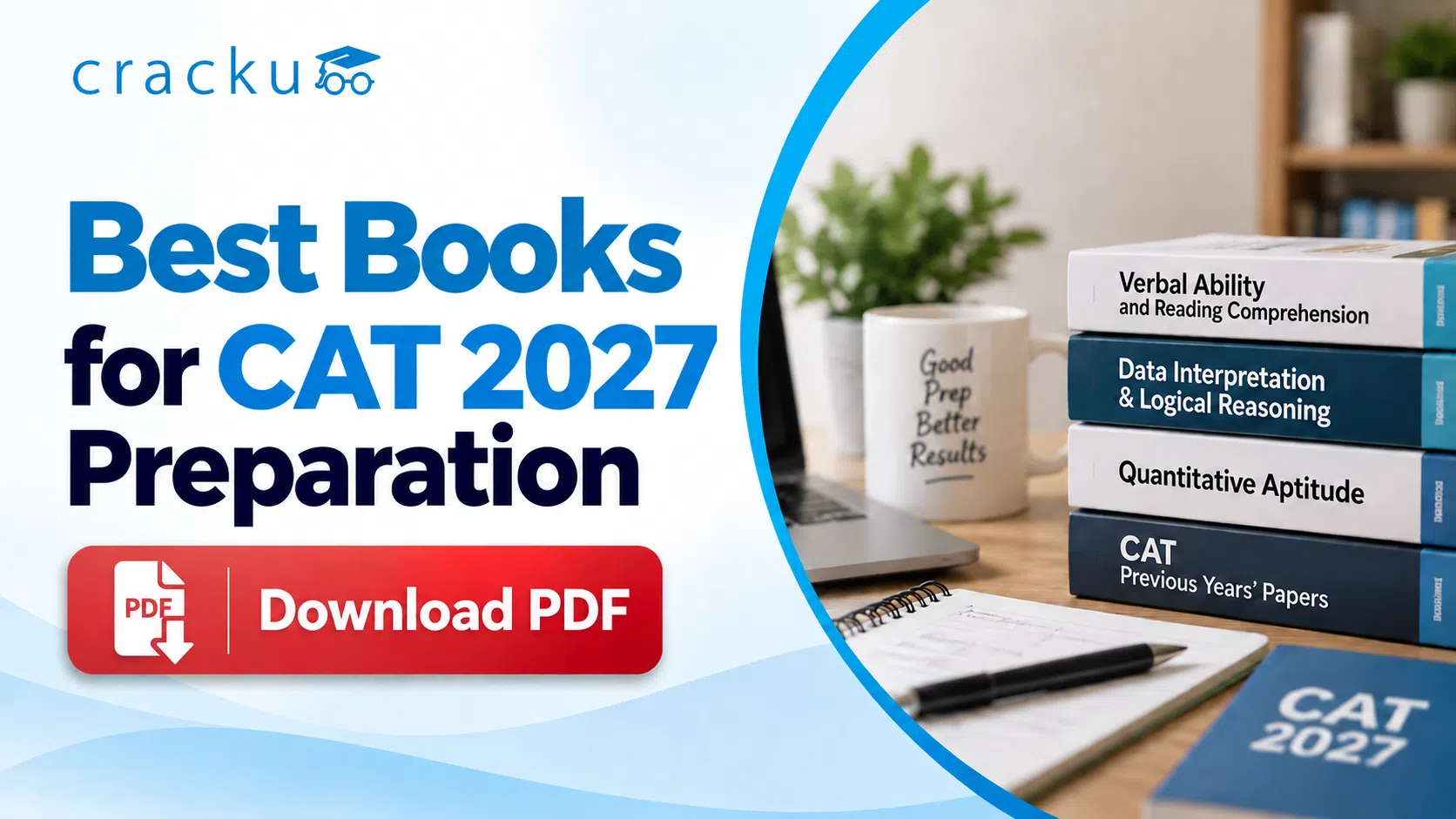
Best Books for CAT 2027 Preparation
For CAT 2027 aspirants, preparation is not about how many questions you solve or books you collect. What matters is consistency, the right CAT study material, and a smart strategy. Randomly picking books from stores or online websites may not help your CAT preparation.
A small set of relevant books, practiced consistently, can take you from basic concepts to tougher CAT-level questions. You do not need a mountain of books to target a 99+ percentile; you need the right resources and a structured approach.
Best CAT 2027 Books for VARC, DILR and Quant
As per the CAT previous year papers, the three major sections- VARC, DILR, and Quantitative Aptitude require different approaches while solving the problems.
Quant requires strong concepts and repeated question practice. VARC needs reading, comprehension, vocabulary, and verbal reasoning skills. DILR improves through exposure to different arrangements, charts, games, and logical situations.
The table below gives you the right starting point for each CAT 2027 section preparation.
CAT Section | Book Name | Author | Best Use |
Quantitative Aptitude | CAT 2026 Quantitative Aptitude | Gautam Puri | Concept building and level-wise practice |
Quantum CAT | Sarvesh K. Verma | Advanced-level Quant practice | |
Quantitative Aptitude for CAT | Nishit K. Sinha | Comprehensive Quant preparation | |
VARC | GKP CAT 2026 Verbal Ability & Reading Comprehension VARC | Gautam Puri | Learning elimination techniques and short-cut tricks for Verbal Ability questions |
Verbal Ability and Reading Comprehension for CAT | Nishit K. Sinha | Verbal and Reading Comprehension practice | |
Word Power Made Easy | Norman Lewis | Vocabulary improvement | |
DILR | GKP CAT Data Interpretation & Logical Reasoning | Gautam Puri | Shortcut strategies and mock-style practice |
Disha 43 Topic-wise CAT Data Interpretation & Logical Reasoning | Disha Experts | Unfiltered real CAT exam practice | |
Logical Reasoning and Data Interpretation for CAT | Nishit K. Sinha | Challenging DILR practice |
You can start with one primary CAT book per section instead of collecting every available title. Once your basics become steady, tougher books can enter your preparation routine.
Also Read: CAT 2027 Syllabus PDF, VARC, DILR, QA Weightage & Topics
Best CAT 2027 Study Material for Complete Preparation
Books are useful, but CAT study material with the right preparation gives you the results. A book can explain a concept, while practice sets can show whether you can apply it under pressure.
For complete CAT 2027 preparation, your study material should cover concepts, topic practice, sectional questions, and mocks. You should also keep previous-year questions within your regular practice cycle.
Students preparing through self-study can build their preparation around books, PYQs and mocks. However, if you need concept videos, organised practice and a defined study schedule in one place, you can supplement these resources with a CAT 2027 online course.
Study Requirement | Recommended Resource | Purpose |
Quant basics | NCERT Mathematics Class 10 | Strengthening fundamental mathematical concepts |
Quant concepts | Quantitative Aptitude for CAT | Building concepts and practising graded questions |
Advanced Quant | Quantum CAT | Handling tougher Quant questions |
VARC concepts | Verbal Ability and Reading Comprehension for the CAT | Understanding verbal concepts and RC approaches |
Vocabulary | Word Power Made Easy | Building vocabulary through regular practice |
Grammar | High School English Grammar & Composition | Improving fundamental grammar |
DILR basics | A Modern Approach to Logical Reasoning | Understanding fundamental reasoning concepts |
DILR practice | Logical Reasoning and Data Interpretation for CAT | Practising CAT-level reasoning and DI sets |
CAT-level practice | CAT Previous Years’ Solved Papers | Understanding actual CAT question patterns |
Topic practice | CAT Section-wise and Topic-wise Solved Papers | Focusing on specific concepts and question types |
Mock practice | Improving speed, accuracy, and exam decision-making |
Your CAT study material should feel like a toolkit rather than a library. Use each resource for a clear purpose, then move forward after checking your performance.
Also Read: Why CAT 2027 Aspirants Should Attempt CAT 2026? Check Here
Best Study Material to Solve CAT PYQs for CAT 2027
CAT Previous-year questions are among the most useful resources for understanding CAT's actual question style. They reveal recurring concepts, changing difficulty levels, question structures, and traps.
However, simply solving CAT PYQs is not enough. You need to review why an answer worked, why another option failed, and where your approach consumed extra time.
PYQ Resource | What You Can Practise | Why It Helps |
CAT Previous Years’ Solved Papers | Full CAT-level questions | Builds familiarity with actual exam questions |
CAT Section-wise Solved Papers | VARC, DILR, and Quant questions | Strengthens individual sections |
CAT Topic-wise Solved Papers | Arithmetic, Algebra, Geometry, RC, DI, LR | Allows focused topic practice |
Previous CAT VARC Questions | RC and Verbal Ability | Improves comprehension and option elimination |
Previous CAT DILR Questions | DI and LR sets | Develops set selection and logical thinking |
Previous CAT Quant Questions | Arithmetic, Algebra, Geometry, Number Systems | Builds exam-level application skills |
A useful approach is solving PYQs after completing a topic. For example, finish percentages and ratios before attempting related CAT questions.
This method gives you immediate feedback about your actual understanding. If your accuracy drops, return to concepts instead of blindly increasing question volume.
You can also maintain a PYQ error log. Record the question type, mistake, correct approach, and time spent solving it.
That small habit becomes valuable during CAT 2027 revision sessions. It works like a map showing exactly where your preparation needs another push.
Also Read, CAT Quant Study Material 2026, Important PYQs, Formula PDF
Which CAT 2027 Books Are Best for Beginners?
If you are starting CAT 2027 preparation from scratch, advanced books can feel like being thrown into deep water. Begin with resources that explain concepts clearly before moving toward difficult exercises.
Also, CAT 2027 registration is expected to start on August 1, 2027 and the exam on 28, November 2027. If you start now with proper consistency, you won't need to be surprised if you achieve 100 percentile.
Book Name | Author/Publisher | Best For |
NCERT Mathematics Class 10 | NCERT | Building basic mathematical concepts |
Quantitative Aptitude for Competitive Examinations | Abhijit Guha | Strengthening Quantitative Aptitude fundamentals |
Quantitative Aptitude for CAT | Nishit K. Sinha | Concept building and level-wise practice |
Verbal Ability and Reading Comprehension for CAT | Nishit K. Sinha | Building VARC concepts |
Word Power Made Easy | Norman Lewis | Improving vocabulary |
High School English Grammar & Composition | Wren & Martin | Strengthening English grammar |
A Modern Approach to Logical Reasoning | R.S. Aggarwal | Learning fundamental reasoning concepts |
Logical Reasoning and Data Interpretation for CAT | Nishit K. Sinha | Developing DILR concepts and practice |
Beginners should not hurry and attempt the hardest exercises immediately. Build a foundation and accuracy even for minimum and easy questions, then increase difficulty as your concepts become more comfortable.
For Quant, NCERT Mathematics Class 10 can refresh basic arithmetic and algebra. After that, Nishit K Sinha's Quantitative Aptitude book gives tougher and slightly more complex problems toward CAT-level questions.
For VARC, regular reading should accompany your book practice. Vocabulary improves gradually, so short CAT daily targets can work better than occasional long sessions.
For DILR, focus on understanding the logic behind each set. Memorising shortcuts will not help when CAT changes the structure of a familiar-looking problem.
Are Books Enough to Prepare for CAT 2027?
CAT books can build your foundation, but they cannot recreate the complete CAT experience. You also need timed practice, mocks, PYQs, and regular performance checks.
More than knowing formulas or recognising question types, you need to decide which questions should be answered so that you won’t get stuck on difficult problems. This habit will come from attempting CAT mock tests. Use mocks to test whether your knowledge survives when the clock starts ticking.
Preparation Area | What Books Provide | What You Still Need |
Concepts | Detailed explanations | Regular revision |
Practice | Topic-wise questions | Timed question sets |
Difficulty | Easy to advanced exercises | Real exam simulations |
PYQs | Can provide solved papers | Repeated analysis of actual questions |
Speed | Limited timed practice | CAT Sectional tests and mocks |
Accuracy | Answer keys and solutions | Error tracking |
Exam strategy | Limited exposure | Full-length CAT mocks |
Performance analysis | Basic solution review | Detailed checking of attempts and mistakes |
How to Use CAT Books and Study Material for CAT 2027
The way you use a book matters just as much as the book itself. Reading chapters without solving questions creates familiarity, but familiarity does not guarantee performance.
Start each topic by understanding the core concepts. Solve basic questions immediately after learning them, then gradually move toward harder exercises.
Preparation Stage | What to Do | Resource Type |
Concept building | Learn formulas, rules, and core methods | Section-specific books |
Basic practice | Solve straightforward questions | Beginner-level exercises |
Topic strengthening | Attempt mixed questions | CAT preparation books |
CAT exposure | Solve actual previous-year questions | CAT PYQs |
Timed practice | Solve questions within fixed limits | Sectional tests |
Exam practice | Attempt complete papers | CAT mock tests |
Error checking | Review incorrect and skipped questions | Error log and solutions |
Revision | Revisit weak areas and repeated mistakes | Notes, books, and PYQs |
Try not to solve every exercise like a problem. After each set, pause and ask what caused the mistake. Was the concept unclear? Did you misread the question? Did calculation consume too much time? Or did you continue with a difficult question for too long?
This checking habit builds exam awareness. Over time, you start recognising which questions deserve immediate attention and which ones can safely wait.
You can also mark questions into three groups: easy, moderate, and difficult. Revisiting the difficult group during revision can reveal patterns in your weak areas. You can also use the CAT reflection room to revisit the problems or concepts you wish to work on.
For VARC, add CAT Daily Article reading alongside your book practice. For DILR, expose yourself to unfamiliar sets instead of repeating comfortable patterns.
For Quant, revise CAT formulas and solve mixed-topic questions after completing individual chapters. This prevents your preparation from becoming too dependent on chapter-specific cues.
Also Read: How to Prepare for CAT 2027: Syllabus, Pattern & Study Plan
Best Books for CAT 2027 Preparation: Conclusion
The best books for CAT 2027 preparation are those that match your current preparation level and help you progress from conceptual understanding to CAT-level problem-solving. Beginners can start with foundational resources before moving to advanced Quant, VARC and DILR books. The goal should not be to finish as many books as possible, but to master the concepts and questions you actually practise.
Books should eventually be combined with CAT PYQs, sectional tests, timed practice and full-length mocks. Your preparation becomes stronger when every resource has a specific purpose—concept building, practice, testing, analysis or revision. Choose fewer resources, use them consistently and spend enough time analysing your mistakes.