91- 6303239042
 CAT WhatsApp Group


 Preferred Source

 Google Discover

How Many Questions Should You Solve Daily for CAT 99 Percentile?
Every CAT aspirant has this question at some point - am I practising enough each day? Most advice online gives answers like "be consistent" or "practice daily." But what does the data actually say?
At Cracku, we looked at thousands of students who used the CAT Daily Target feature and then appeared for the CAT exam. We matched their practice volume with their final percentile. The results are clear: students who practise more daily, consistently perform better. Here is exactly what the numbers show.
What the Data Says: Daily Targets vs CAT Percentile
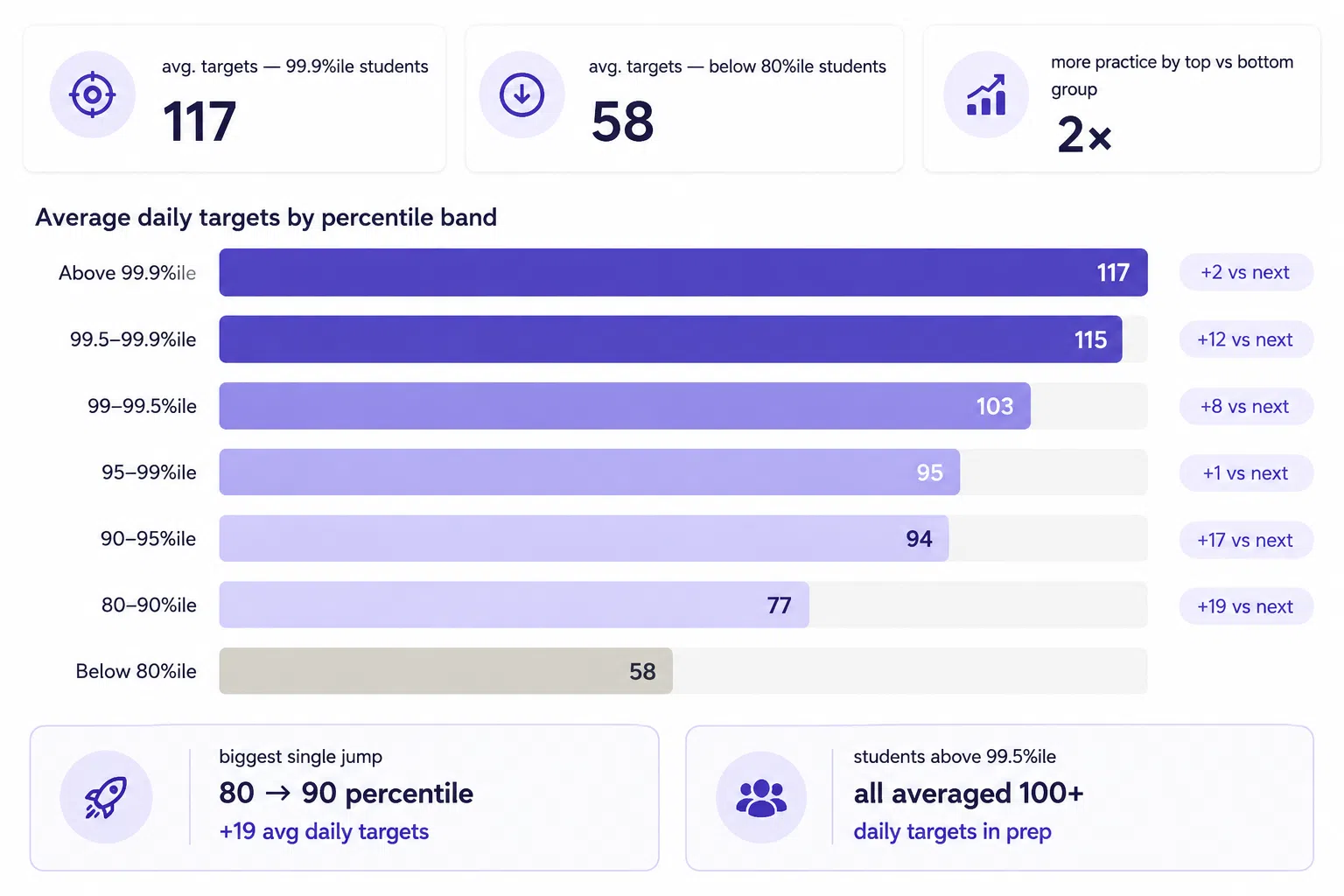
The graph below shows the average number of daily targets attempted by students in each percentile bucket.
The trend is consistent across all groups. Higher daily practice leads to higher scores. Students scoring above 99.9 percentile attempted nearly double the daily targets compared to those below 80.
How Much Daily Practice Do You Need? Percentile-wise Benchmarks
Based on the data, here is a simple goal-setting guide:
Targeting 99+ percentile → Aim for 35-50 daily questions consistently
Targeting 95-99 percentile → Aim for 25-35 questions
Targeting 90-95 percentile → Aim for 20-25 questions
Just starting out / below 80 → Focus on building the habit; start with 10-15 questions and grow from there
These are based on average values, which represent what a typical top-performer actually did - not the extreme outliers. This makes these targets achievable for most students without burning out.
Read Also, More Daily Target, Better CAT Score? Cracku Data Analysis
Section-Wise Daily Question Targets for QA, VARC and DILR
Knowing how many questions to solve is one thing. Knowing how to split them across sections is equally important. CAT has three sections, and all three have sectional cutoffs. Neglecting even one section can cost you the overall percentile.
Here is a practical daily split:
Section | CAT Daily Target | Additional Practice |
Verbal Ability & Reading Comprehension | 1 RC passage or 5 VA questions | Reading + 1-2 RC passages |
Logical Reasoning & Data Interpretation | 1 full set (4-6 questions) | 1-2 full sets |
Quantitative Aptitude | 5 questions | 25-30 mix questions |
The key is rotation, not obsession. You do not need to do all three sections every single day. Just keep solving daily targets for the 3 sections and study any 2 sections on a rotation.
Quality vs Quantity: Why Reviewing Mistakes Matters as Much as Solving
The data shows a correlation between volume and percentile. But students who attempted more questions and reviewed their errors showed a steeper improvement curve than those who just churned through questions.
A good rule of thumb: spend at least 30% of your practice time reviewing mistakes, not solving new questions. After each daily target session, go back and understand why you got a question wrong. Was it a concept gap? A silly error? A time management issue? Each of these requires a different fix.
Students who skipped this review step often scored around the 90-95 range, despite high practice volumes.
How to Build a Daily Practice Habit That Lasts 6 Months
Consistency is harder than intensity. Most students start strong and drop off within a few weeks. Here is what works:
Fix a daily time slot - same time every day trains your brain to switch into preparation mode automatically
Use the 2-day rule - never miss two consecutive days. Missing one is fine; two in a row breaks the habit loop
Track your streaks - even a simple notebook log of daily targets completed keeps you accountable
Start small if needed - 10 questions a day done consistently beats 50 questions done sporadically
Students in the top percentile did not necessarily do the most questions. They did enough, consistently.
CAT Daily Target vs Mock Tests: What Role Does Each Play?
These two tools serve completely different purposes and work best together.
CAT Daily Targets build your skills. They improve accuracy, speed, and concept clarity over time through repeated exposure to CAT-level questions.
CAT Mock Tests measure where you stand. They simulate exam conditions and reveal time management gaps and sectional weaknesses.
A common mistake is relying only on mocks and skipping daily practice. Mocks show you the problem. Daily targets fix it. Without both, your preparation has a blind spot.
A practical weekly structure: 5-6 days of daily targets + 1-2 full mock every week in the peak preparation phase.
How Many Questions Should You Solve Daily for CAT 99 Percentile : Conclusion
The data from thousands of Cracku students makes one thing very clear: students who practise daily, even at moderate levels, consistently outperform those who do not. You do not need to solve 100+ questions every day. What you need is a realistic daily goal, the discipline to stick to it, and the habit of reviewing what went wrong.
Start where you are, set a target that fits your percentile goal, and build from there. Small daily steps, taken consistently over 4-6 months, is what separates a 90 percentile from a 99+ percentile on exam day.