91- 6303239042
 CAT WhatsApp Group


 Preferred Source

 Google Discover
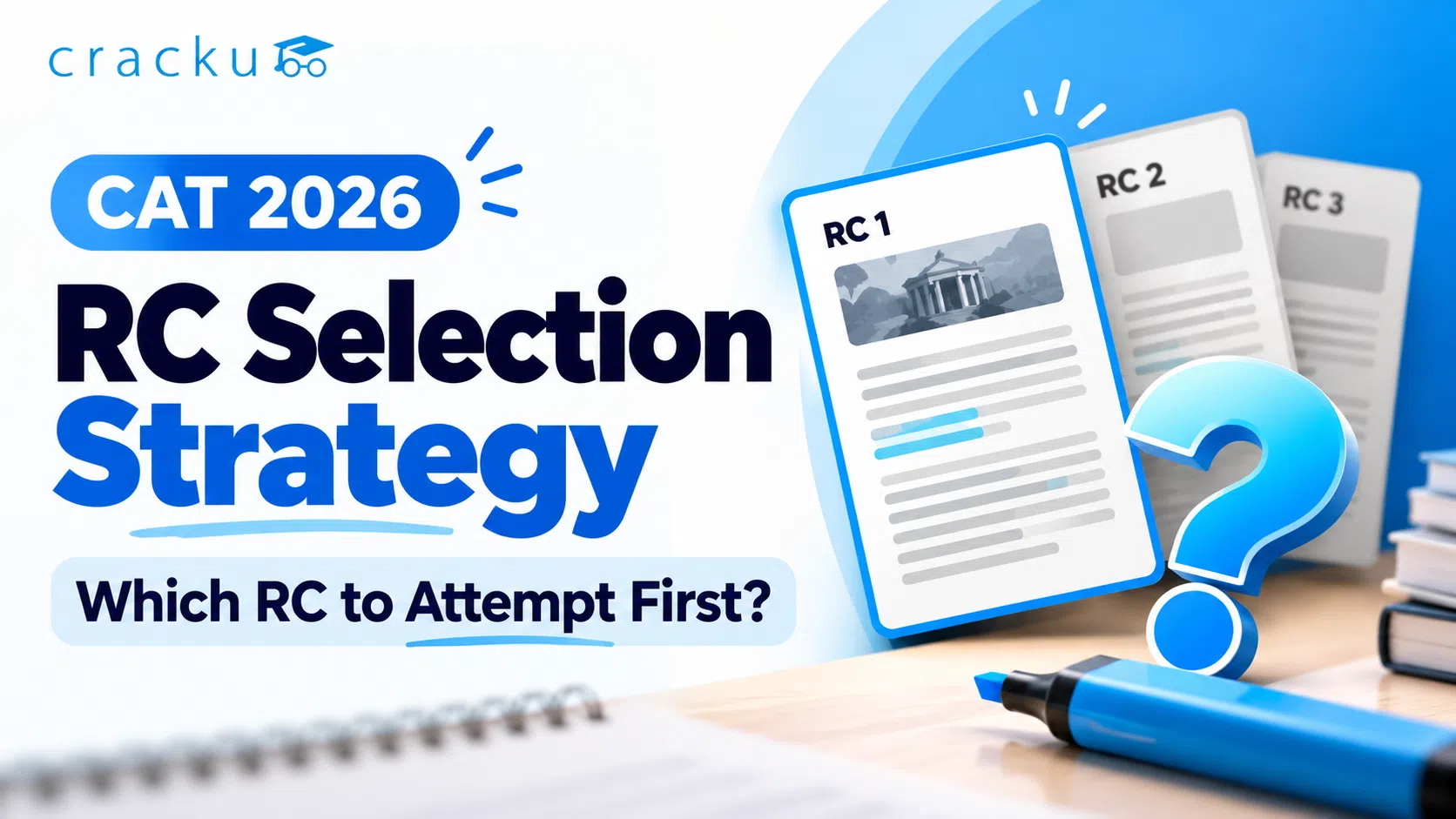
CAT 2026 RC Selection Strategy
Reading Comprehension is not only about reading quickly. A strong CAT VARC Preparation Strategy 2026 also requires smart passage selection, accurate comprehension and effective time management.In CAT, the ability to identify the right passage can make a significant difference to your VARC score.
Many students waste valuable time trying to solve a difficult RC simply because they started with it. A better approach is to quickly scan all the passages, judge their difficulty and then decide where to invest your time.
The goal should not be to attempt every passage. The goal is to select the passages where you have the highest probability of getting questions correct.
How to Choose Which RC Passage to Attempt First?
Do not automatically start with the first passage shown on the screen. CAT does not reward you for following the order of the passages.
Use the initial few minutes to scan the passages. Look at the topic, length, writing style and the questions associated with each passage. A passage that looks familiar is not necessarily easy. Similarly, an unfamiliar topic may actually be easier if the author's argument is clear and the questions are straightforward.
Factor | What to Look For |
Topic | Is it reasonably understandable? |
Language | Is the writing clear or extremely dense? |
Structure | Can you identify the author's main argument? |
Questions | Are they direct or highly inferential? |
Length | Is the passage unnecessarily time-consuming? |
Interest | Can you comfortably stay focused while reading it? |
Choose the passage where you feel you can maintain both understanding and accuracy.
Also Read: How Maruti Sir Attempts CAT, Question Selection & Accuracy
What Should Be the Priority Order for CAT RC Passages?
There is no universal order that works for every student. Your priority should depend on the passage and your personal strengths.
A practical order is to first attempt passages with a clear structure, manageable language and questions that appear relatively direct. Do not make the mistake of deciding that "short passage = easy passage." A short RC can contain extremely difficult questions, while a longer passage can have a much clearer argument.
A useful priority order is:
Priority | Type of Passage |
1st | Clear argument + manageable questions |
2nd | Familiar or comfortable topic |
3rd | Moderate difficulty but predictable structure |
4th | Dense or highly abstract passage |
Last/ Avoid | Confusing argument + difficult questions |
The priority should always be based on expected accuracy versus time required, not just passage length.
How to Identify Easy and Difficult RC Passages?
The first 2–3 minutes of scanning are extremely important. You do not need to read every passage completely during this stage.
Instead, look for signals. An easy passage generally has a clear central idea, logical paragraph progression and an argument that you can follow without repeatedly rereading sentences. A difficult passage may involve highly abstract ideas, complicated language, multiple viewpoints or an argument that is difficult to identify.
Easier RC | Difficult RC |
Clear central argument | Main idea is difficult to identify |
Logical paragraph flow | Highly abstract discussion |
Familiar vocabulary | Dense or unfamiliar language |
Clear author's viewpoint | Multiple conflicting viewpoints |
Questions appear manageable | Questions require extensive inference |
However, don't reject a passage simply because its topic is unfamiliar. CAT tests comprehension, not your prior knowledge of the subject.
Also Read: CAT VARC PYQ Analysis 2026, Difficulty, Repeated Topics
How Much Time Should You Spend on Each RC Passage?
There is no fixed rule that every RC must be completed in exactly the same amount of time. However, as a broad strategy, spending around 8-10 minutes on a standard RC passage is reasonable for many students. This includes reading the passage and answering its questions. If a passage has unusually difficult questions, don't allow it to consume disproportionate time.
RC Situation | Approximate Time |
Short and relatively easy | 6–8 minutes |
Standard RC | 8–10 minutes |
Longer/ difficult RC | 10–12 minutes |
Very difficult RC | Consider skipping |
The important point is not the exact number of minutes. If you have spent several minutes reading a passage but still cannot explain its main argument in your own words, continuing may not be the best decision.
How to Improve RC Selection Through CAT Mocks?
The best way to improve RC selection is through systematic CAT mock analysis.
After every mock, don't just check how many RC questions you got right. Record which passage you selected, how much time you spent and how accurate you were.
Over several mocks, patterns will emerge. You may discover that you consistently perform well on philosophical passages but struggle with science-based passages, or that you spend too much time on long RCs without getting enough questions correct.
Maintain a simple tracker:
Mock | Passage Type | Time Taken | Attempts | Correct | Accuracy |
RC 1 | Philosophy | 11 min | 4 | 3 | 75% |
RC 2 | Economics | 8 min | 4 | 4 | 100% |
RC 3 | Science | 12 min | 4 | 2 | 50% |
RC 4 | History | 9 min | 4 | 3 | 75% |
After 5–10 mocks, you will have enough data to understand your strengths and weaknesses.
The purpose of mock analysis is not to decide that you should always attempt one particular type of RC. It is to understand which characteristics of a passage help or hurt your performance.
Also Read: CAT 2026 50 Days Preparation Plan PDF for VARC, DILR & QA
CAT RC Selection Strategy 2026: Do's and Don'ts
RC selection can have a major impact on your VARC performance. You do not need to solve every passage to score well. You need to identify the passages where your time is most likely to convert into correct answers.
Start by scanning all the passages, assess their structure and questions, and then select the passage with the best combination of clarity, comfort and expected accuracy.
Don't Do This | Do This Instead |
Start with RC 1 automatically | Scan all passages first |
Choose only based on length | Check structure and questions |
Read every passage completely | Spend time strategically |
Continue a confusing RC | Be ready to leave it |
Chase maximum attempts | Prioritise accuracy |
Change strategy every mock | Analyse your selection patterns |
The biggest improvement comes when RC selection becomes a decision-making skill rather than a random choice. In CAT 2026, your objective should be simple: read less, understand better, select smarter and maximise the questions you can answer accurately.
With CAT 2026 approaching, choosing the right RC passage can save you valuable time in VARC. Learn how to quickly assess a passage, decide which one to attempt first, and avoid spending too much time on passages that are unlikely to convert into correct answers. RC selection plays an important role in managing the VARC section. Understand how to assess different passages, compare their difficulty, and decide which ones are worth attempting during CAT 2026.
CAT RC Selection Strategy 2026: Conclusion
A strong CAT RC Selection Strategy 2026 is about choosing passages intelligently rather than attempting every Reading Comprehension question. By scanning passages, understanding their structure, assessing question difficulty and prioritising accuracy, you can make better decisions during the VARC section. Remember that a shorter passage is not always easier, and an unfamiliar topic is not necessarily difficult. The right passage is one you can understand confidently and solve within a reasonable amount of time.
To improve your CAT Reading Comprehension strategy, practise passage selection consistently through CAT mock tests and analyse your accuracy, attempts and time spent after every test. Use these insights to recognise passages that offer better scoring opportunities and avoid spending valuable minutes on confusing questions. For CAT 2026, the key to improving your VARC score is simple: select the right RC passages, manage your time wisely and focus on accurate attempts.