91- 6303239042
 CAT WhatsApp Group



 Preferred Source

 Google Discover

Talent leads but Consistency Wins
After four mocks, the average of Student 6 was 15.5 marks behind Student 5. By Mock 13, that gap was almost gone.
Two CAT toppers took 54 mocks between them, and their journeys look nothing alike on paper. The first stayed at almost the same average for 16 straight mocks, then averaged 96 in the last ten. The second crashed from 123 to 41 within two mocks, then scored 91 in the very next attempt without a single practice test in between. Along the way, the aspirant who started far behind caught up with the one who started ahead.
You cannot see any of these stories by looking at one mock at a time. This article digs into the mock data for Student 5 and Student 6 to find patterns hidden beneath their scores. It then turns those patterns into a three-number check you can run on your own mock history in under five minutes.
CAT Journey of Two CAT Toppers at a Glance
Both aspirants finished their last 10 mocks about 16 marks above their first 10, but almost every other number tells a different story.
Metric | Student 5 | Student 6 |
Mocks attempted | 26 | 28 |
Practice tests taken | 933 | 1,739 |
Moving average after Mock 4 | 76.75 | 61.25 |
Average of first 10 mocks | 79.40 | 69.40 |
Average of last 10 mocks | 96.30 | 85 |
Gain (first 10 vs last 10) | 16.90 | 15.60 |
Highest score | 123 (Mocks 18 and 25) | 123 (Mock 13) |
Lowest score | 65 (Mock 11) | 39 (Mock 1) |
Lowest score in last 10 mocks | 74 | 59 |
Scores of 100 or more | 5 | 4 |
Floor, Ceiling and Bounce: The Numbers Behind Every Mock Score
Most aspirants track one number: their latest score. These two journeys show that three other numbers explain far more.
- Floor: the lowest score in your last six mocks. It shows how bad your worst day is.
- Ceiling: the highest score in your last six mocks. It tells you what you can do on a good day.
- Bounce: how much your score changes in the mock right after a fall of 15 marks or more. It tells you how fast you recover.
Student 5 had a solid floor from day one and spent the journey raising the ceiling. Student 6 touched a high ceiling early and spent the journey lifting the floor and recovering faster. They reached a similar level by opposite routes.
Also Read: How to Analyse CAT Mock Test: Free Mock Analysis Excel Sheet
Student 5: Sixteen Mocks of "Nothing is Happening", Then a Breakout
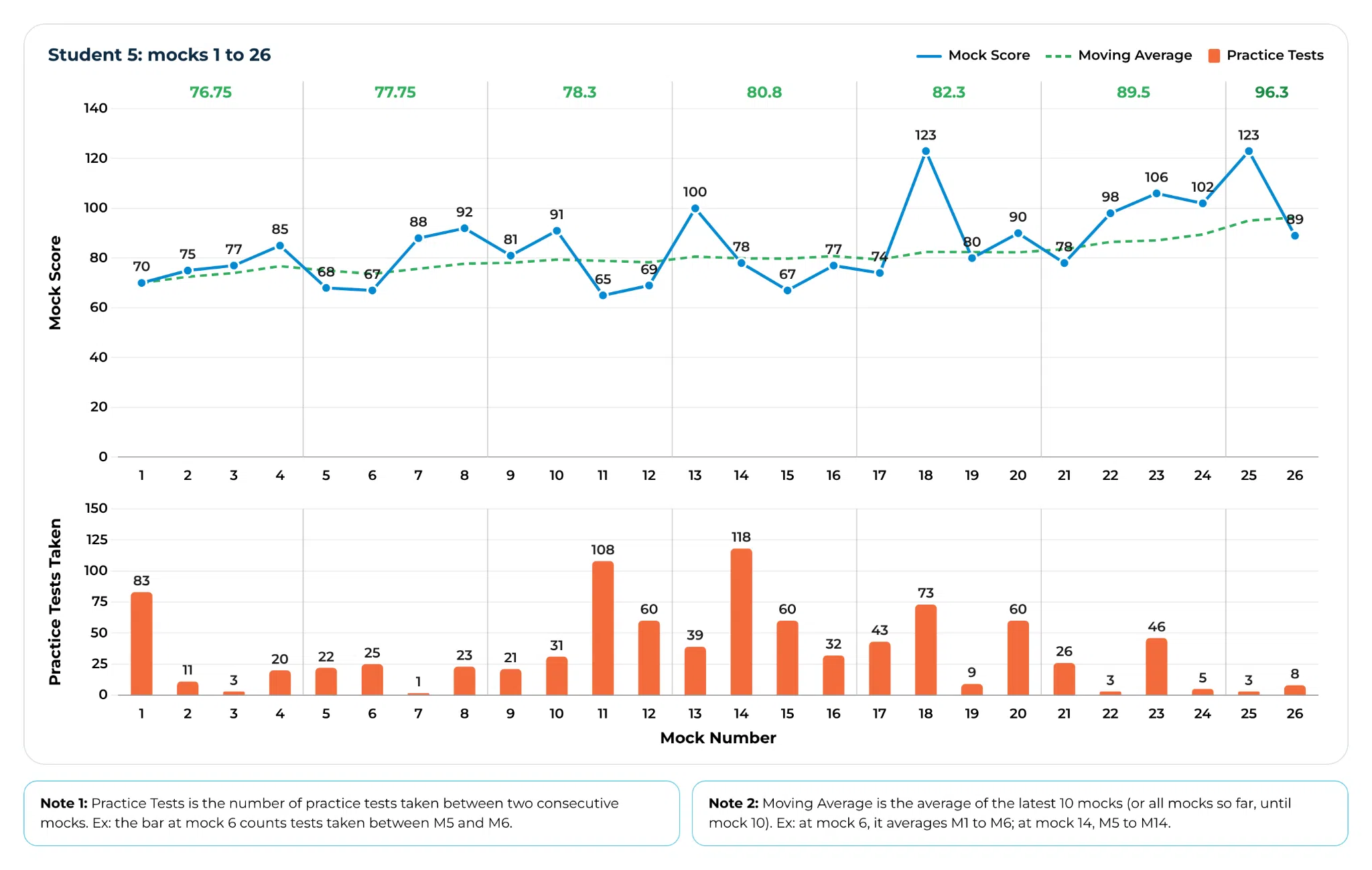
Student 5 averaged 77.75 in the first eight mocks and 78.5 in the next eight. Across sixteen mocks, the average moved by less than a mark.
This is the stretch where most aspirants start doubting their preparation. Yet it was also when Student 5 worked hardest. Between Mocks 9 and 16, the student took 469 practice tests, half of everything they practised across the entire journey.
The payoff arrived late, and all at once. The last 10 mocks averaged 96.3, nearly 18 marks above the plateau. Four of the student's five scores of 100 or more came in the final nine mocks.
Three details make this journey worth studying:
- The floor never cracked. In 26 mocks, Student 5 never scored below 65. After Mock 15, the lowest score was 74, and the final six mocks never dipped below 78.
- The best scores came on the lightest practice. Mock 25 produced a 123 with just 3 practice tests before it. The final six mocks averaged 99.3 on only 91 practice tests combined.
- The swings grew, but upward. The average move from one mock to the next widened from about 12 marks in the first half to 19 in the second. That extra movement came from new highs, not new lows.
The lesson: a plateau does not mean nothing is changing. Practice works like a deposit. Student 5 made the biggest deposits during the flattest stretch and collected the returns several mocks later.
Student 6: the Comeback Specialist
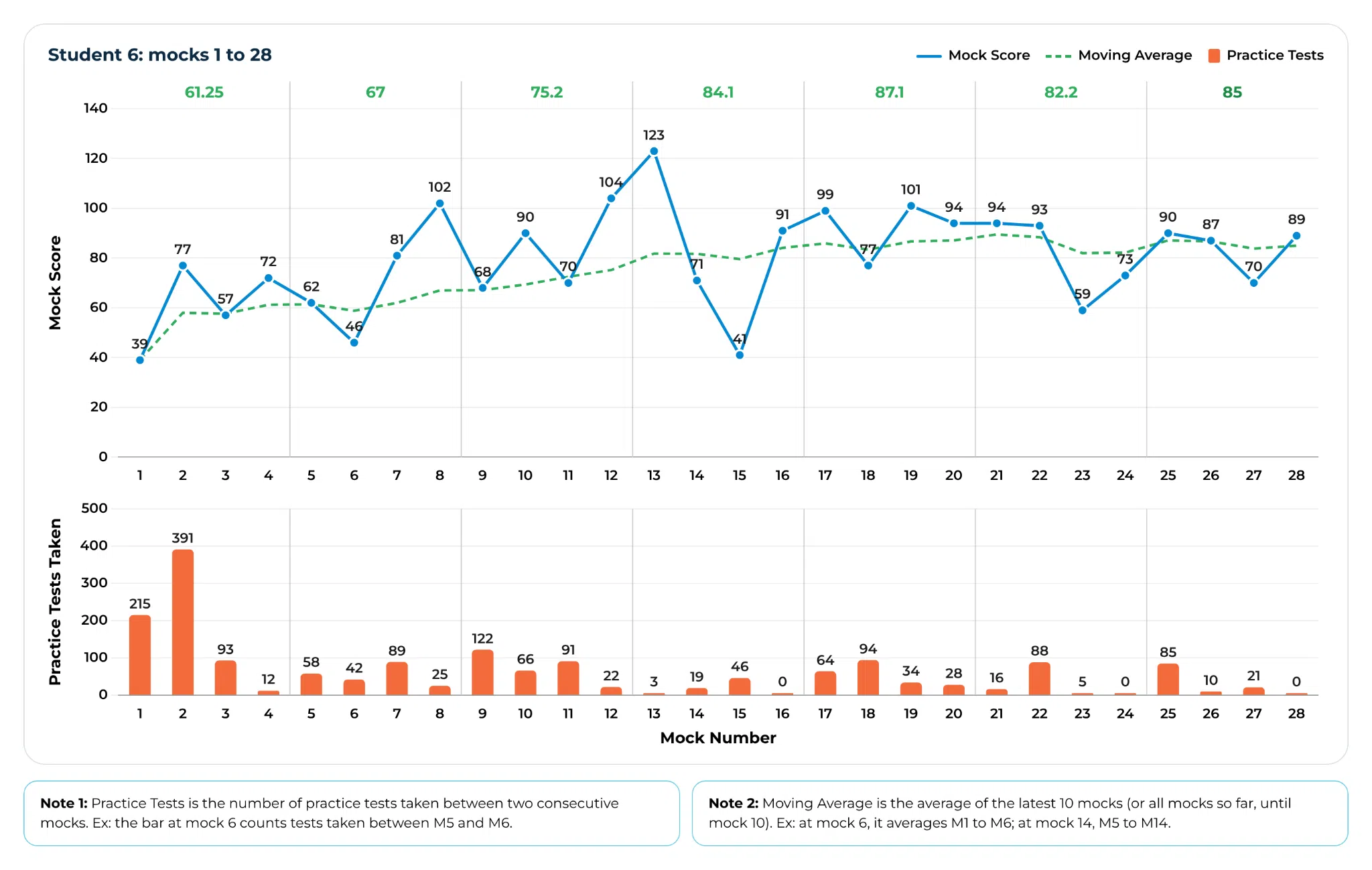
Student 6 opened at 39, the lowest score in either journey, and answered it with sheer volume. The student took 699 practice tests till Mock 3, 40% of their entire practice in the opening stretch.
The ceiling arrived early: 102 in Mock 8, 104 in Mock 12 and 123 in Mock 13. Then came the toughest moment in either dataset. Within two mocks, the score collapsed from 123 to 41, a fall of 82 marks.
What happened next is the most striking pattern in this data:
- Mock 16 rebounded to 91, with zero practice tests in between. The data cannot say what Student 6 did between those two mocks, but it rules out one explanation: more practice.
- It was not a one-off. Student 6 fell by 15 marks or more nine times. In eight of those nine cases, the very next mock was higher. Across all nine, the next mock won back about 20 marks on average.
- Three rebounds needed no practice at all. The climbs from 41 to 91 (Mock 16), 59 to 73 (Mock 24) and 70 to 89 (Mock 28) each came with no practice tests in between.
- The scores grew calmer. The average move from one mock to the next shrank from about 26 marks in the first half to under 18 in the second. Scores of 90 or more rose from 4 to 7, while scores below 70 fell from 5 to 2.
The lesson: recovery is a skill you can train. Student 6's fastest comebacks point to a corrected approach, not more questions.
From 15 Marks Behind to at Par: How Student 6 Caught Up
Student 6 did not start as Student 5's equal. After four mocks, Student 6's moving average was 61.25 against Student 5's 76.75, a gap of 15.5 marks. Comparing the same mock numbers, Student 6 outscored Student 5 in only 2 of the first 8 mocks.
Then the gap began to close, bundle by bundle:
After mock | Student 5 moving average | Student 6 moving average | Who was ahead |
4 | 76.75 | 61.25 | Student 5, by 15.5 |
8 | 77.75 | 67.00 | Student 5, by 10.75 |
12 | 78.30 | 75.20 | Student 5, by 3.1 |
16 | 80.80 | 84.10 | Student 6, by 3.3 |
20 | 82.30 | 87.10 | Student 6, by 4.8 |
24 | 89.50 | 82.20 | Student 5, by 7.3 |
By Mock 13, Student 6's moving average had drawn level. For the next ten mocks, it stayed level with or ahead of Student 5's, leading by as much as 6.5 marks at Mock 17.
Three things powered the catch-up:
- Heavy groundwork, early. By Mock 12, when the gap had shrunk to about 3 marks, Student 6 had taken 1,226 practice tests. That is three times Student 5's 408 at the same point.
- A stronger middle stretch. Between Mocks 9 and 20, Student 6 averaged 85.75 against Student 5's 82.9 and scored 90 or more seven times against four. Student 6 also outscored Student 5 in 7 of those 12 mocks.
- Fast recoveries. With an average bounce of about 20 marks, Student 6's bad days rarely dragged on long enough to undo the progress.
The gap reopened at the very end. Student 5's late breakout (98, 106, 102 and 123 in Mocks 22 to 25) lifted their moving average to 96.3, while Student 6's settled at 85. Student 6 did not finish ahead, but a 15-mark deficit does not disappear for ten straight mocks by accident.
The lesson: your first few mocks do not decide where you can reach. A weaker start can be closed with enough mocks, focused practice and the habit of bouncing back.
The Pattern Hidden Between the Bars and the Line
Put the orange bars beside the blue line and an unexpected relationship appears. For both students, the stretches with the most practice did not have the highest scores.
Student | Heavy-practice stretch | Practice tests | Average score | Light-practice stretch | Practice tests | Average score |
Student 5 | Mocks 9–16 | 469 | 78.5 | Mocks 19–26 | 160 | 95.75 |
Student 6 | Mocks 1–8 | 925 | 67 | Mocks 21–28 | 225 | 81.9 |
This does not mean practice stopped mattering. It means the job of practice changed. Early on, practice builds the base: concepts, speed and comfort with every question type. Later, it becomes surgical, with a few targeted sets aimed at the exact errors the last mock exposed.
Also Read: CAT Mock Journey of DashCAT Toppers: From 30s to 100+
Run the Floor–Ceiling–Bounce Test on Your Own Mocks
All you need is a list of your mock scores in the order you took them. Then work out three numbers:
- Floor: the lowest score among your last six mocks. Compare it with the lowest among the six before those.
- Ceiling: the highest score among your last six mocks. Compare it the same way.
- Bounce: find every mock where your score fell by 15 marks or more, note how much the next mock changed, and average those changes.
Student 5 shows how the test reads. At Mock 16, the floor was 65 and the ceiling 100. By Mock 26, they were 78 and 123. Both numbers moved up, and that is the breakout in two figures. Student 5's bounce was only +0.5, but with a floor that high, the student rarely had far to climb back.
Now match your result:
What your numbers show | What it usually means | What to do next |
Steady floor, flat ceiling | A stable base that has not broken through yet (Student 5, Mocks 1–16) | Stay the course, and aim targeted practice at the questions you currently skip |
Rising ceiling, low floor | High potential with unreliable bad days (Student 6, Mocks 1–13) | Study your worst mocks, not your best ones |
Both rising | Genuine all-round progress (Student 5, Mocks 17–26) | Protect your process, and do not overhaul it after one poor mock |
Both flat for six or more mocks | Practice is not reaching the real gaps | Diagnose your errors before adding more volume |
Negative bounce | One bad mock tends to trigger another | Analyse each mock fully before you attempt the next |
Also Read: CAT Mock Scores Fluctuating? Here's What You Should Do
Your Next Five Mocks: A Plan Drawn From Both Journeys
- Write down your floor and ceiling before every mock. Know the score you are protecting and the score you are chasing.
- Within 24 hours, sort every lost mark into one of three buckets: you didn't know it, you knew it but ran out of time, or you knew it but got it wrong. Each bucket needs a different fix.
- Pick the two biggest leaks and fix only those. In VARC, it may be one type of passage you keep misreading. In DILR, it may be sticking with a set you should have dropped after five minutes. In QA, it may be one chapter that keeps costing you two questions.
- Size your practice to the leak, not the calendar. A focused 25-question set on a weak area beats 100 random questions.
- After a bad mock, change one thing, not everything. Student 6 went from 41 to 91 without a single extra practice test. One correction to your approach can outweigh a week of extra volume.
Conclusion: Judge the Trend, not the day
Student 5 shows that a flat stretch can be the quiet build-up to a breakout. Student 6 shows that even an 82-mark collapse is survivable. Student 6 also shows that a 15-mark head start is not permanent: the aspirant who started behind drew level by Mock 13 and held that level for ten mocks. Both finished their last 10 mocks about 16 marks above their first 10.
Your mock scores will rise and fall, and no single scorecard can tell you where your preparation stands. But these three questions can: is your floor climbing, is your ceiling stretching, and is your bounce getting quicker? Track those numbers, and one bad mock loses its power to shake you.
Take a free CAT mock today and start tracking your floor, ceiling and bounce.