91- 6303239042


 Preferred Source

 Google Discover
CAT Arithmetic Cheat Sheet 2026
Arithmetic is one of the most fundamental areas of CAT Quantitative Aptitude because many questions test how well you can convert everyday situations into mathematical relationships. Unlike formula-heavy preparation, CAT Arithmetic requires you to recognise percentages, ratios, rates, averages and quantities hidden inside word problems.
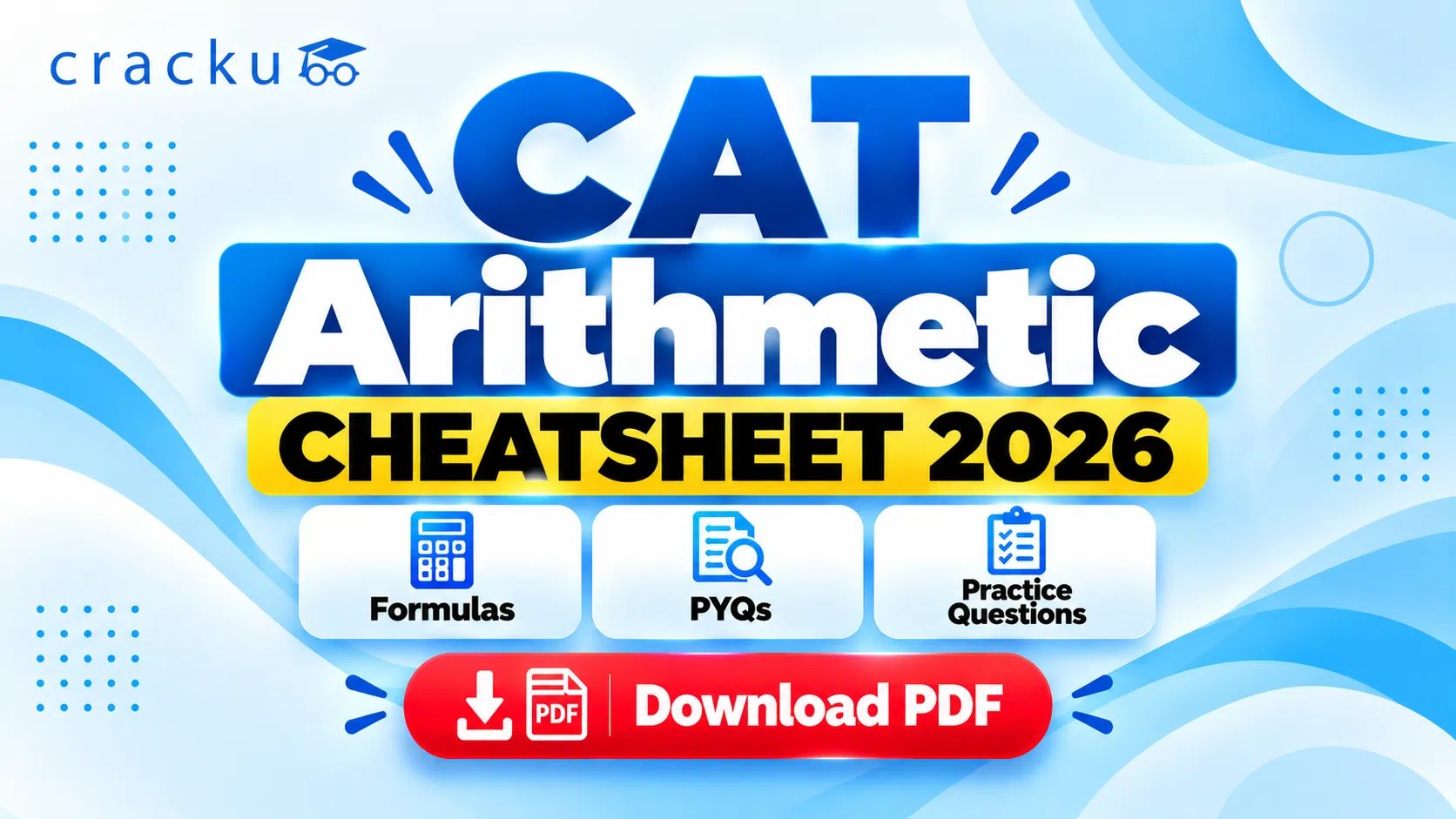
The CAT Arithmetic Cheat Sheet 2026 brings together formulas, concepts, shortcuts and CAT-focused methods for percentages, ratios, averages, profit and loss, interest, mixtures, time-speed-distance, time and work and other important Arithmetic areas.
Use this cheat sheet for quick revision after learning individual concepts and alongside regular CAT Quant questions practice.
Download CAT Arithmetic Cheat Sheet PDF
A CAT Arithmetic Cheat Sheet PDF is useful when you need to revise a large number of interconnected concepts without reopening detailed chapter notes.
The provided sheet covers fractions and ratios, percentages, profit-loss-discount, SI and CI, averages, alligation, mixtures, TSD, trains, boats, races, time and work, pipes, partnership, ages, income-expenditure, successive percentage changes, clocks, calendars and other Arithmetic applications.
Rather than simply reading the PDF repeatedly, keep it beside you while analysing CAT Mock Tests. Every time an Arithmetic question takes longer than expected, check whether a standard relationship or shortcut could have reduced the calculation.
Important CAT Arithmetic Formulas for Quick Revision
Some CAT Arithmetic formulas appear repeatedly across different types of questions.
Download CAT Arithmetic Formula PDF
For percentage change:
Percentage Change= Change in Original Value/ 100
For successive changes of $$a\%$$ and $$b\%$$:
Net Change = a + b + (ab/100)
Treat a decrease as a negative percentage. The cheat sheet also highlights that an $$x\%$$ rise followed by an $$x\%$$ fall does not cancel out. The net change is a decrease of:
$$\frac{x^2}{100}\%$$
For averages:
Average=Sum of all Observations/ Number of Observations
For equal distances travelled at speeds u and v:
Average Speed= 2uv/u+v
For time and work, if A and B independently complete a job in x and y days:
Time Together=xy/(x+y)
Students using CAT Sectional Tests should identify which of these relationships they repeatedly derive from scratch and work on recalling them instantly.
Also Read, CAT Arithmetic PYQs with Video Solutions & Formula PDF
CAT Arithmetic Important Topics for CAT 2026
Arithmetic contains several interconnected topics. A percentage question can turn into profit and loss, while ratios can appear inside mixtures, averages, partnership or time and work.
For effective revision, divide the CAT Arithmetic syllabus into broader concept families:
Area | Important Topics to Revise |
Percentage change, successive changes, reverse percentages | |
Ratios, direct and inverse proportion | |
Profit, loss and discount | |
Simple and compound interest | |
Simple, combined and replacement averages | |
Alligation, concentration, repeated replacement | |
Relative speed, trains, boats and streams | |
Work rates, efficiency and wages | |
CAT Pipes | Filling and emptying rates |
Clocks, calendars and word-problem modelling |
The cheat sheet's final revision checklist similarly groups the material into percentages, commercial maths, ratios, averages, TSD, work-based questions, applications and miscellaneous Arithmetic.
Also Read, 100+ Most Important CAT Arithmetic Questions For CAT 2026
Best Shortcuts and Approaches for CAT Arithmetic
The best Arithmetic shortcuts often involve choosing better numbers rather than calculating faster.
For percentage and ratio problems, consider taking a convenient base such as 100 instead of immediately introducing variables. The cheat sheet specifically recommends convenient bases for percentage and ratio word problems because this can reduce unnecessary equations.
For time and work questions, another useful technique is taking total work as the LCM of individual completion times. This converts fractional daily work into integer units and can make calculations substantially easier.
For mixtures, track the absolute quantity of the component rather than working only with percentages.
These are the kinds of approaches that should become automatic through a good CAT Quant Course and repeated topic-wise practice.
Fraction to Percentage Conversions for CAT
Fast fraction-percentage conversion is particularly valuable because it reduces calculation time across percentages, ratios, profit-loss, mixtures and DI.
Fraction | Percentage |
1/2 | 50% |
1/3 | 33⅓% |
2/3 | 66⅔% |
1/4 | 25% |
3/4 | 75% |
1/5 | 20% |
1/6 | 16⅔% |
1/8 | 12.5% |
1/9 | 11.11% |
1/10 | 10% |
1/12 | 8⅓% |
1/16 | 6.25% |
1/20 | 5% |
1/25 | 4% |
The cheat sheet includes these high-value conversions as a dedicated quick-reference table.
Try to recognise these conversions directly instead of repeatedly using division during timed practice.
Common CAT Arithmetic Mistakes to Avoid
Arithmetic questions can appear easy, which makes careless errors particularly costly.
Some important traps are:
- calculating percentage change on the wrong base;
- assuming equal percentage increases and decreases cancel;
- taking a simple arithmetic mean for average speed;
- calculating profit or loss percentage on the wrong quantity;
- adding completion times instead of work rates;
- ignoring changing principal in compound interest;
- working only with percentages instead of absolute quantities in mixtures;
- mixing kilometres/hour with metres/second;
- assuming age ratios remain constant;
- applying repeated-replacement formulas without considering whether the mixture is homogeneous.
These traps are specifically highlighted in the supplied Arithmetic cheat sheet.
When solving CAT Previous Year Questions, maintain an error log that separates conceptual mistakes from calculation and interpretation errors.
How to Use the CAT Arithmetic Cheat Sheet for Preparation
Do not treat the cheat sheet as a replacement for concept learning.
A better cycle is:
Learn → Practise → Analyse → Revise → Reattempt
After completing a topic, solve CAT-level questions without looking at the formulas. Then use the sheet during analysis to identify formulas, shortcuts or relationships you failed to recognise.
Students enrolled in a CAT 2026 Course can revise the corresponding section after completing each Arithmetic chapter. Closer to CAT, shift from isolated topic practice towards mixed Quant sets so that you learn to identify the underlying Arithmetic concept without being told the chapter beforehand.
CAT Arithmetic Cheat Sheet 2026: Conclusion
The CAT Arithmetic Cheat Sheet 2026 should ultimately help you translate word problems into ratios, percentages, rates and equations more quickly. Memorising formulas alone will not achieve this. The bigger improvement comes from recognising what remains constant, selecting a convenient base and choosing the right mathematical representation.
If you are preparing through a CAT Crash Course, use the cheat sheet as a rapid revision tool alongside mocks and PYQs. Mark the formulas and conversions you repeatedly forget, revisit the Arithmetic problems that consumed excessive time, and gradually build a personal list of shortcuts that work reliably under exam conditions.