 91- 6303239042
According to the passage, the disadvantage of ‘solar paint’ is that the:
Sign in
Please select an account to continue using cracku.in
↓ →
Read the given passage and answer the questions that follow.
In the past four decades, people around the world have become increasingly aware of the problem of energy. Traditional energy sources such as oil and natural gas are dwindling rapidly. In many countries, this has meant extracting natural resources at the expense of the environment. In order to solve this problem, scientists are looking for new ways to satisfy the world’s energy needs.
One possible solution to the energy problem is a “solar paint” called “Sun-believable”. Scientists at the University of Notre Dame have invented a paint that can produce energy. The paint has energy-producing particles called “quantum dots” that convert sunlight into electricity. Despite the promise of solar paint, there are still some problems. While the paint only converts about one per cent of light to energy, it is cheap to make and can be used anywhere. Scientists are trying to make the paint more efficient in converting sunlight to energy.
Garbage and waste can also be changed to energy but there are some issues with this method. This method, called ‘Waste to Energy’ or WtE, has become popular in the last decade. In this, solid waste is burned at very high temperatures to create energy. However, the burning process causes pollution and creates more problems. Some new energy plants use a cleaner method of converting waste to energy. However, these types of energy plants still emit carbon dioxide (CO2), which contributes to other environmental problems. Waste to Energy plants remain somewhat controversial among scientists and environmental activists. Finally, the use of wind as a source of energy is becoming more popular recently. Floating wind farms are large groups of big wind turbines (fans) that many countries are beginning to build. Building the turbines on the ocean is more effective than building them on land because there tends to be a steadier and stronger wind on the ocean. Building the farms on the ocean also helps save valuable space in crowded countries.
According to the passage, the disadvantage of ‘solar paint’ is that the:
Option D: Correct.
This is a direct question that can be answered by pointing to the sentence in the passage that discusses the drawbacks of solar paint. The second sentence of the second paragraph, "Despite the promise of solar paint, there are still some problems. While the paint only converts about one per cent of light to energy..." answers the question.
From here, we know that the only disadvantage of the solar paint mentioned in the passage is that it converts about one per cent of light to energy.
Option A: Incorrect. There is no mention of the manufacturing time of the solar paint.
Option B: Incorrect. The cost of paint is not mentioned, but a low cost is an advantage.
Option C: Incorrect. The second paragraph, in fact, mentions that scientists are actively working to improve quantum dots. There is no mention that the scientists cannot achieve the same.
Based on the passage, we can say that the problem with the ‘Waste to Energy’ method
is that it:
Option C: Correct. It is mentioned a couple of times in the last paragraph that discusses WtE method that the problem it causes is of "pollution". As visible through the direct sentences from the passage: "the burning process causes pollution and creates more problems. ..."
"these types of energy plants still emit carbon dioxide (CO2), which contributes to other environmental problems..."
Option A: Incorrect. Though it might seem relevant to the passage but notice the word that has been used in the passage, that is, controversial; "Waste to Energy plants remain somewhat controversial among scientists and environmental activists...." a controversy does not imply a debate and moreover the scientists and environmentalists both agree upon the fact that WtE method causes pollution.
Option B: Incorrect. Energy efficiency of WtE plants is not discussed at all.
Option D: Incorrect. New types of WtE plants is infact neither a proposed solution nor a problem in fact the passage mentions that new types of WtE plants still cause the same pollution problem; Some new energy plants use a cleaner method of converting waste to energy. However, these types of energy plants still emit carbon dioxide (CO2),...
In the last paragraph of the passage, the writer suggests that:
Option B: Correct. Looking at the question stem is necessary here to eliminate other likely answers. The question stem is what the author "suggests" in the last paragraph, so we have to look at inferences rather than facts from the same. From the last paragraph; "Building the turbines on the ocean is more effective than building them on land because there tends to be a steadier and stronger wind on the ocean....." and the passage also ends with highlighting the advantage of floating wind farms. That is what the author is suggesting, remaining things are facts.
Option A: Incorrect. Though the last paragraph does mention this particular fact but it is not what the author suggests, hence it does not answer the question stem.
Option C: Incorrect. No where in the passage it is mentioned that there will be lesser floating wind turbines in the future.
Option D: Incorrect. This will appear as a strong contender for the right answer, it fits the question stem as well, but, notice the use of the word "must"- it is an extreme word and the author is merely suggesting that building wind farms on ocean will help save space for crowded countries. Moreover, the option says wind as a source of energy saves space, whereas floating wind farms save the space as clearly mentioned in the last line of the passage.

According to the passage, conventional energy sources
To answer this particular question we have to just focus on the relevant paragraph that talks about conventional energy sources as asked.
Option D: Correct. "Traditional energy sources such as oil and natural gas are dwindling rapidly...." directly mentioned in the first paragraph.
Option A: Incorrect. "Disappeared" serves as a wrong and an extreme word here. The conventional energy sources have dwindled, not disappeared.
Option B: Incorrect. It is nowhere mentioned that the traditional energy sources have become more easily available.
Option C: Incorrect. The passage mentions that the extraction of these resources is at the expense of environment, this does not imply that they are difficult to extract. "In many countries, this has meant extracting natural resources at the expense of the environment..."
Read the given passage and answer the questions that follow.
The tale, the parable and the fable are all common and popular modes of conveying instruction - each being distinguished by its own special characteristics.
The tale is the narration of a story either founded on facts, or created solely by the imagination, and not necessarily associated with the teaching of any moral lesson. A parable is a short story used to illustrate a moral or spiritual lesson and it comes from a Greek word meaning ‘comparison’. The fable, a short fictional story, partly agrees with, and partly differs from both of these. It will contain, like the tale, a short but real narrative; it will seek, like the parable, to convey a hidden meaning, and that not so much by the use of language, as by the skillful introduction of fictitious characters; and yet unlike both the tale or parable, it will ever keep in view, the great purpose of instruction, and will necessarily seek to inculcate some moral maxim, social duty, or general truth.
The purpose of a fable is to convey moral messages to the readers and this objective is usually achieved through animals, birds or trees that behave and speak as human beings. As the story conveyed through the fable progresses, the reader becomes appreciative of all that is pure, honourable and praiseworthy, and critical of all that is low, dishonourable and unworthy. In a fable, the reader receives advice without perceiving the presence of the adviser and it is for this reason that the advice finds greater acceptance. The true fabulist (a writer of fables) therefore, is all of these- a teacher, a corrector of morals, a commender of virtue and a censor of vice. It is in this that the fable scores a point over the tale and the parable.
The passage suggests that one of the objectives of a fable is to:
We have to look into the paragraphs talking about fables and understand what a fable does as the question stem is "objective" of a fable.
Option B: Correct. As we skim through the lines mentioning what does a fable do, we find; "The purpose of a fable is to convey moral messages to the readers ..." this line particularly mentions the clear objective/ purpose of a fable which is to convey moral messages which ultimately aim at upliftment of character, this option fits and no other options fit the objective of moral teachings.
Option A. Incorrect. Though a line mentions about the role of animals and birds in fables that; "The purpose of a fable is to convey moral messages to the readers and this objective is usually achieved through animals, birds or trees..." but here the animals and birds and trees are used a "medium" to convey moral messages, they are not the message being conveyed.
Option C: Incorrect. No where the problems of contemporary society is mentioned or discussed.
Option D: Incorrect. No where the past is mentioned or discussed.
By stating that the fabulist is a ‘great teacher, a corrector of morals, a censor of vice,
and a commender of virtue’, the writer implies that:
Here since a line from the passage is mentioned, we trace where it is exactly present in the passage and skim around it to understand its implication.
Option D: Correct. The line clearly talks about how a fabulist dons many hats and sounds appreciative of the fabulist. Since a fabulist is a writer and their writing fulfills many purposes, this option fits well.
Option A: Incorrect. There is no mention of the need for more fabulists even though the passage appreciates their role.
Option B: Incorrect. Fabulists must be honored can be a correct inference, but, they must be respected "above" other writers is a wrong and extreme implication that is not mentioned.
Option C: Incorrect. The passage does mention that a fabulists is multifaceted, but to infer that they can replace teachers is not right, neither is it mentioned in the passage.

Based on the passage, it could be suggested that the difference between a tale and a
parable lies in the:
To answer this question correctly we have to navigate to the part of the passage that talks about parables and tales.
Option A: Correct. The line where comparison is drawn between fables, tales and parables, it is mentioned about fables that; "It will contain, like the tale, a short but real narrative; it will seek, like the parable, to convey a hidden meaning..." This line draws the difference between a tale and a parable- that is a parable has a concealed or a hidden meaning while a tale does not have it, a tale has short and real narrative.
Option B: Incorrect. Depiction of facts is not a difference between a tale and a fable. As mentioned in the passage both tale and parable are narration of stories through different methods.
Option C: Incorrect. Length of the narrative is not mentioned as a comparative point between a tale and a fable.
Option D: Incorrect. The choice of characters is not mentioned as a difference between tale and fable, in fact choice of characters is mentioned with regards to fables, which has animals, birds and trees.
The main idea of the passage is that:
To answer the "main idea" of the passage, we must skim through and especially focus on the first and the last paragraphs, and try to compare options and then choose the best fit.
Option B: Correct. "It is in this that the fable scores a point over the tale and the parable...." This is directly mentioned in the passage and it says that fable is superior to tale and parable, preceded by an explanation for the same. The other parts of the passage talk about the qualities of a fable after introducing what tales, parables and fables are. Hence, the passage builds up to the main idea of how fables are better.
Option A: Incorrect. The passage does indirectly imply that each of these formats is distinguished, creative pursuits and hence should be respected. But, it is not explicitly mentioned, and hence it cannot be the "main idea".
Option C: Incorrect. The purpose of a fable is to convey moral messages to the readers ...it is mentioned that conveying moral messages is in fact purpose of a fable and that these messages maybe hidden is not stated in the passage. Moreover, this is not the main idea of the passage. As the passage is more focused on the "qualities of the fable".
Option D: Incorrect. The main idea of the passage is not to highlight the main difference between the three modes. They are introduced to build to the fact that how fables are better. Moreover, the difference between the three is not in the portrayal of characters but in their objectives and styles.
Read the given passage and answer the questions that follow.
Beneath the snow lies the subnivium (from the Latin nivis for snow, and sub for below), a small, protected area that is insulated and maintains a constant temperature. This microhabitat turns traditional thinking about snow on its head. Thanks to the emerging field of winter ecology, we now know that snowy environments have lives of their own. "Without snow, plant and animal life would be completely different," says biologist Jonathan Pauli of the University of Wisconsin-Madison. Pauli and scientists such as Ben Zuckerberg, are members of a new breed of researchers called winter ecologists who study the relationships among animals, plants and their snow-covered environments.
Their studies have shown that tiny mammals like shrews don't migrate but spend their winters in the subnivium. For some of the tiniest forms of life - fungi, invertebrates, soil bacteria and plant roots- snow maintains a mild winter temperature in which they can survive, compared to the killing cold up above. Plants and soil benefit from this layer because the lack of a hard frozen surface lets plant roots function. The active fungi release important nutrients to plants. As the temperature warms, the snow slowly melts and provides water for spring flowers. On an average, snow covers almost 18 million square miles of the planet each year. However, climate change is upsetting that chilly balance. Winter ecologists are studying how the lack of snow cover directly affects the ecology of many subnivium ecosystems, exposing organisms to temperatures for which they are not adapted.
The main idea of the passage is:
To answer the "main idea" of the paragraph correctly, we have to skim through the passage and especially pay attention to the concluding paragraph, and make sure it is encapsulated in the main idea answer.
Option C: Correct. The passage mentions about "subnivium" which is the hidden world beneath snow, the concluding paragraph mentions that climate change is adversely affecting winter snow. This option encapsulates both the aspects and hence, is right.
Option A: Incorrect. "Thanks to the emerging field of winter ecology, we now know that snowy environments have lives of their own..." this line does mention that winter ecology which has subnivium is an emerging field and new researchers are studying it- the paragraph does not explicitly mention any "creative approaches", moreover, it is not the main idea, it is used to introduce a topic.
Option B: Incorrect. The last paragraph mentions sufficient information about survival of plants and animals beneath the snow and nowhere it is mentioned in the passage that we know "very little" about them.
Option D: Incorrect. It is not mentioned that the field of "winter ecology" has emerged because of climate change. Winter ecology is also mentioned above as a field to study subnivium as well. So it is clear that winter ecology as a field did not emerge to study climate change as it studies other things as well.

Based on the information in the fourth paragraph, it can be reasonably inferred that:
Option C: Correct. The last paragraph mentions how the snow cover in winter helps in the survival of many life forms like - fungi, invertebrates, soil bacteria and plant roots-...the paragraph also mentions about climate change but we have to analyse and compare other options as well and check if they are right inferences.
Option A: Incorrect. There is no mention of animals feeling "more comfortable" during snowfall.
Option B: Incorrect. It is mentioned that the tiniest lifeforms can survive beneath snow and fulfill their nutritional requirements but it is not mentioned that they "depend" upon frozen surfaces for their food, moreover there is no mention of large lifeforms specifically.
Option D: Incorrect. The temperature in subnivium is higher than that of the frozen surface, it is mentioned. But, it enables the organisms to survive.
Which of the following sentences is best supported by the last paragraph?
We have to focus primarily on the last paragraph here.
Option B: Correct. The last paragraph talks about the impact that climate change will have on the subnivium and that it is being studied "climate change is upsetting that chilly balance. Winter ecologists are studying how the lack of snow cover directly affects the ecology of many subnivium ecosystems...". Hence, it is the right answer.
Option A: Incorrect. The statement might be right, but the last paragraph does not talk about access to water resources at all.
Option C: Incorrect. The paragraph does not mention the mechanism of the formation of subnivium at all.
Option D: Incorrect. While the statement might be true but this statement is not being discussed in the last paragraph.
In the second paragraph of the passage, the author seems to imply that:
To answer this question focus on what the second paragraph is talking about.
Option C: Correct. The second paragraph mentions how the traditional belief that snowy environments are inactive is challenged through the study of winter ecology, which shows that snowy environments "have lives of their own". As depicted by the extract;" This microhabitat turns traditional thinking about snow on its head...."
Option A: Incorrect. It is nowhere mentioned that the winter ecologists do not know much about the subnivium, neither a reasoning for the same is provided.
Option B: Incorrect. It is nowhere mentioned what is the best time to see the subnivium.
Option D: Incorrect. It is nowhere mentioned that there was ever any reason because of which scientists did not study the winter environment. The passage does mention that this study field is fresh and there were traditional beliefs about the winter environment, but no historical reasons are provided for not studying the field earlier.

Select the most appropriate option to fill in the blank.
Famous for being a long distance swimmer, Mihir Sen was the first Asian to swim
__________ the English Channel.
Option B: Correct. Swim "across" the English Channel is correct because, across is the preposition that indicates movement from one side to another, which is what swimming is. Hence, it is the most appropriate.
Preposition "over" refers to movement to a "higher level". Hence, it is not right, since swimming is sideways movement.
Preposition "against" refers to moving opposite something. Like against the river current. Hence, it is not valid here.
Preposition "through" refers to movement from one side to another, in an enclosed space. Since English Channel is not enclosed, hence through is not valid here.
Given here is a paragraph. Its last sentence is missing. Select the most appropriate sentence to complete the paragraph.
Most of the year 2021was focused on the revival of businesses. Companies have continued their investments in up-skilling and re-skilling their workforce. In fact, in 2021, investments in up-skilling saw18% to 25%increase. _______
Option C is the most appropriate choice because it provides additional information that directly supports the context of the paragraph.
Throughout the paragraph, the focus is on the revival of businesses in 2021 and how companies have been investing in up-skilling and re-skilling their workforce. The missing sentence needs to complement this theme by providing more details about where these investments have been directed.
Option C does exactly that by specifying some of the sectors where these investments have increased, such as IT, e-commerce, pharma, and EdTech. By mentioning these sectors, it gives a clearer picture of where the up-skilling efforts have been concentrated, highlighting areas of growth and importance in the business landscape during the specified time period.
Therefore, Option C serves to enhance the coherence and relevance of the paragraph by providing specific examples that align with its central theme.
Select the most appropriate option to fill in the blanks.
Mr. Joshi ______ from his trip to Maldives. He ________ hard to finish the pending work since then.
Option D: Correct.
From the first glance we can understand that the paragraph is talking about an action that has happened in the past and the impact of which is in the present. In such cases "Present Perfect" tense and its forms are used.
has returned- present perfect
has been trying- present perfect continuous

Select the most appropriate option to fill in the blanks.
An opportunity ______ at everyone’s door but some people miss it and some people ______ them into success stories.
Option C: Correct.
It is known that "opportunity knocks" is a common phrase. Hence, it is the right choice for the first blank.
The partner choice for the second blank "convert" also fits as "convert to success"
Select the odd one out.
Option A: Correct.
Sumptuously, plentiful and richly are all synonymous- as they all mean- "in abundant quantity"
Selectively, is the odd one out as it means- choosing few things among other many things.
Select the most appropriate set of idioms to fill in the blanks.
His offhand remarks ___________ of the members of the committee. But the Chairman told the members to ______________ and stop arguing.
Option B: Correct.
This question uses common phrases/ idioms
The right idioms used here are- ruffled the feathers, cool their heels and cool it.
Now we have to use the right combination on the basis of the sentence.
Ruffled the feathers is appropriate for the first blank because it means "to annoy" or "upset".
Cool their heels means to wait for a significant amount of time, mostly for someone else, therefore cool their heels is a misfit here, since the members are likely being asked to calm down and not wait.
Cool it means to calm down and hence it is the right choice.
Sentences of a paragraph are given below. While the first and the last sentences (S1 and S6) are in the correct order, the sentences in between are jumbled up. Arrange the sentences in the correct order to form a meaningful and coherent paragraph.
S1. I was standing at the gaol gate talking to the gaoler when we noticed a man carrying a strange animal.
A. This animal had been twisted round in a most peculiar way forming a kind of knot.
B. The gaoler sent for him and I saw something between a lizard and crocodile, about two feet long with claws and a scaly covering.
C. When asked by the gaoler what he proposed to do with it, he replied with a broad smile that he would make bhujji- a kind of curry - out of it.
D. Its owner had passed a pole through this knot and was merrily carrying it in this fashion.
S6. Subsequently I discovered from reading F W Champion’s book -The Jungle in Sunlight and Shadow- that this animal was the pangolin.
Option C: Correct.
We have to first understand and make a rough sense of what the entire paragraph is trying to convey. We can understand that it talks about seeing a strange animal -> describes the strange animal -> tells the purpose/ function of that animal -> as given in the final sentence; ascertains what the animal is.
The first sentence mentions that a man was noticed by the gaoler, so the follow up sentence should be "B. The gaoler sent for him and I saw something between a lizard and crocodile, about two feet long with claws and a scaly covering." Him being the cue here, it is naturally the follow up sentence.
The next sentence following the end of the previous sentence should describe how the animal looked, which is done by option A.
Since there is one more sentence further explaining the features and appearance, so the next sentence would be D.
The sentence C fits at last, which describes, what is supposed to be done with the animal, after its features and appearance are described.
Select the odd one out.
Option A: Correct.
Saunter, Amble and Stroll, all three are synonymous, meaning "to walk in a slow or relaxed manner."
Hence, option A, scurry is the odd one out, which is an antonym of these words and means; "to walk rapidly".
The following sentence has been divided into parts. One of them may contain an error. Select the part that contains the error from the given options. If you don’t find any error, mark ‘No error’ as your answer.
Despite of her busy schedule / she decided to visit / her friend on her birthday.
Option A: Correct.
Despite her busy schedule is the correct sentence. Despite is never followed by "of".
Select the most appropriate synonym of the given word.
Impenetrable
Option A: Correct.
Impenetrable means something that cannot be "passed through" or hard to get through.
Impassable means the same thing.
Also note that in vocabulary knowing what certain prefixes mean, can assist in predicting word meanings.
The prefix "im" used here means- "not", "without", "opposite of".
Select the most appropriate set of idioms to fill in the blanks.
A new project is ________ in Central Delhi. My father, being the chief architect, is always _________, even on weekends.
Option D: Correct.
Understanding the meaning of idioms and phrases is the key to this question. Also, identifying, if the idiom is correct is important.
On the air- broadcasting
On the cards- a future event likely to happen
On call- being available usually outside the designated working time
On the boil- on the verge or at peak
So, option D fits best, as the sentence tries to convey that a new project in Central Delhi is being worked upon and the speaker's father is expected to be available even on the weekends.
Select the most appropriate option to fill in the blanks.
My father ______ that he _______ me to school tomorrow.
Option A: Correct.
To describe a planned action happening tomorrow.
A combination of present perfect and future tense will be used.
has promised- present perfect tense
will drop- simple future
Four statements are given here, labeled A, B, C and D. Among these, three statements are in logical order and form a coherent paragraph. From the given options, choose the option that does NOT fit into the theme of the passage.
A. As per the Census 2011, as many as 76.34 crore persons in the country are literate.
B. The overall literacy rate works out to be 72.9 %for the country.
C.As per the Census report, the population of Panipat City in 2011 is 2.94 lakhs.
D. Of these, 43.46 crore are males and 32.88 crore are females.
Option A: Correct.
The third sentence or sentence C is an outlier.
The paragraph is clearly talking about literacy rates in the country and how many of literates are present gender wise.
The sentence talking about Panipat city is irrelevant here.
Select the most appropriate option to fill in the blank.
The flower woman, _______, is very well-off.
Option B: Correct.
This question is about understanding that when a sentence refers to a person, grammatically "which" is never used for a person, it is used for things. "Whom" is how a person should be referred to. This information, eliminates all other options.
Select the most appropriate option to fill in the blanks.
In this time of economic crisis, such a _______ expenditure of public funds needs to be _______.
Option C: Correct.
Understanding the tone of the sentence is the key here.
When referring to an economic crisis, followed by a comment about expenditure, it becomes clear that the expenditure at the time of crisis will be condemned, criticized or questioned upon.
The only option doing so is C.
Sentences of a paragraph are given below in jumbled order. Arrange the sentences in the correct order to form a meaningful and coherent paragraph.
A. Suddenly they fell into a deep pit someone had dug to trap foolish animals like them who weren’t watching where they were going.
B. Their wild squawking brought the other animals to the pit.
C. Ostrich and Emu were racing each other across the Australian outback.
D. Ostrich and Emu tried to jump out of the pit but it was too deep.
Going through the sentences, we can see that C sets the context of the discussed event.
A and D would make a good chronological pair; the ostrich and emu fell into the pit (A), and then they tried to jump out of the pit but could not as it was too deep (D)
B serves as the conclusion of the paragraph, as after the ostrich and emu were trapped in the pit, their squawking brought other animals to the pit.
CADB is the sequence in these sentences that should be arranged in order to make a logically coherent paragraph.
Therefore, option C is the correct answer.
Select the odd one out.
Option A: Correct.
Going through the options we can clearly see that humane, patient and forgiving are all words denoting positive aspects of a person's nature.
Vicious is hence the odd one out.
Vicious means deliberately cruel, but even if one does not know the meaning, one can eliminate it by grouping other similar words together.
Select the most appropriate option to fill in the blank.
The skill of carpet weaving is ____________ from generation to generation.
Option A: Correct.
Understanding the meaning of the phrases is the key here.
When something is being passed from generation to generation, it indicates, that it is "passing down", because there is a transfer from a senior to new comer, indicating a hierarchy.
Hence, handed down is the right choice here.
Select the most appropriate ANTONYM of the given word.
Repulsive
Option D: Correct.
Knowing the meaning of the word in the question is the key to answer here.
Repulsive means to be drawn away from, disinterest.
Attractive is hence the right choice since it means being drawn towards something.
Select the most appropriate synonym of the given word.
Contemplate
Option B: Correct.
Knowing the meanings is important here.
Contemplate means to think or ponder upon something, hence the word consider is closest in meaning to it, and is therefore the synonym.
Select the option in which the words share the same relationship as that shared by the given pair of words.
drum : beat :: ?
Option A: Correct.
Understanding the relationship between the words in the question is the key here.
Drum: Beat means - a drum which is an instrument is beaten (an action) to generate sound/ effect, that's how a drum functions.
Similarly among the options, Trumpet: blow means - a trumpet which is an instrument is blown (an action) to generate sound/ effect, that's how a trumpet functions.
The other options rightly place the instruments but they are not followed by actions that generate sound from them, but, rather, the objects or body parts used to play them, hence they are incorrect.
Four statements are given here, labeled A, B, C and D. Among these, three statements are in logical order and form a coherent paragraph. From the given options, choose the option that does NOT fit into the theme of the passage.
A. Teacher attendance is just 85% in primary and middle schools.
B. Primary school enrollment in India has been a success story.
C. The enrollment has reached at least 96% since 2009 of which girls make 56% of new students between 2007 and 2013.
D. Largely due to various programs and drives, the enrollment has increased even in remote areas.
Statements B, C, and D talk about how attendance in India has increased overall, with B providing a good introduction to the topic and D expanding the discussion to include even the rural areas.
Statement A, on the other hand, talks about how teacher attendance is low. This not only introduces the context of teachers being considered in terms of attendance but also goes against the general theme of attendance records improving.
Hence, Statement A is out of context among the given sentences.
Therefore, Option A is the correct answer.
Sentences of a paragraph are given below in jumbled order. Arrange the sentences in the correct order to form a meaningful and coherent paragraph.
A. He also advised me to come to table.
B. An English passenger, taking kindly to me, drew me into conversation.
C. He laughed at my insistence on abjuring meat, and said in a friendly way, “It is so
cold in England that one cannot possibly live there without meat.”
D. He asked me what I ate, what I was, where I was going, why I was shy, and so on.
Statement B sets the passage's context: an English passenger drawing someone into a conversation.
The natural follow-up to this is statement D, which clarifies what conversation is being talked about here.
At this point, we can mark option C as our answer, but it is always good to look at the complete sequence and see if it is logically coherent. From D, we go to A, which mentions one more thing the Englishman brought up during his conversation; after which comes statement C, which continues with the responses to the previous question posed by the Englishman.
BDAC is a logically coherent sequence
Therefore, Option C is the correct answer.
Select the option in which the words share the same relationship as that shared by the given pair of words.
shrug : indifference :: ?
To solve this analogy, we need to understand the relationship between "shrug" and "indifference."
A shrug is a gesture that typically expresses indifference.
We need to find a pair where the first word is a gesture that typically expresses the second word.
Let's analyze the options:
A wave : fatigue - A wave is a gesture that does not typically express fatigue.
B blink : scorn - A blink is an involuntary action, not a gesture expressing scorn.
C scowl : desire - A scowl is a facial expression that typically expresses anger or displeasure, not desire.
D nod : assent - A nod is a gesture that typically expresses assent (agreement or approval).
Hence, only the relationship in option D matches the relationship in the given pair: a gesture expressing a specific feeling or state.
Therefore, option D is the correct answer.
The following sentence has been divided into parts. One of them may contain an error. Select the part that contains the error from the given options. If you don’t find any error, mark ‘No error’ as your answer.
Group discussion and pair work are / good classroom strategies encourage / students to speak out their ideas.
The phrase "good classroom strategies encourage" should be "good classroom strategies that encourage" or "good classroom strategies to encourage"
Hence, this part of the sentence is incorrect and therefore, Option D is the correct answer.
Select the most appropriate option to fill in the blank.
The secretarial job,___________, was advertised on the internet.
Option A: "for which she has applied"; this option correctly uses "for which" to refer back to the secretarial job. It indicates that she has applied for the job. The preposition "for" is necessary here to indicate the action of applying for something.
Option B: "which she has read" The phrase "which she has read" suggests she simply read the advertisement but does not imply any further action.
Option C: "That she bought." this option is incorrect because it does not make sense in the context of a job advertisement. You cannot buy a job.
Option D: "for which she has written." this option could make sense in a different context, such as if she wrote the job advertisement herself. However, it does not fit the common scenario where someone applies for a job. The typical and expected action related to a job advertisement is applying, not writing the advertisement.
Overall, A would be a better fit over D
Therefore, Option A is the correct answer.
Select the most appropriate option to fill in the blanks.
The migrant workers, feeling tired _____ a long journey, rested _______ the shade of a big banyan tree.
Option C: Correct.
The correct usage of prepositions is the key here.
We can take up the second blank first and understand that if one is resting in the periphery of a tree, one rests "under" it, so now we are left with option C and D.
Now we check the first blank. Feeling tired "after" a long journey is right.
Select the most appropriate option to fill in the blank.
Every year, some boys ________ in the middle of the course due to their family or financial problems.
Option A: drop off means to take someone or something to a particular place, usually by car, as you travel to a different place
Option B: drop by means to pay a brief, casual visit
Option C: drop out means to withdraw from participation or membership
Option D: Drop-in means to come for a visit, especially without having received an invitation for a specific time
Of all the given options, only option C fits in the context of the sentence, implying that every year, some boys, stop their participation or leave in the middle of the course.
Therefore, Option C is the correct answer.
Study the given table and answer the questions that follow.
The table shows the data regarding the number of medals won by countries A, B, C, D, E and F in International games in 2020

The total number of Silver medals won by countries C, D and F is approximately what per cent of the total medals won by countries A, B and C together?
Total number of Bronze and Silver medals won by Country C = 42 - 16 = 26 and the ratio of silver medals to bronze medals = 6:7.
So, the number of silver medals = $$\frac{6}{13}\times\ 26\ =\ 12$$.
Similarly, Silver medals won by D and F are 8 and 15 respectively.
Total Silver medals won by C, D and F = 12 + 8 + 15 = 35.
Total medals won by A, B and C together = 40 + 38 + 42 = 120.
Required percentage = $$\frac{35}{120}\times\ 100=29.16\%\approx\ 29.2\%$$.
The total number of Gold medals won by countries B, D and E together is what per cent more than the total number of Bronze medals won by countries C and F (correct to one decimal place)?
The number of gold medals won by B, D, E = 14+10+12=36.
Now calculate the bronze medals won by C and F.
Bronze medals won by C:
16+6x+7x=42
13x=26
x=2
7x=14
Bronze medals won by F :
13+5y+6y=46
11y=33
y=3
6y=18
Bronze medals won by C and F=14+18=32
The percentage by which 36 is more than 32.
$$\frac{\left(36-32\right)}{32}\cdot100$$=12.5%
The average number of Bronze medals won by all the five countries is what per cent less than the total number of Silver medals won by all the five countries (nearest to an integer)?
What is the ratio of the total number of silver medals won by countries A and E to the total number of Bronze medals won by countries D and F?
Silver medals won by A = $$\frac{3}{5}\times\ 25=15$$
Silver medals won by E = $$\frac{4}{9}\times\ 27\ =\ 12$$
Bronze medals won by D = $$\frac{3}{5}\times\ 20=12$$
Bronze medals won by F = $$\frac{6}{11}\times\ 33\ =\ 18$$
Required ratio = 15+12 : 12+18 = 27:30 = 9:10
Read the given information and answer the question that follows.
In an institute, 1800 students are studying five different courses -A, B, C, D and E. The number of male students is $$57\frac{1}{7}\%$$ more than that of female students. Out of male total students, 24% are studying course B and the ratio of the number of female students to male students studying this course is 5:6. The total number of students studying course C is 342, out of which female students are 104.18% of female are studying course A and the ratio of male students to female students studying A is 4:3. One-fifth of total males are studying course D and the number of female students studying D is 25% less than that of males studying D.The remaining male and female students are studying course E.
The average number of female students studying courses A, B and C is approximately what per cent less than the total number of male students studying courses D and E?
It is giving that 1800 students are studying five different courses -A, B, C, D and E.
The number of male students is $$57\frac{1}{7}\%$$ more than that of female students.
Let number of female students be 100x, thus number of male students will be 100x+(400/7)x = 1100/7x
Total students = 1800
100x+1100x/7 = 1800
1800x/7 = 1800
x = 7
Thus, number of female students = 700 and number of male students = 1100
It is given that Out of male total students, 24% are studying course B = 24% of 1100 = 264
the ratio of the number of female students to male students studying this course is 5:6.
Number of female students studying course B = (264/6)*5 =220
Total students studying course B = 264+220 = 484
It is given that the total number of students studying course C is 342, out of which female students are 104. Hence, number of male students = 342 - 104 = 238
It is given that 18% of females are studying course A = 18% of 700 = 126
Also, the ratio of male students to female students studying A is 4:3.
Hence, the number of male students = (126/3)*4 = 168
Total students studying A = 168+126 = 294
It is also given that One-fifth of total males are studying course D = 20% of 1100 = 220
Also, the number of female students studying D is 25% less than that of males studying D = 220*0.75 = 165
Total number of students studying D = 165+ 220 = 385
Therefore, we make a table from the above information-

The average number of female students studying courses A, B and C = (126+220+104)/3 = 150
The total number of male students studying courses D and E = 220+210 = 450
The average number of female students studying courses A, B and C is approximately what per cent less than the total number of male students studying courses D and E = (300/450)*100 = 66.66% (Approx)
What is the ratio of the number of male students studying course B to that of female
students studying course D?
It is giving that 1800 students are studying five different courses -A, B, C, D and E.
The number of male students is $$57\frac{1}{7}\%$$ more than that of female students.
Let number of female students be 100x, thus number of male students will be 100x+(400/7)x = 1100/7x
Total students = 1800
100x+1100x/7 = 1800
1800x/7 = 1800
x = 7
Thus, number of female students = 700 and number of male students = 1100
It is given that Out of male total students, 24% are studying course B = 24% of 1100 = 264
the ratio of the number of female students to male students studying this course is 5:6.
Number of female students studying course B = (264/6)*5 =220
Total students studying course B = 264+220 = 484
It is given that the total number of students studying course C is 342, out of which female students are 104. Hence, number of male students = 342 - 104 = 238
It is given that 18% of females are studying course A = 18% of 700 = 126
Also, the ratio of male students to female students studying A is 4:3.
Hence, the number of male students = (126/3)*4 = 168
Total students studying A = 168+126 = 294
It is also given that One-fifth of total males are studying course D = 20% of 1100 = 220
Also, the number of female students studying D is 25% less than that of males studying D = 220*0.75 = 165
Total number of students studying D = 165+ 220 = 385
Therefore, we make a table from the above information-
Number of male students studying course B = 264
Number of female students studying course D = 165
The ratio of the number of male students studying course B to that of female students studying course D = 264:165 = 88:55 = 8:5
The number of male students studying course A is what per cent of the total number of students studying course D (correct to one decimal place)?
It is giving that 1800 students are studying five different courses -A, B, C, D and E.
The number of male students is $$57\frac{1}{7}\%$$ more than that of female students.
Let number of female students be 100x, thus number of male students will be 100x+(400/7)x = 1100/7x
Total students = 1800
100x+1100x/7 = 1800
1800x/7 = 1800
x = 7
Thus, number of female students = 700 and number of male students = 1100
It is given that Out of male total students, 24% are studying course B = 24% of 1100 = 264
the ratio of the number of female students to male students studying this course is 5:6.
Number of female students studying course B = (264/6)*5 =220
Total students studying course B = 264+220 = 484
It is given that the total number of students studying course C is 342, out of which female students are 104. Hence, number of male students = 342 - 104 = 238
It is given that 18% of females are studying course A = 18% of 700 = 126
Also, the ratio of male students to female students studying A is 4:3.
Hence, the number of male students = (126/3)*4 = 168
Total students studying A = 168+126 = 294
It is also given that One-fifth of total males are studying course D = 20% of 1100 = 220
Also, the number of female students studying D is 25% less than that of males studying D = 220*0.75 = 165
Total number of students studying D = 165+ 220 = 385
Therefore, we make a table from the above information-
The number of male students studying course A is what per cent of the total number of
students studying course D (correct to one decimal place)?
The number of male students studying course A = 168
The total number of students studying course D = 385
The number of male students studying course A is per cent of the total number of students studying course D = (168/385)*100 = 43.6%
Option C is the correct answer.
The difference between the number of male and two times the female students studying course E is x. Which of the following is true?
It is giving that 1800 students are studying five different courses -A, B, C, D and E.
The number of male students is $$57\frac{1}{7}\%$$ more than that of female students.
Let number of female students be 100x, thus number of male students will be 100x+(400/7)x = 1100/7x
Total students = 1800
100x+1100x/7 = 1800
1800x/7 = 1800
x = 7
Thus, number of female students = 700 and number of male students = 1100
It is given that Out of male total students, 24% are studying course B = 24% of 1100 = 264
the ratio of the number of female students to male students studying this course is 5:6.
Number of female students studying course B = (264/6)*5 =220
Total students studying course B = 264+220 = 484
It is given that the total number of students studying course C is 342, out of which female students are 104. Hence, number of male students = 342 - 104 = 238
It is given that 18% of females are studying course A = 18% of 700 = 126
Also, the ratio of male students to female students studying A is 4:3.
Hence, the number of male students = (126/3)*4 = 168
Total students studying A = 168+126 = 294
It is also given that One-fifth of total males are studying course D = 20% of 1100 = 220
Also, the number of female students studying D is 25% less than that of males studying D = 220*0.75 = 165
Total number of students studying D = 165+ 220 = 385
Therefore, we make a table from the above information-
The difference between the number of male and two times the female students studying course E is x
=> 210-2*85 = x
=> 210-170 = x
=> x = 40
Option C is correct answer.
Study the given bar graph and answer the question that follows.

What is the ratio of the total imports in 2015, 2017 and 2019 to the total exports in 2014, 2015 and 2017?
Imports in 2015,17, and 19 is 520, 400, 480. Exports in 2014, 15, and 17 are 300, 240, 360.
Imports = 520+400+480=1400
Exports = 300+240+360=900
1400:900=14:9
In which year(s) was/were the exports less than the imports by p%, where p lies between 25 and 30?
We need to find the difference between imports and exports as a percentage of Imports for each year:
2014: Difference = 120
Percentage = (120/420)*100 = 28.57%
2015: Difference = 280
Percentage = (280/520)*100 = 53.84%
2016: Difference = 150
Percentage = (150/430)*100 = 34.88%
2017: Difference = 40
Percentage = (40/400)*100 = 10%
2018: Difference = 130
Percentage = (130/450)*100 = 28.89%
2019: Difference = 80
Percentage = (80/480)*100 = 16.67%
So the change in percentage for 2014 and 2018 is between 25% to 30%.
In 2020, exports decreased by the same percentage relative to 2019 as they had from 2017 to 2018, while imports increased by the same percentage relative to 2019 as they had from 2017 to 2018. In 2020, by what percentage were exports less than imports (nearest integer)?
Percentage changes (2017 to 2018)
Imports: From 400 to 450
Increase = 50/400 = 12.5%
Exports :From 360 to 320
Decrease = 40/360 = 11.11%
Exports in 2020
2019 value = 400
Decrease by 11.11%
400×(1−0.1111)=355.6
Imports in 2020
2019 value = 480
Increase by 12.5%
480×1.125=540
Difference = 540 - 355.6 = 184.4
The percentage by which exports were less than imports (2020)
(184.4/540)*100 = 34.2%
The average exports (per year) in 2015, 2018 and 2019 are approximately what percentage less than the imports in 2018?
average exports (per year) in 2015, 2018 and 2019 : (240+320+400)/3 = 320
Imports in 2018: 450
Difference = 130
Difference percentage = (130/450)*100 = 28.9%
Study the given pie charts and answer the question that follows.
The pie chart shows the percentage wise distribution of expenditure of a family in January 2020 and December 2020 on items A, B, C, D, E and F.
The expenditure is December is 20% more than that in January.

Total expenditure in January = ₹54,000
The expenditure on item D in December is ₹108 more than the total expenditure in
January over items:
It is given that total expenditure in January = ₹54,000
And, the expenditure is December is 20% more than that in January = 20% of 54000 + 54000 = ₹ 64800
Expenditure on items A,B,C,D,E and F in January
A = 20% of 54000 = 10800
B = 15% of 54000 = 8100
C = 18% of 54000 = 9720
D = 25% of 54000 = 13500
E = 12% of 54000 = 6480
F = 10% of 54000 = 5400
Similarly, Expenditure on items A,B,C,D,E and F In December.
A = 18% of 64800 = 11664
B = 12% of 64800 = 7776
C = 16% of 64800 = 10368
D = 21% of 64800 = 13608
E = 20% of 64800 = 12960
F = 13% of 64800 = 8424
The question is "The expenditure on item D in December is ₹108 more than the total expenditure in January over items:"
The expenditure on item D in December is = 13608
Option A) Expenditure of item C and E in January = 9720 + 6480 > 13608
Option B) Expenditure of item B and C in January = 8100 + 9720 > 13608
Option C) Expenditure of item B and F in January = 8100 + 5400 = 13500
Thus, we can see that The expenditure on item D in December is ₹108 more than the total expenditure in January.
Hence, Option C is the correct answer.
The average expenditure on items A, C and D together in January is what per cent less than the expenditure on item E in December?
It is given that total expenditure in January = ₹54,000
And, the expenditure is December is 20% more than that in January = 20% of 54000 + 54000 = ₹ 64800
Expenditure on items A,B,C,D,E and F in January
A = 20% of 54000 = 10800
B = 15% of 54000 = 8100
C = 18% of 54000 = 9720
D = 25% of 54000 = 13500
E = 12% of 54000 = 6480
F = 10% of 54000 = 5400
Similarly, Expenditure on items A,B,C,D,E and F In December.
A = 18% of 64800 = 11664
B = 12% of 64800 = 7776
C = 16% of 64800 = 10368
D = 21% of 64800 = 13608
E = 20% of 64800 = 12960
F = 13% of 64800 = 8424
The average expenditure on items A, C and D together in January is what per cent less than the expenditure on item E in December?
The average expenditure on items A, C and D together in January is = (10800+9720+13500)/3 = 11340
Tthe expenditure on item E in December = 12960
It is less by [(12960- 11340)/12960]*100 = 12.5%
Option D is the correct answer.
In January, if the income of the family is 20% more than the total expenditure, and the income in December is 15% more than the total expenditure in the same month, then by what per cent are the savings in January more than that in December (nearest to an integer)?
It is given that total expenditure in January = ₹54,000
And, the expenditure is December is 20% more than that in January = 20% of 54000 + 54000 = ₹ 64800
Expenditure on items A,B,C,D,E and F in January
A = 20% of 54000 = 10800
B = 15% of 54000 = 8100
C = 18% of 54000 = 9720
D = 25% of 54000 = 13500
E = 12% of 54000 = 6480
F = 10% of 54000 = 5400
Similarly, Expenditure on items A,B,C,D,E and F In December.
A = 18% of 64800 = 11664
B = 12% of 64800 = 7776
C = 16% of 64800 = 10368
D = 21% of 64800 = 13608
E = 20% of 64800 = 12960
F = 13% of 64800 = 8424
It is given that in January the income of the family is 20% more than the total expenditure.
Thus, income in January = 1.2*54000 = 64800
Savings in January = 64800 - 54000 = 10800
It is also given that in December the income of the family is 15% more than the expenditure.
Thus, the income in December = 1.15*64800 = 74520
Savings in December = 74520 - 64800 = 9720
The savings in January are more than that in December by = 10800 - 9720 = 1080
=> [(1080)/9720]*100 = 11.11%
Approx 11% (Option B is the correct answer)
On which item was there 4% decrease/increase in expenditure in December as
compared to that in January?
Total Expenditure for January = 54000.
December's expenditure is 20% more than January's i.e. 1.2*54000 = 64800.
Now, we calculate month wise distribution of expenditures on the given items.
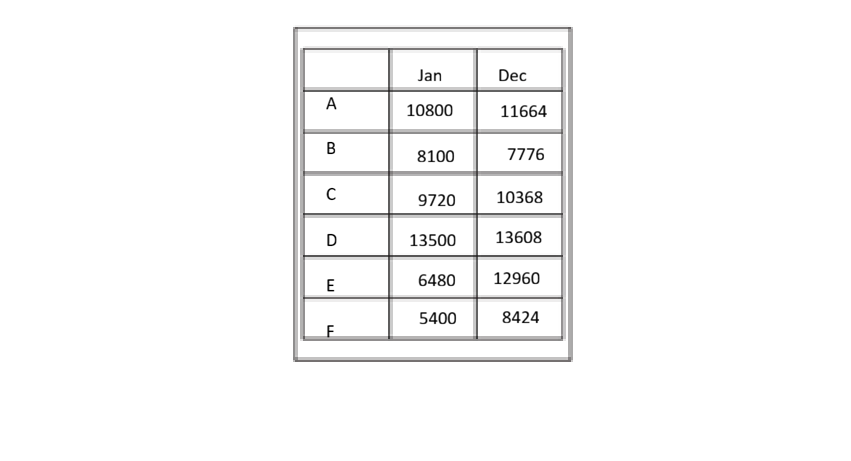
The item on which there is 4% decrease in December as compared to January is B.
Study the given pie charts and answer the question that follows.

Number of employees Number of male employees
in office C = 288 in office E = 224
The pie charts show the distribution of total number of employees and the total number of male employees of a company working in its six offices A, B, C, D, E and F
If 25% of the male employees in offices A are transferred to office C and 35% of female
employees in D are transferred to office E, then the number of female employees in E
as a percentage of the number of male employees in C is approximately equal to:
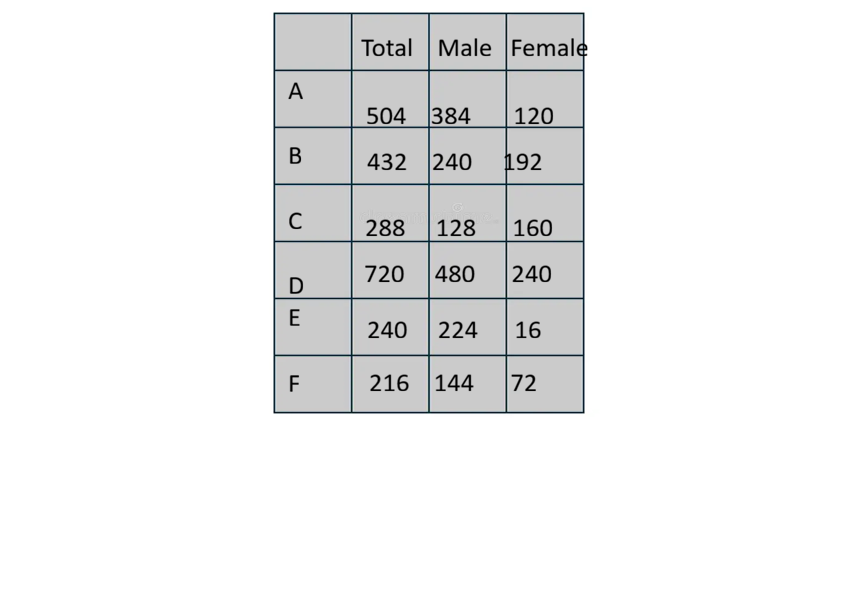
If 25% of the male employees in offices A are transferred to office C, then the number of male employees in Office C are 128 + 25% of 384 = 224.
And, if 35% of female employees in D are transferred to office E, then the number of female employees in E are 16 + 35% of 240 = 100.
The required percentage = $$\frac{100}{224}\times\ 100\approx\ 44.6\%$$
What is the ratio of the total number of male employees in offices C and F to the
number of employees in office B?
Male employees in Office E = $$\frac{50.4}{360}\times\ Total$$.
This gives the total number of male employees = 1600.
Total male employees in offices C and F = $$\frac{28.8+32.4}{360}\times\ 1600\ =\ 272$$.
Total employees in Office C = $$\frac{43.2}{360}\times\ Total$$.
This gives the Total number of employees = 2400.
Total employees in Office B = $$\frac{64.8}{360}\times\ 2400\ =\ 432.$$
The required ratio = 272:432 = 17:27.
The number of female employees as a percentage of male employees is second lowest
in office:
Using the table,
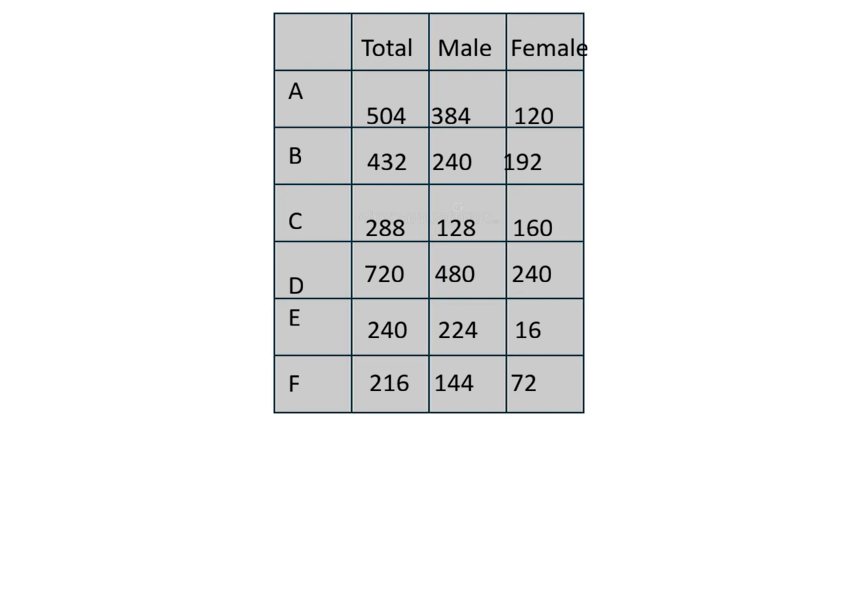
the number of female employees as a percentage for male employees is: 31.25%, 80%, 125%, 50%, 7.14% and 50% for the offices A, B, C, D, E and F respectively.
The number of female employees as a percentage of male employees is second lowest in office A.
The average number of male employees in offices A, D and F is what per cent more
than the total number of female employees in offices B, E and F?
Number of male employees in E = $$\frac{50.4}{360}\times\ Total\ Male$$ i.e. 224.
This gives the number of Total male employees = 1600.
And Total employees in C = $$\frac{43.2}{360}\times\ Total$$ i.e. 288.
This gives the Total number of Employees = 2400.
Using these values, we can calculate Total number of Employees and Total number of Female employees for all the offices.
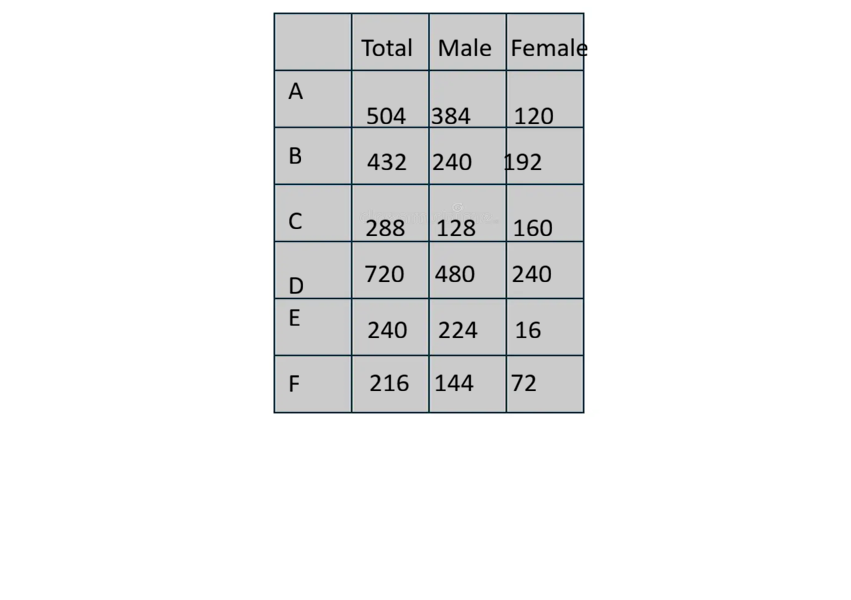
average number of male employees in offices A, D and F = 336 and the total number of female employees in offices B, E and F are 280.
The required percentage = $$\frac{336-280}{280}\times\ 100\ =\ 20\%$$.
Study the given bar graph and answer the questions that follows.

What is the ratio of the total production of rice in 2016 and 2018 to the total production
of maize in 2015 and 2019?
Total Production of Rice in 2016 and 2018 = 320 + 280 = 600.
Total Production of Maize in 2015 and 2019 = 250 + 500 = 750.
The required ratio = 600:750 = 4:5.
In which year was the increase in the production of maize the second largest as
compared to its preceding year?
Increase in maize production = $$\frac{Current\ -\ \Pr evious}{\Pr evious}\times\ 100$$.
Increase in Production in the following years are:
2016 = 20%,
2017 = 26.66%,
2018 = 5.26%,
2019 = 25%.
The 2nd highest increase is in year 2019.
The average production of wheat (per year) in 2015, 2017 and 2019 is what per cent
less than the production of maize in 2018?
Production of Wheat in 2015, 2017 and 2019 is 240, 330 and 360 respectively.
The average will be: $$\frac{240+330+360}{3}=310$$.
Production of Maize in2018 = 400.
The difference is 400 - 310 = 90.
The percentage by which the average is less than the Maize production = $$\frac{90}{400}\times\ 100\ =\ 22.5\%$$.
In 2020, the production of wheat increased over 2019 by the same percentage as in
2018 over its preceding year. If 16.5% of the production of wheat in 2020 was exported,
then the amount of wheat left for domestic consumption (in lakh tonnes) was
approximately:
Percentage by which wheat production increased in 2018 over 2017 = $$\frac{400-330}{330}\times\ 100\ =\ 21.21\%$$.
Production in 2020 = (1 + 21.21%)*Production in 2019 = 1.2121*360 = 436.36.
16.5% of this production is exported which means that 83.5% was left for domestic use i.e. 0.835*436.36 = 364.36 $$\approx\ $$ 364.4
Study given information and answer the questions that follows.
Companies X and Y, both produce all the five products A, B, C, D and E. The total units of all these products produced by X and Y together are 5500 and company Y produces 20% more units than company X. Out of the total units of the products produced by company Y, 12% are of the product B and company X produces 30% more units of B than Y. The ratio of the units of product A produced by companies X and Y is 5 : 6 and total number of units of A is 990. The number of units of product D produced by company X is 650 and company Y produces 40% more of it. The company X produces 550 units of C and company Y produces 55 more units of it. The units of the products left with companies X and Y are of product E.
The number of units of product C produced by company Y is what per cent of the total
number of units of product B and E produced by company X (correct to one decimal place)?
The following points are given in the question.
i)The total units of all these products produced by X and Y together are 5500, and company Y produces 20% more units than company X.
Let x be the number of products from company X. Then the number of products from company Y will be x+$$\frac{20}{100}$$ = 1.2x
x+1.2x=2.2x=5500
$$\Rightarrow$$ x =2500
The number of products from company x is 2500, and that from y is 1.2*2500=3000
ii) Out of the total units of the products produced by company Y, 12% are of product B, and company X produces 30% more units of B than Y.
Given that 12% of Y products are B.
12% of 3000 = 360. Company Y produces 360 products of type B.
company X produces 30% more units of B than Y.
Company X produces 468 products of type B.
iii) The ratio of the units of product A produced by companies X and Y is 5: 6, and the total number of units of A is 990.
Let's say the constant proportionality of the given ratio is k. 5k+6k = 11k = 990.
$$\Rightarrow$$ k = 90
Company X produces 450 products of type A, and Company Y produces 540 products of type A.
iv) The number of units of product D produced by company X is 650, and company Y produces 40% more of it.
The number of units of product D produced by company X is 650.
Company Y produces 40% more than company X. That will be 910.
v) company X produces 550 units of C, and Company Y produces 55 more.
Company X produces 550 units of C. And Company Y produces 605(55 more).
vi) The units of the products left with companies X and Y are of product E.
The product left for company X is 382, and that for company Y is 585.

The number of units of product C produced by company Y is 605.
The number of units of product B and E produced by company X is 468+382 = 850
605 is what percent of 850?
$$\frac{605}{850}$$*100 = 71.2
What is the ratio of the number of units of product B produced by company X to the
number of units of product E produced by company Y?
The following points are given in the question.
i)The total units of all these products produced by X and Y together are 5500, and company Y produces 20% more units than company X.
Let x be the number of products from company X. Then the number of products from company Y will be x+$$\frac{20}{100}$$ = 1.2x
x+1.2x=2.2x=5500
$$\Rightarrow$$ x =2500
The number of products from company x is 2500, and that from y is 1.2*2500=3000
ii) Out of the total units of the products produced by company Y, 12% are of product B, and company X produces 30% more units of B than Y.
Given that 12% of Y products are B.
12% of 3000 = 360. Company Y produces 360 products of type B.
company X produces 30% more units of B than Y.
Company X produces 468 products of type B.
iii) The ratio of the units of product A produced by companies X and Y is 5: 6, and the total number of units of A is 990.
Let's say the constant proportionality of the given ratio is k. 5k+6k = 11k = 990.
$$\Rightarrow$$ k = 90
Company X produces 450 products of type A, and Company Y produces 540 products of type A.
iv) The number of units of product D produced by company X is 650, and company Y produces 40% more of it.
The number of units of product D produced by company X is 650.
Company Y produces 40% more than company X. That will be 910.
v) company X produces 550 units of C, and Company Y produces 55 more.
Company X produces 550 units of C. And Company Y produces 605(55 more).
vi) The units of the products left with companies X and Y are of product E.
The product left for company X is 382, and that for company Y is 585.
The number of units of product B produced by company X is 468.
The number of units of product E produced by company Y is 585.
The ratio is 468:585 = 4:5
The different between the number of units of product A produced by company X and 40% of the number of units of products D produced by company Y is k. The value k lies between.
The following points are given in the question.
i)The total units of all these products produced by X and Y together are 5500, and company Y produces 20% more units than company X.
Let x be the number of products from company X. Then the number of products from company Y will be x+$$\frac{20}{100}$$ = 1.2x
x+1.2x=2.2x=5500
$$\Rightarrow$$ x =2500
The number of products from company x is 2500, and that from y is 1.2*2500=3000
ii) Out of the total units of the products produced by company Y, 12% are of product B, and company X produces 30% more units of B than Y.
Given that 12% of Y products are B.
12% of 3000 = 360. Company Y produces 360 products of type B.
company X produces 30% more units of B than Y.
Company X produces 468 products of type B.
iii) The ratio of the units of product A produced by companies X and Y is 5: 6, and the total number of units of A is 990.
Let's say the constant proportionality of the given ratio is k. 5k+6k = 11k = 990.
$$\Rightarrow$$ k = 90
Company X produces 450 products of type A, and Company Y produces 540 products of type A.
iv) The number of units of product D produced by company X is 650, and company Y produces 40% more of it.
The number of units of product D produced by company X is 650.
Company Y produces 40% more than company X. That will be 910.
v) company X produces 550 units of C, and Company Y produces 55 more.
Company X produces 550 units of C. And Company Y produces 605(55 more).
vi) The units of the products left with companies X and Y are of product E.
The product left for company X is 382, and that for company Y is 585.
The number of units of product A produced by company X is 450.
40% of the number of units of products D produced by company Y is $$\frac{40}{100}$$*910 = 364
450 - 364 = 86
So, k is 86.
The average number of units of products A, B and E produced by company Y is what
percentage less than the average number of units of products C and D produced by
company X?
The following points are given in the question.
i)The total units of all these products produced by X and Y together are 5500, and company Y produces 20% more units than company X.
Let x be the number of products from company X. Then the number of products from company Y will be x+$$\frac{20}{100}$$ = 1.2x
x+1.2x=2.2x=5500
$$\Rightarrow$$ x =2500
The number of products from company x is 2500, and that from y is 1.2*2500=3000
ii) Out of the total units of the products produced by company Y, 12% are of product B, and company X produces 30% more units of B than Y.
Given that 12% of Y products are B.
12% of 3000 = 360. Company Y produces 360 products of type B.
company X produces 30% more units of B than Y.
Company X produces 468 products of type B.
iii) The ratio of the units of product A produced by companies X and Y is 5: 6, and the total number of units of A is 990.
Let's say the constant proportionality of the given ratio is k. 5k+6k = 11k = 990.
$$\Rightarrow$$ k = 90
Company X produces 450 products of type A, and Company Y produces 540 products of type A.
iv) The number of units of product D produced by company X is 650, and company Y produces 40% more of it.
The number of units of product D produced by company X is 650.
Company Y produces 40% more than company X. That will be 910.
v) company X produces 550 units of C, and Company Y produces 55 more.
Company X produces 550 units of C. And Company Y produces 605(55 more).
vi) The units of the products left with companies X and Y are of product E.
The product left for company X is 382, and that for company Y is 585.
The average number of units of products A, B and E produced by company Y is $$\frac{(540+360+585)}{3}$$ = 495
The average number of units of products C and D produced by company X is $$\frac{(550+650)}{2}$$ = 600
The average number of units of products A, B and E produced by company Y is 105 less than the average number of units of products C and D produced by company X.
That is $$\frac{105}{600}$$*100 = 17.5%
Study the given bar graph and answer the questions that follows.

Profit(loss)= Income = Expenditure
Percentage profit(loss) = $$\frac{Profit(loss)\times 100}{Expenditure}$$
What is the ratio of the profit earned by the company in 2015 and 2017 together to the
loss incurred in 2016 and 2019 together?
Profit earned by the company in 2015 and 2017 together = (560 + 655) - (440 + 600) = 175 and,
loss incurred in 2016 and 2019 together = (560 + 500) - (400 + 450) = 210.
The required ratio = 175:210 = 5:6.
What is the percentage loss incurred by the company in 2016 and 2019 together
(correct to one decimal place)?
Income for 2016 and 2019 together = 400 + 450 = 850.
Expenditures for 2016 and 2019 together = 560 + 500 = 1060.
Loss incurred = 1060 - 850 = 210.
Loss% = $$\frac{210}{1060}\times\ 100=\frac{2100}{106}=\frac{1050}{53}=19.81\%$$.
What is the average profit (in ₹ crores) earned by the company in 2015, 2017, 2018 and
2020 together?
Profit = Income - Expenditures.
This gives the profit as 120, 55, 175 and 125 for years 2015, 2017, 2018 and 2020 respectively.
The average profits = $$\frac{120+55+175+125}{4}=118.75$$.
If the ratio of expenditures of the company 2018 and 2021 was 7 : 11 and the company
earns a profit of 18% in 2021, then what was the income (in ₹ crore) of the company in
2021?
Let us assume the expenditures in 2021 = X.
Now, 525 : X = 7:11. This gives X = 825.
Profit Percentage in 2021 = 18%.
The income for 2021 will be 1.18*825 = 973.5.
Study the given bar graph and answer the questions that follows.

Profit percent = $$\frac{Income - Expenditure}{Expenditure} \times 100$$
If the expenditures of companies A and B in 2019 were equal and the total income of
both companies was ₹354 crores, then what was the total expenditure (in ₹ crores) of A
and B in that year?
It is given in the question that Profit percent = $$\frac{Income - Expenditure}{Expenditure} \times 100$$.
That means profit is calculated as a percent of expenditure.
Income = Expenditure + $$\frac{profit percent * Expenditure}{100}$$
Let 'e' be the expenditure company A in 2019.
The profit percentage of company A is 55, and B's is 40.
The income of company A in 2019 = Expenditure + $$\frac{profit percent * Expenditure}{100}$$ = e+$$\frac{55 * e}{100}$$=1.55e
The income of company B in 2019 = Expenditure + $$\frac{profit percent * Expenditure}{100}$$ = e+$$\frac{40 * e}{100}$$=1.4e
The total income of companies A and B in 2019 is 1.55e+1.4e = 2.95e.
Given that the total income of both companies was ₹354 crores.
So, 2.95e = 354
$$\Rightarrow$$ e = 120.
Then the total expenditure (in ₹ crores) of A and B in 2019 is 2e = 2*120=240
If the incomes of company B in 2016 and 2020 were equal and the expenditure in 2016
was ₹240 crores, then what was the expenditure (in ₹ crores) in 2020?
It is given in the question that Profit percent = $$\frac{Income - Expenditure}{Expenditure} \times 100$$.
That means profit is calculated as a percent of expenditure.
Income = Expenditure + $$\frac{profit percent * Expenditure}{100}$$
The question shows that the expenditure for company B in 2016 was ₹240 cr.
From the graph, the profit percent for company B in 2016 is 45.
Income for company B in 2016 = expenditure + $$\frac{profit percent * Expenditure}{100}$$ = 240+ $$\frac{45 * 240}{100}$$ = ₹348 cr.
The income for company B in 2020 is also equal to ₹348 cr.
From the graph, the profit percent for company B in 2020 is 60.
Let's assume the expenditure of company B in 2020 is e.
Income for company B in 2020 = expenditure + $$\frac{profit percent * Expenditure}$${100}
348 = e+$$\frac{60 * e}{100}$$ = 1.6e
e = $$\frac{348}{1.6}$$ = 217.5
If the expenditure of company A in 2018 and 2020 was the same, then what was the
ratio of the incomes of the company in 2018 and 2020, respectively?
Profit % = $$\frac{Income\ -\ Expenditures}{Expenditures}\times\ 100$$.
Profit % of A for 2018 and 2020 is 40 and 35 respectively.
We will assume the expenditure to be 1 and calculate Income for both years using the stated formula.
Incomes for 2018 and 2020 will be $$\frac{100}{140}\ and\ \frac{100}{135}$$ respectively.
Their ratio will be 28:27.
If the income of company B was ₹446.4 crores in 2017, then what was its expenditure
(in ₹ crores) in that year?
Profit percent for B in 2017 = 55% and Income = 446.6 crores.
55 = $$\frac{446.6-Expenditure}{Expenditure}\times\ 100$$.
This gives Expenditure $$\approx\ $$ 288 crores.
Study the given table and answer the questions that follows.

The table shows the number of students Appeared (A) and Passed (P) in a examination, from three schools X, Y and Z in five years.
The ratio of boys and girls passed from school Y in 2017 is 7 : 8 and that of boys and
girls passed from school X in 2019 is 12 : 13. The percentage of girls appeared from
school Z in 2020 is 80%. The total number of girls passed from schools X in 2019 and
from Y in 2017, is what per cent less than the number of girls appeared from school Z
in 2020 (correct to one decimal place)?
A total of 225 students passed from School Y in the year 2017.
We are given that among these students, the boys and girls are in the ratio of 7:8
This would give us the girls passing from school Y in 2017 to be $$\frac{225}{15}\times\ 8=120$$, and the boys passing from school Y in 2017 to be $$\frac{225}{15}\times\ 7=105$$
Next, we are given the ratio of boys and girls that passed from school X in the year 2019 as 12:13
The total number of students that passed from X in 2019 is 280; this would give us the number of boys and girls passing in that year to be $$\frac{275}{25}\times\ 12=132$$ and $$\frac{275}{25}\times\ 13=143$$ respectively.
The total number of girls passing from X and Y would be: 120+143 = 263
We are given that in 2020, 80% of the students who appeared were girls, giving us this value to be $$\frac{80}{100}\times\ 400=320$$
We are asked how many percentages is 263 less than 320; this value would be $$\frac{320-263}{320}\times\ 100=17.81\%$$
Therefore, Option C is the correct answer.
In which year was the difference between the number of students appeared and the
number of students passed the second lowest in school Z?
for this question, we only have to consider the data from School Z
We need to subtract the number of students who passed from the number of students who appeared for each year and see in which year is that value at the second lowest rank.
2016: 300-285 = 15
2017: 320-304 = 16
2018: 380-362 = 18
2019: 352-325 = 27
2020: 400-381 = 19
If we rank the years in the increasing order of their differences:
2016(15), 2017 (16), 2018 (18), 2020(19), 2019 (27)
We see that the year with the second-lowest difference is 2017
Therefore, Option A is the correct answer.
If m is the average of the number of students passed from school Y over all the five
years and n is the average of the number of students passed from all the three schools
in 2018, then m : n is equal to:
For this question, we would have to find the total number of students that passed from school Y
The number of students that passed from school Y: 175+225+254+280+276 = 1210
The average number of students that passed from Y would be 1210/5 = 242
The average number of students that passed from all three schools combined in 2018 would be $$\frac{242+254+362}{3}=\frac{858}{3} = 286$$
Giving us the ratio to be $$242:286$$
$$11:13$$
Therefore, Option A is the correct answer.
The total number of students appeared from school X in 2016, 2017 and 2019 is
approximately what per cent more than the total number of students passed from
school Y in 2018 and 2020?
The total number of students that appeared from school X in 2016, 2017 and 2019 are 250+275+300 = 825
The number of students that passed from School Y in 2018 and 2020 is 254+276= 530
The difference between the two is 825-530 = 295
We need to find the percentage of this value compared to the total number of students who passed from school Y in 2018 and 2020, giving the answer to be $$\frac{295}{530}\times\ 100\approx\ 55.66\%$$
This is closest to option D, which shows a value of 55.7%
Therefore, Option D is the correct answer.
If $$\left(x^2 + \frac{1}{x^2}\right) = 8.25$$, what is the value of $$\left(x^3 - \frac{1}{x^3}\right)?$$
Since $$\left(x^2 + \frac{1}{x^2}\right) = 8.25$$, we can rewrite the same as $$\left(x-\ \frac{\ 1}{x}\right)^2\ +\ 2x\times\ \ \frac{\ 1}{x}$$ = 8.25
This gives us $$\left(x-\ \frac{\ 1}{x}\right)^2$$ = 6.25
Or, $$\left(x-\ \frac{\ 1}{x}\right)$$ = 2.5
Now, $$\left(x\right)^3-\ \left(\frac{\ 1}{x}\right)^3$$ =
On substituting the values, we get the answer as 30.625
x varies inversely as $$(2y^2 - 5)$$ and is equal to 25 when y = 15. Find the value of x when y = 10 (approximate value).
Since x is inversely proportional to $$(2y^2 - 5)$$, we get the equation as x= $$\frac{k\ }{2y^2-5}$$ where k is the proportionality constant.
Now, x= 25 when y=15. Putting this in the above equation, we get the value of k as 11,125.
When y= 10, x = $$\frac{11125\ }{200-5}$$, which is approximately equal to 57.
What is the composite function $$(f o g)(x)$$, if
$$f(x) = x + 7$$,
$$g(x) = x^4 ?$$
g(x) = $$x^4$$
Now, fog(x) is $$x^4$$ + 7, which is Option C.
Anil climbs a staircase stage by stage. He climbs the first 10 steps at 10 a.m., 11 more steps at 12.00 p.m. and 20 more steps at 2.00 p.m. Find the total number of steps Anil has climbed.
The summation of 10 steps, 11 steps, and 20 steps is 41 steps.
What are coordinates of the point that divides the line segment joining the points (4, 4) and (8, 12) internally in the ratio of 3 : 5?
The section formula to find the point dividing the line is $$\ \frac{\ na+mb}{n+m}$$ where the ratio is n:m and the coordinates (x or y axis) are a and b.
Applying the same for x-coordinate: $$\ \frac{\ 44}{8}$$, which is equal 5.5
For y-coordinate: $$\ \frac{\ 56}{8}$$ which is 7.
Hence, the point is (5.5 , 7)
Seven different coloured lights are fixed on a mast to produce signals by illuminating them. How many signals can be produced, if any number of lights is used?
Since the different combinations (both selection and placement) would produce different signals, we need to consider each case.
Case 1: When only 1 light is used
Here, we need to select and arrange 1 light out of seven. It can be done in 7 ways. However, two produce signals, we need at least two lights. Hence, we shall discard this case.
Case 2: When 2 lights are used
This can be done by selecting two lights out of seven and then arranging them, which is $$7c_2\times\ 2!$$, which is 49 ways
Case 3: When 3 lights are used
This can be done by selecting three lights out of seven and then arranging them, which is $$7c_3\times\ 3!$$, which is 210 ways
Case 4: When 4 lights are used
This can be done by selecting four lights out of seven and then arranging them, which is $$7c_4\times\ 4!$$, which is 840 ways
Case 5: When 5 lights are used
This can be done by selecting five lights out of seven and then arranging them, which is $$7c_5\times\ 5!$$, which is 2520 ways
Case 6: When 6 lights are used
This can be done by selecting 6 lights out of seven and then arranging them, which is $$7c_6\times\ 6!$$, which is 5040 ways
Case 7: When 7 lights are used
This can be done by selecting 7 lights out of seven and then arranging them, which is $$7c_7\times\ 7!$$, which is 5040 ways
Adding Case 2 till Case 7, we get the answer as 13,699
In a coffee estate there are two varieties of coffee. At what ratio must the two varieties of coffee be mixed together into one at ₹40 per kg and the other at ₹50 per kg? The cost of the mixture is ₹43 per kg.
Let the ratio in which the two varieties are mixed be a:b
Hence, $$\ \frac{40a+50b}{a+b}$$ = 43
$$\ 40a+50b=43a+43b$$
This gives us 7b = 3a or a:b = 7:3
The option has an error; this happened in the actual exam paper, so we can't change it.
Find the missing term of the series
5050 , 7381, ? , 14365 , 19306.
If a water bill is paid before the due date, overall there is a reduction of 5% on the bill amount. A person paid the bill before the due date he got a reduction of ₹250. Find the amount of the water bill.
Since the reduction is ₹250, which is 5% of the total bill amount.
Hence, the total due amount is x, whose 5% is ₹250.
This gives us: 5% of x is ₹250, which makes x as 5% is ₹5,000
Two mixtures A and B contain petrol and kerosene. A has 40% of petrol and B has 60% of petrol. If 8 litres of A and 12 litres of B are mixed together, what will be the ratio of petrol and kerosene in the new mixture?
In 8 litres of A, the quantity of petrol (40% of the total quantity) is 3.2 litres and that of kerosene is 4.8 litres.
In 12 litres of B, the quantity of petrol (60% of the total quantity) is 7.2 litres and that of kersone 4.8 litres.
In the final mixture, the quantity of petrol becomes 10.4 litres and that of kerosene becomes 9.6 litres, making the ratio as 13:12.
If $$6^{15} + 6^{16} + 6^{17} + 6^{18}$$ is divided by 24, find the remainder of finite series.
$$6^{15} + 6^{16} + 6^{17} + 6^{18}$$
Let's take $$6^{15}$$ common from the whole.
We get $$6^{15}$$(1+$$6^{1}$$+$$6^{2}$$+$$6^{3}$$).
$$6^{15}$$ can be written as $$2^{15}$$*$$3^{15}$$.
24 can be written as $$2^{3}*3$$.
So, $$6^{15}$$ is divisible by 24. Hence, the remainder is zero.
All options are wrong in this P.Y.Q.
In a big drum there are three cubes of ice whose edges are 5 cm, 7 cm and 9 cm respectively. The ice cubes are melted and formed into a single cube. Find the edge of a new cube (approximate value).
The volume of a cube is $$s^3$$, where s is the edge measure.
Hence, the volume of the three cubes is: 125 cub.cm, 343 cub.cm, and 729 cub.cm
When melted, the total volume is 1,197 cub.cm.
To find the cube's edge with the volume of 1,197 cub.cm, we shall find the cube root of this number, which happens to be 10.62 cm (approximately).
$$\alpha$$ and $$\beta$$ are the roots of the equation $$ax^2 + bx + c = 0$$. What is the condition for which $$\beta = 5 \alpha$$ ?
Since $$\beta\ =\ 5\alpha\ \ $$, we can say that the product of roots ($$5\alpha\ ^2\ \ $$) = $$\ \frac{\ c}{a}$$ ............ (1)
and sum of roots ($$6\alpha\ $$) = $$\ \frac{\ -b}{a}$$ ................. (2)
Hence, $$\alpha\ $$ = $$\ \frac{\ -b}{6a}$$ ............. (3)
Substituting (3) in (1), we get $$5\times\ \ \frac{\ b^2}{a^2}$$ = $$\ \frac{\ c}{a}$$
or, $$5b^2 = 36 ac$$
While shifting glass bottles from one country to the other, on an average, 1 out of 9 bottles breaks. What is the probability that out of 4 bottles, at least 3 will arrive safely?
Probability of at least 3 bottles being safe = Probability of at least 3 bottles being safe + Probability of all 4 bottles being safe
To find Probability of all 4 bottles being safe, we also need to multiply the result with 4, since any of the four bottles can be damaged.
Also, probability of a bottle being damaged is $$\ \frac{\ 9}{10}$$
Hence, Probability of at least 3 bottles being safe = $$\ \ \left(\frac{\ 8}{9}\right)^4$$ + 4$$\ \times\ $$ $$\ \left(\frac{\ 8}{9}\right)^3\times\ \left(\ \frac{\ 1}{9}\right)$$
On solving this, we get the answer as $$\frac{\ 2048}{2187}$$
Consider that $$[p_n]$$ and $$[qn]$$ are two arithmetic progressions with 50 elements each. If $$[p_n]$$ has the elements $$a_1 = 4, a_2 = 6$$ and so on, and $$[qn]$$ has $$b_1 = 2, b_2 = 5$$ and so on, how many common elements do both $$[p_n]$$ and $$[qn]$$ have ?
The common difference of $$[p_n]$$ is 2, while that of $$[qn]$$ is 3.
The last term for $$[p_n]$$ will be 4 + 49$$\times\ $$2, which is 102
Similarly, the last term for $$[qn]$$ will be 2 + 49$$\times\ $$3, which is 149
Now, the first common term for these two series is 8. Further, the common difference for the series of common terms shall be the LCM (2,3), which is 6.
Hence, 8 + 6K < 102
Or, K < 15.666....
This means K can take the maximum value of 15 and minimum of 0. Hence, 16 terms are common to the two series.
Solve the inequality.
$$\frac{x + 1}{2x - 1} > 1$$
In this question, we need to assume two cases for the sign of the denominator because of the inequality.
Case 1: 2x-1 > 0, or x> $$\frac{\ 1}{2}$$
This makes x+1 > 2x-1, or x<2
Hence, the range is $$\frac{\ 1}{2}$$ < x < 2
Case 2: 2x-1 < 0, or x < $$\frac{\ 1}{2}$$
This makes x+1 < 2x-1, or x > $$\frac{\ 1}{2}$$
This case is inconsistent in nature. Hence, the answer is $$\frac{\ 1}{2}$$ < x < 2
In $$\triangle ABC, BO$$ and $$CO$$ are the bisectors of the $$\angle ABC$$ and $$\angle ACB$$. If the measure of $$\angle A = 54^\circ$$, what is the measure of $$\angle BOC$$

$$\angle A$$+$$\angle B$$+$$\angle C$$ = 180
Or, $$\angle B$$+$$\angle C$$ = 126
Now, the angle bisectors divide $$\angle B$$ and $$\angle C$$ into half, hence their sum is 63
Now, in $$\triangle BOC$$, we 63+$$\angle BOC$$ = 180, or $$\angle BOC$$ = $$117^\circ$$
Avinash invested ₹6,400 in three business at 3%, 5% and 7% per year with simple interest. At the end of the year, he received the same amount from three business. The money invested at 3% is ( up to two decimals):
=> Avinash invested ₹6,400 in three business at 3%, 5% and 7% per year with simple interest.
Simple interest formula is $$SI\ =\ \frac{PRT}{100}$$
Where P is principal, R is rate of interest and T is time duration in years
Here, Let us assume the amount invested in three businesses is P1, P2 and P3.
Therefore, the interest after 1 year because of simple interest will be 3P1/100 , 5P2/100 and 7P3/100
These are equal, Hence
=> 3P1 = 5P2 = 7P3
It is also known that total investment done in three business is equal to 6400
P1 + P2 + P3 = 6400
Substituting values of P2 and P3 in terms of P1
P1+3P1/5 + 3P1/7 = 6400
We need to calculate the value of P1
(35+21+15)P1/35 = 6400
=> 71P1/35 =6400
=> P1 is approximately 3200 (Option B is correct answer)
If $$(21^{13} + 29^{13})$$ is divided by 25, then what is the remainder?
To divide $$(21^{13} + 29^{13})$$ by 25, we shall divide 21 and 29 individually by 25.
By doing so, we get the remainder as $$(4^{13} + (-4)^{13})$$, which is 0.
Find the sum of infinity of the series
$$\frac{1}{5} + \frac{3}{5^2} + \frac{1}{5^3} + \frac{3}{5^4} + .....$$
First, we shall consider the series as a summation if two infinite series:
S1: $$\ \ \frac{\ 1}{5}\ +\ \ \frac{\ 1}{25}+\ ......$$
S2: $$\ \ \frac{\ 3}{25}\ +\ \ \frac{\ 3}{625}+\ ......$$
Taking S1: The sum of series shall be $$\ \ \frac{\ a}{1-r}\ $$, hence $$\ \ \frac{\ \ \frac{\ 1}{5}}{1-\ \frac{\ 1}{25}}\ $$, which is $$\ \frac{\ 25}{120}$$
Taking S2: The sum of series shall be $$\ \ \frac{\ a}{1-r}\ $$, hence $$\ \frac{\ \ \frac{\ 3}{25}}{1-\ \frac{\ 1}{25}}$$, which is $$\ \frac{\ 1}{8}$$
Adding S1 and S2, we get the answer as $$\ \frac{\ 1}{3}$$
If the resulting numbers be the consecutive terms of Harmonic Progression, then what number should be added to the numbers 8, 10, 14?
Let the number subtracted be x. Hence, the terms are 8-x, 10-x, and 14-x.
10-x = $$\ \frac{\ 2\left(8-x\right)\left(14-x\right)}{8-x+14-x}$$
On cross multiplying, we get x as -2.
The population of Kompally village is 10,000. The population increases by 10% in the first year and 15% in the second year. Due to increase in pollution the population decreases by 5% in the third year. What will be its population after 3 years (round off number)?
The population after 3 years will be: 10,000 $$\times\ 1.1\times\ 1.15\times\ 0.95$$, which is equal to 12,018 (approximately).
What is the value of x in the following equation?
$$3 \log \frac{3}{5} - \log \frac{x}{21} + 2 \log \frac{25}{9} = 0$$
The above expression can be simplified as $$\log\ \ \frac{\ 27}{125}\times\ \ \frac{\ 21}{x}\times\ \ \frac{\ 625}{81}$$ = 0
On solving the same, we get $$\log\ \ \frac{\ 35}{x}=\ 0$$, for which x shall be 35, making $$\log1=\ 0$$
In a cricket stadium, the people are made to sit to watch the match. If the organisers make a row of 15 people each, there will be 10 people left. If they make rows of 20 people each then there will be 15 people left and if they make rows of 24 people each, 19 people will be left. If they make rows of 28 people each there will be 23 people left. Find the minimum number of people present in the stadium.
Let the total number of people be X.
1) When X is divided by 15, we get a remainder of 10. Hence, X = 15a + 10
2) When X is divided by 20, we get a remainder of 15. Hence, X = 20b + 15
3) When X is divided by 24, we get a remainder of 19. Hence, X = 24c + 19
4) When X is divided by 28, we get a remainder of 23. Hence, X = 28d + 23
This is a classic case when the difference between the divisor and remainder is the same, which is 5 in this case. In such instances, the number is expressed as (LCM of the divisors)$$\times$$K - (difference between the divisors and remainders).
Hence, the number of people shall be 840k - 5.
The minimum number is when k=1, hence the minimum number shall be 835.
The ratio of the number of sides of two regular polygons is 2 : 3 and the ratio of the sum of their interior angles is 5 : 8. What is the number of sides of the first polygon and the measure of the interior angle (in degrees) of the second polygon, respectively?
Let the sides of the polygons be 2x and 3x.
Hence, the ratio of the sum of interior angles for the two polygons is: $$\ \frac{\ \left(2x-2\right)\times\ 180}{\left(3x-2\right)\times\ 180}$$ = $$\ \frac{\ 5}{8}$$
On solving this, x=6
This increases the number of sides in the first polygon to 12 and 18 for the second one.
To find the measure of each interior angle of the second polygon, we get $$\ \frac{\ \left(18-2\right)\times\ 180}{18}$$, which is 160 degrees.
The GST on groceries is reduced by 20% and its consumption increases by 15% . Find the percentage of effect on revenue.
Revenue is the product of spending and consumption. Hence, this is a case of successive percentage change.
The multiplying factor of reduction of 20% is 0.8, while that of increase by 15% is 1.15.
Assuming the initial revenue be X, we get the new revenue as X$$\times\ 1.15\times\ 0.80$$, which 0.92X.
This means there is a reduction of 8% in the revenue.
A spherical disc of radius 5 cm is placed on a horizontal surface against a vertical wall as given.

Another small disc is placed in the gap between the right angle and the disc such that the horizontal surface, vertical wall, the larger disc, and the smaller disc touch each other. What is the radius (in cm) of the smaller disc ?
The radius of the bigger circle is 5 cm while of the smaller circle is r cm.
Since the two sides of the wall are tangential to the circles, we get a square formed by the radius of the bigger circle and the two sides wall, each with the length of 5 cm.
Now, the diagonal of this square (s1) shall be $$5\sqrt{\ 2}$$.
Focusing on the smaller circle, on which the wall is tangential again. We get a square here as well, the diagonal of which is $$r\sqrt{\ 2}$$.
Hence, the diagonal of s1: $$5\sqrt{\ 2}$$ = r + $$r\sqrt{\ 2}$$ + 5
On solving this, we get r = $$15 - 10sqrt{\ 2}$$
The remainder is 20, when a number is divided by a divisor. If the remainder is 7 when thrice the original number is divided by the same divisor, find the value of the divisor.
Let us assume the number be 'x'.
Also, let us assume that the divisor is 'n'
Hence, x = n(a) + 20, where 'a' is the quotient ............ (1)
Also, 3x = n(b) + 7, where 'b' is the quotient ................(2)
Dividing (2) by (1), we get n (b-3a) = 53
Now, 53 is a prime number, and it can be broken into 53$$\times$$1.
Further, it is clear that the divisor cannot be 1, hence n = 53
ABCDE is a pentagon. There are 5 paths connecting A and B, 4 paths connecting B and C, 6 paths connecting C and D, 5 paths linking D and E, 3 paths connecting E and A. Also, 3 paths joining A and C. If an ant starting from A is always heading towards point C, how many different valid routes can it take?
In this scenario, the ant has three options:
1) Go to C directly from A, for which it has 3 paths.
2) Use the path A-B-C, for which it has 5$$\times\ $$4, which is 20 paths.
3) Use the path A-E-D-C, for which it has 3$$\times\ $$5$$\times\ $$6, or 90 paths.
Adding the above numbers, we get 113 as the total number of ways in which the ant can reach C from A.
Two-fifths of a number is five more than one-fifth of the number. Find the number.
Let the number be 5x.
As per the question, 2x = x+5, or x = 5.
Hence, 5x = 25
The average height of 30 students of a class is 165 cm. 5 new students with average height 172 cm join the class. What is the new average (in cm) of the class?
The total sum of heights of 30 students was 30 $$\times$$ 165, which is 4950 cm.
Now, 5 students with an average height of 172 cm joined the class, which makes the total height as 860+4950= 5810 cm.
The average height of the 35 students now will be $$\ \frac{\ 5810}{35}$$ = 166 cm.
What is the sum of the vertex angles (in $$^\circ$$) of a nine-pointed star?
In any star-shaped figure, the sum of vertex angles is 180$$\times\ $$(n-4), where n is the number of vertices.
Hence, in this case, it has to be 180$$\times\ $$(5), which is 900$$^\circ$$
The present value of an ATM machine is ₹55,000. The value of the machine depreciates at the rate of 25% every year. What will be the value of the machine after two years?
The multiplying factor for a decrease of 25% is 0.75
Hence, the value of the ATM machine after two years shall be 55,000$$\times0.75\times\ 0.75$$, which is 30,937.5
A large container having three different vessels contains 780 , 690 and 950 litres of oil and petrol, respectively. Find the largest measure among all three vessels.
In this question, we shall find the HCF of the three numbers 780, 690, and 950, which shall match with the options.
It is clear that 10 shall be the answer, which can used to measure all the three different volumes.
The garph of $$f(x) = x^2 - 5x + 6$$ is translated 2 units left and 12 units down to get h$$(x)$$. Express h$$(x)$$ in the form $$h(x) = ax^2 + bx + c$$.
When f(x) is shifted 2 units to left, it becomes f(x+2). Now, 12 units downwards would mean f(x+2) - 12
Hence, the new equations h(x) is $$\left(x+2\right)^2-5\left(x+2\right)\ +\ 6\ -12$$, which is $$x^2 - x - 12$$
What is the domain and the vertical asymptote (VA), respectively, of $$f(x) = \log_{5}(x-4)-4, x > 0$$?
For $$f(x) = \log_{5}(x-4)-4, x > 0$$ to be valid, (x-4) has to be greater than 0. Hence, x > 4
Now, the VA is a line that guides the graph (above which the graph is valid and below which it becomes invalid). Hence, it has to be the line x=4, as x>4 for the graph to be valid.
Two straight parallel lines are cut by a transversal, such that, the measures of two co-interior angles are $$\frac{3x}{4}$$ and $$\left(\frac{5x}{4} - 20 \right)$$. What are the values of the measures of the two angles (in $$^\circ$$), respectively?
The sum of two co-interior angles in the same side shall add up to 180$$^\circ$$.
Hence, $$\frac{3x}{4}$$+$$\left(\frac{5x}{4} - 20 \right)$$ = 180
Or 8x = 800, making x = 100
Hence, $$\frac{3x}{4}$$ = 75 and $$\left(\frac{5x}{4} - 20 \right)$$ = 105
The length of the major axis is 12 cm and that of the minor axis is 2.8 cm. What is the area (in $$cm^2$$) of the ellipse?
Area of ellipse is: $$\pi\ ab$$, where a and b are the half of the length of major and minor axis.
Substituting a with 6 and b with 1.4 ($$\pi$$ being 3.14), we get the area as 26.4 approximately.
If $$(x^2 - x - 6)$$ is a factor of $$x^4 + ax^3 - x^2 - bx - 12 = 0$$, what are the values of constants a and b, respectively, in the above equation ?
$$(x^2 - x - 6)$$ is a factor of the fourth degree equation. Hence, the roots of $$(x^2 - x - 6)$$ (3 and -2) will satisfy the fourth degree equation.
Putting x=3 in $$x^4 + ax^3 - x^2 - bx - 12 = 0$$, we get 81+27a-9-3b-12=0, or 27a-3b= -60..............(1)
Putting x= -2 in the equation, we get 16-8a-4+2b-12=0, or 8a-2b=0............ (2)
Solving the two, we get a as -4 and b as -16
A train overtakes two persons walking along a railway bridge. The first one walks at 4 km/h and the other one walks at 6 km/h. The train needs 4.2 and 4.8 seconds, respectively, to overtake them. What is the speed of the train, if both the persons are walking in the same direction?
Let the speed of the train be x km/h.
The resultant speed of the train with respect to the first person shall be (x-4) km/h, and that for the second person is (x-6) km/h.
In 4.2 seconds, the train overtakes the first person. Hence, the distance between them is $$\frac{\ 4.2}{3600}\times\ \left(x-4\right)$$
In 4.8 seconds, the train overtakes the first person. Hence, the distance between them is $$\frac{\ 4.8}{3600}\times\ \left(x-6\right)$$
These two values are equal. From this, we get x= 20 km/h.
Read the given passage and answer the question that follows.
Access to material wealth does not necessarily mean that one country is out of poverty. A strong economy in a developed nation doesn’t mean much when a significant percentage (even a majority) of the population is struggling to survive.
Which of the following options most logically completes the argument?
True riddance from poverty means:
The passage discusses how the presence of wealth in a country does not necessarily mean the country is out of poverty. The author's argument is that having a strong economy is meaningless if a significant portion of the population is struggling to survive.
Therefore, Option A is the correct answer.
A train crosses a bridge in 30 seconds at the speed of 72 km/h. If the length of train is 250 m, then what is the length of the bridge?
Converting the speed of the train from km/hr into m/s, we get $$72\times\ \frac{5}{18}=20$$ m/s
To completely cross the bridge, the train end would have entered from one end, and the end of the train would have to come out, which, we are given, makes 30 seconds.
The total distance covered by the engine of the train int his distance would be the train's length and bridge's length.
$$20\times\ 30=250+$$ Bridge length
Bridge length $$=600-250=350$$ m
Therefore, option B is the correct answer.
Read the given information carefully and answer the questions that follow.
The children of Shyam colony are selecting a team to play a cricket match with Vasant colony. Varun is captain of the team of Shyam colony. He wants his team to have two batsmen, two bowlers and two wicketkeepers. Among the players Rohan, Raveena, Sonal and Animesh are batsmen Brijesh, Cynthia and Manish are bowlers. Similarly, Ruby, Bhuvan, Tiya and Yash are wicketkeepers.
Some of the other conditions are as follows:
i) Ruby and Yash will always be selected together.
ii) If Sonal is selected, then neither Manish nor Bhuvan can be selected.
iii) If Raveena is selected, then Bhuvan is definitely selected.
iv) Tiya and Yash can never be selected together.
Which of the following is a possible combination of a team?
In such questions, instead of writing down all the possible team combinations, we should consider each option individually and see which option does not break any rule and is a valid team composition.
looking at the options,
We can eliminate option B on the basis of rule 1 itself.
Rule 1 says that Ruby and Yash will always be selected together. In option B, we have Yash but not Ruby, so this configuration would not be possible.
We can eliminate option C on the basis of breaking rule 2.
Rule 2 says that if Sonal is selected, neither Manish nor Bhuvan can be selected, yet in option C, we have Sonal and Bhuvan on the same team.
We can eliminate option A on the basis of breaking rule 3.
Rule 3 states that if Raveena is selected, Bhuvan is definitely selected, but in option A, Raveena is selected, and Bhuvan is not selected.
That leaves us with only option D, which would be our answer.
Read the given statement and conclusions carefully. Assuming that the information given in the statement is true, even if it appears to be at variance with commonly known facts, decide which of the given conclusions logically follow(s) from the statement.
Statement:
Many countries around the globe have either put a ban on the plastic bag or levi tax on it. However, the problem hasn’t been solved completely because the implementation of these measures hasn’t been as successful.
Conclusions:
I. Plastic bags are illegal to use or sell in many countries.
II. The authorities are not strict enough to impose the ban on plastic bags completely.
The main statement talks about ban/tax on plastic bags and measures not being implemented properly.
Hence, we can safely say that plastic bags are illegal to use at certain places as they are banned in some countries. This makes 1 a valid conclusion.
Further, the lack of implementation of measures show that authorities are not strict enough. This makes 2 a valid conclusion.
Read the given statements and conclusions carefully. Assuming that the information given in the statements is true, even if it appears to be at variance with commonly known facts, decide which of the given conclusions logically follow(s) from the statements.
Statements:
a) All parrots are sparrows.
b) Some eagles are vultures.
c) All vultures are sparrows.
Conclusions:
I. All vultures are parrots.
II. Some parrots are eagles.
III. Only some vultures are sparrows.
The information in the statements can be represent as follows:

Coming to conclusions:
(1) As we can see, there might be some vultures that are not parrots. Therefore, conclusion 1 is not necessarily true.
(2) "Some parrots are eagles." Although in the diagram, there is an overlapping region between Parrots and Eagles, the region can be empty as well. Therefore, we cannot conclusively say that some parrots are eagles.
(3) This conclusion directly goes against statement c which said that all vultures are sparrows, therefore, this too can be concluded.
None of the conclusions can be reached from the statements.
Therefore, option A is the correct answer.

Select the number from among the given options that can replace the question mark(?) and complete the pattern.
Multiplying the opposite numbers in the first diagram we get $$5\times\ 2=10\ \&\ 6\times\ 3=18$$
Adding them, we get the number in between, which is 28
Multiplying the opposite numbers in the second figure, we get $$4\times\ 4=16\ \&\ 3\times\ 8=24$$
Adding them, we get the number in between, which is 40
Similarly, for the third figure, by multiplying the opposite numbers, we get $$6\times\ 4\ =24\ \&\ 6\times\ 5=30$$
Addin them, we should get the number which should come in between, which is 54
Therefore, Option A is the correct answer.
Select the number that will come next in the following series.
113, 117, 126, 151, 200, ?
The difference between the first two numbers is 117-113 = 4
The difference between the third and the second number is 126-117=9
The difference between the fourth and the third number is 151-126=25
The difference between the fifth and the fourth number is 200-151=49
We can see that all the differences are squares of the prime numbers.
The next difference would be the square of the next prime number, $$11^2=121$$
making the sixth number of the series to be 200+121 = 321
Therefore, Option C is the correct answer.
Ishaan is standing at a bus stop facing the East. From there he turns right and starts walking for 30 m. Then he turns left and walks 10 m. He again turns left and walk 15 m. What is the shortest distance (approximate) between Ishaan and the starting point?
Ishan was initially facing east, so when he turned right, he faced south.
Then he walked 30 m south.
The then turned left, facing east, walked 10 m east.
He then finally turned left again, facing north and walked 15m
In essence, he walked 30 m south and 15 m not, making him move 15 m southwards.
And he moved 10 m eastwards.

Givng his net distance from his starting position to be $$\sqrt{\ 225-100}=\sqrt{\ 125}$$, which is slightly more than 11m
Read the given information carefully and answer the questions that follow.
The children of Shyam colony are selecting a team to play a cricket match with Vasant colony. Varun is captain of the team of Shyam colony. He wants his team to have two batsmen, two bowlers and two wicketkeepers. Among the players Rohan, Raveena, Sonal and Animesh are batsmen Brijesh, Cynthia and Manish are bowlers. Similarly, Ruby, Bhuvan, Tiya and Yash are wicketkeepers.
Some of the other conditions are as follows:
i) Ruby and Yash will always be selected together.
ii) If Sonal is selected, then neither Manish nor Bhuvan can be selected.
iii) If Raveena is selected, then Bhuvan is definitely selected.
iv) Tiya and Yash can never be selected together.
If Raveena is selected, then who among the following will definitely NOT be selected?
From statement III in the question, if Raveena is selected, then Bhuvan has to be definitely selected. Given that Raveena is selected, we can say that Bhuvan is also selected.
From statement II, we can see that Sonal can be selected only when none of Manish and Bhuvan are chosen.
We know that Bhuvan is selected. So, Sonal can't be chosen.
If it was Wednesday on 1 January 2007, then what was the day of the week on 1 January 2011?
The number of days in between 1 January 2011 and 1 January 2007 is 1461.
1461%7 = 5. So, if 1 January 2007 is Wednesday then 1 January 2011 is Monday(5 days after Wednesday).
Three persons Shruti, Vihaan and Vishi gave the following statements about Anu's sweater.
Shruti said, “She is either wearing red or green.”
Vihaan said, “She is wearing red.”
Vishi said, “She is neither wearing red nor green.”
Of these three, only one person is wrong.
Which colour sweater is Anu wearing?
Vishi's statement contradicts Shruti's and Vihan's statements, so only Vishi's statement can be false.
This means Vihan's statement, "She is wearing red," is true. So, Anu's dress is red.
Select the option that is true regarding the following two statements labelled Assertion (A) and Reason (R).
A. A stable atom has the net charge of zero.
R. When the number of electrons does not equal the number of protons, the atom is ionized.
A talks about a stable atom having zero net charge. R talks about the ionization of atoms. Both statements are true, but A needs an explanation as to why a stable atom has a net charge of zero, which R doesn't.
Three materials paper, cloth and plastic are cut into three shapes circle, triangle and square but not necessarily in the same order. Also, they are painted red, pink and green but not necessarily in this order. The paper is green and the plastic is cut in a square but is not painted pink. The circle shaped material is painted pink.
What is the shape and colour of the cloth?
Paper is green.

Plastic is cut in a square but not pink. Only color left is red.
So. Plastic is cut in a square and colored red.

So, cloth is pink. The questions says that pink colored material is circle shaped.
So, cloth is pink and circled shaped. And paper is triamgle.

Select the option which represents the number of black colored items that are warm but NOT bedsheets.

There was an error in the question, even in the actual exam. We can't resolve it.
In an examination Roma was ranked $$8^{th}$$ from the top and Arjun was ranked $$9^{th}$$ from the bottom. In the next exam their rankings were interchanged, hence Arjun became $$28^{th}$$ from the bottom. How many total students were there, if equal number of students gave both the exams?
Roma was ranked $$8^{th}$$ from the top, and Arjun was ranked $$9^{th}$$ from the bottom. In the next exam, their rankings were interchanged. This means Arjun is ranked $$8^{th}$$ from the top and is also given as $$28^{th}$$ from the bottom. So, there are seven people ahead of Arjun and 27 below Arjun. The total number of students is 7+27+1(Arjun) = 35.
Select the option that is true regarding the following two statements labelled Assertion (A) and Reason (R).
A. A person who does hard work smartly gets the desired goals.
R. Only hard work is not enough to reach to your desired goals.
A states that hard work and doing the same smartly are important for achieving the desired goals. R elaborates upon the same and substantiates that only hard work is not sufficient to reach the goals. Hence, A and R are true with R being the correct explanation of A.
Harry is the husband of Eli and Sue is the sister of Christa's father and Fred is the father of Sue. Nichole is Eli's mother-in-law and Fred is the husband of Eli's husband's mother. Sue is the sister-in-law of Eli who is the only child of her parents. If Nichole has only two children, then how is Fred related to Christa?
Becca can complete a work in 12 days and Jason can complete the same work in 24 days. If they work together, then the work can be finished in how many days?
Let us take the LCM of 12 and 24, which is 24 (total work).
Hence, we can say that Becca does 2 units of work per day while Jason does 1 unit of work per day.
Together, they shall do 3 units of work per day.
To complete 24 units, they shall take 8 days.
Read the given statements and conclusions carefully. Assuming that the information given in the statements is true, even if it appears to be at variance with commonly known facts, decide which of the given conclusions logically follow(s) from the statements.
Statements:
(a) All curtains are sheets.
(b) Some sheets are shawls.
(c) Some covers are sheets.
Conclusions:
I. Some curtains are covers.
II. Some shawls are covers.
Statements:
(a) All curtains are sheets.
(b) Some sheets are shawls.
(c) Some covers are sheets.
The venn diagram of the information from above statements looks as

Conclusions I. Some curtains are covers.
From the diagram the statement some curtains are covers is not true.
Conclusions II. Some shawls are covers.
We can see in the diagram, that there is no intersection in the shawls and covers. So, conclusion II is also false.
Five students Leena, Poonam, Sarika, Afreen and Monisha are sitting in a row facing the North. Monisha is sitting between Sarika and Poonam. Afreen is sitting on the west end. Poonam is sitting third to the right of Afreen. Who is sitting in the middle of the row?
Let us use the initials of names to denote them.
We know:
1. It can be SMP or PMS
2. A_ _ _ _
3. A_ _ P_
Now, for 3 to be valid, we can have SMP from 1 as the second combination will make this invalid.
Hence, ASMP_, which means Monisha is in middle.
Read the given statements and conclusions carefully. Assuming that the information given in the statements is true, even if it appears to be at variance with commonly known facts, decide which of the given conclusions logically follow(s) from the statements.
Statements:
a) All cities are villages.
b) Some states are cities.
Conclusions:
I. All states are villages.
II. Some villages are states.
III. Some villages are cities.
Statement a) All cities are villages.
Statement b) Some states are cities.
Since all cities are villages and some states are cities, some states are villages.
Conclusion i)All states are villages.
We know only some states are villages. So, all states cannot be villages.
Conclusion II. Some villages are states.
We know only some states are villages. So, some villages will definitely be states.
Conclusion III. Some villages are cities.
We know all cities are villages. So, some villages are cities is true.
Conclusion II and III follows but not I.
Sanjay started from a point facing North. He walked for 10 m and then took a left turn and again walked 10 m. Then he took a right and walked 20 m further. Next he took right and walked 20 m. He further turned right and moved 20m. In which direction is Sanjay from the starting point?
The path he travelled will look as below.

From start the final position is in north-east direction.
Select the Venn diagram that best represents the relationship between
Shark, Oviparous and Ostrich.
The oviparous animal or bird reproduces by laying eggs. Ostrich is oviparous. Some types of sharks are oviparous. So, the diagram looks as follows.

So, option 2 is the answer.
Read the given statements and conclusions carefully. Assuming that the information given in the statements is true, even if it appears to be at variance with commonly known facts, decide which of the given conclusions logically follow(s) from the statements.
Statements:
a) It is seen very often that a big corporation sets up small industries in a rural area, and around this, infrastructure is built, and development and urbanisation take place.
b) Jamshedpur is an example of such a place, where Tata Industries set up small industries many years ago and made the area highly developed.
Conclusions:
I. Urbanisation definitely encourages the people of a place to have a better life.
II. The big corporations facilitate development in one way or another.
Statement A discusses how small industries often lead to development and urbanization in rural areas. Statement B provides an example of this concept in action.
Conclusion A exaggerates in two ways: first, by using the word "definitely," which implies certainty, whereas the statements indicate that this process often occurs but is not guaranteed; second, by suggesting that people are encouraged to seek a better life. The statements focus on development and urbanization, not on people's motivations or aspirations.
Conclusion B states that big corporations help facilitate development in some way. This logically follows from the statements, as even if big corporations are not directly serving the rural areas where they set up industries, they contribute to development through infrastructure improvements.
Therefore, option D is the correct answer.
Indar is Ani's father. Lakshay is Ruchi's father-in-law and Ani is Tara's sister. Arohi is Indar's paternal grandmother. Tara is Lakshay's granddaughter. If Lakshay has only one child, then how is Ani related to Arohi?
We are given that Tara is Lakshay's granddaughter.
And we are also given that Lakshay only had one child.
Along with the information that Lakshay is Ruchi's father-in-law, we can deduce that Lakshay had a son who was married to Ruchi, and they had a daughter named Tara

We are given that Ani is Tara's sister.
We are also given that Indar is Ani's father, making Indar Ruchi's husband and Lakshay's son.
Finally, we are given that Arohi is Indar's paternal grandmother.
Making Arohi Lakshay's mother.

We can finally get Ani to be Arohi's great-granddaughter.
Therefore, option C is the correct answer.
Read the given statement and courses of action and decide which of the given courses of action follow(s) from the statement.
Statement:
A large number of people die due to road accidents daily.
Courses of action:
I. The government should make adequate arrangements to reduce any accidents on roads.
II. People should not be allowed to go on the roads.
The main statement concerns the high number of road accidents. Hence, the course of action shall be aimed at reducing the same and shall be reasonable at the same time.
This makes 1 correct. 2 is incorrect, as it is an unreasonable step to stop people from using the roads.
Consider the given statements and decide which of the given assumptions is/are implicit in the statement.
Statements:
‘Your performance will be evaluated after two months of studying in the institution to confirm the admission’ as stated in the selection letter of the institution.
Assumptions:
I. The aptitude of a student is determined after the selection not before it.
II. Generally a student tries to prove their potential in the final evaluation.
Since the final admission is granted after the evaluation done at the end of two months, it is clear that the aptitude is determined after the selection process. Also, considering that the evaluation takes place for final admission, it is implicit that the students try to prove their potential for the same. Hence, both the assumptions are valid.
A clock was 5 minutes behind the actual time at 4 p.m. on Monday and 10 minutes ahead of the actual time at 2 p.m. the next Wednesday. When will it show the correct time?
Eight friends are sitting around a round table facing the centre with equal distances between two neighbours. Sehaj is sitting opposite to Farhan. Aparna is second to the left of Ruchi. Only Karan is sitting between Tony and Sehaj. Ruchi is opposite to Prerna who is immediate neighbour to Farhan. Harsh is somewhere between Ruchi and Farhan. Who is sitting opposite Karan?
The only directional constraint we have is for Ruchi and Aparan, so that would be a good starting point.
Placing Ruchi at the bottom and Aparna to the second left to her.
After that we are also given that Prerna is opposite to Ruichi, making Prerna at the top.
Net, we are given that Sehaj, Karan and Tony are in a sequence, so they must occupy the right side of the circle.
As for their positioning, Frahan sits next to Prerna and opposite to that, giving us only one possible configuration, i.e., Frahan is to the right of Prerna, and Tony is to the left of Prerna.
And the only spot left would be acquired by Karan.

As we can see, Aparna sits opposite Karan.
Therefore, Option D is the correct answer.
Read the given statements and conclusions carefully. Assuming that the information given in the statements is true, even if it appears to be at variance with commonly known facts, decide which of the given conclusions logically follow(s) from the statements.
Statements:
(i) Some robots are machines.
(ii) All phones are gadgets.
(iii) All robots are gadgets.
(iv) No phones are robots.
Conclusions:
I. Some gadgets are machines.
II. Some machines are phones.
III. No phones are machines.

We are also given No phones are robots, therefore, the overlap of Phone and robots would be empty.
Now, coming to the statements:
As we can see, Some gadgets would indeed be machines
Only one of conclusions II and III can be true, depending on whether the overlap of phones and machines is empty.
Therefore, conclusion I follows, and one of II or III would follow.
Therefore, Option C is the correct answer.
Select the number from among the give options that can replace the question mark(?) in the figure?

64 is 4 cubed.
The ? should be replaced by 13 cubed.
$$13^3=2197$$
Therefore, Option B is the correct answer.
Lora, Bhumi and Tammy were given a work each and only one of the three completed their work. Each person was employed in one of the three different companies - Avtech, Prosys and Kygard. Avtech employees always speak the truth, Prosys employees always lie and Kygard employees tell the truth and lie, alternatively. After asking them about the work they gave these statements.
Bhumi:
Lora has completed her work.
Tammy is not a Prosys employee.
Lora:
I would have completed the work, if Tammy had not distracted me with movies.
Tammy always speaks the truth.
Tammy:
I hadn’t distracted Lora with the movies.
Bhumi completed her work.
Bhumi is an employee of which company?
Let's take a look at Lora's statements:
In her first statement, Lora says that Tammy distracted her, and in the second statement, she says that Tammy always tells the truth.
According to this, Lora herself can never be the truth-teller because she says that Tammy is the truth-teller and there can only be one truth-teller.
That leaves us with three cases:
Lora is a liar
In that case, Tammy is not a truth-teller. Making Tammy the alternator.
In her first statement, Lora said that Tammy distracted her, which must be a lie.
This must mean that Tammy's first statement must be true, making her second statement false that Bhumi completed her work meaning that Bhumi did not complete her work. As the only remaining option, it must be the truth-teller.
According to Bhumi's second statement, Tammy cannot be a liar, which is true.
Bhumi's first statement can also be true, and Lora could have completed the work.
This case is valid for all scenarios, making Bhumi the truth-teller or an Avtech employee.
Let's take Lora to be an alternator which says the truth first:
In this case, Tammy is not a truth teller, meaning Tammy must be a liar. Making Bhumi the truth-teller, but Bhumi saysa that Tammy is not a liar. We have a contradiction here.
Let's consider the final case, where Lora is an alternator who says the lie first:
In this case, Tammy is the truth-teller, and Bhumi is the liar. But Bhumi says that Tammy is not a liar. If Bhumi always lies, that cannot be the case, and we run into contradictions yet again.
Therefore, the only possible scenario is that Lora is a liar, Tammy is an alternator, and Bhumi is the truth-teller and must be an Avtech employee.
Therefore, Option B is the correct answer.
Read the given passage and answer the question that follows.
India’s earthen lamp makers are losing domestic sales because of lower-priced imports of cheap fancy electric lamps, which is because foreign government employs forced labour to work without any labour charges. Whatever the reason be, the cost is the means of livelihood of the domestic lamp makers and sellers. Therefore, it would not only support and protect domestic lamp makers, but also other industries sales, if our government took measures to reduce cheap material imports.
Which of the following, if true, most seriously weakens the above argument?
The statement about cheap imports benefiting other industries weakens the argument because it shows that many industries rely on affordable foreign materials to stay competitive. If the government reduces these imports, it could harm other industries, making it harder to justify limiting imports just to protect lamp makers.
Read the given statement and courses of action and decide which of the given courses of action follow(s) from the statement.
Statement:
A new strain of the virus is reported to have spread across the country.
Courses of action:
I. People should be made aware people about the virus and implementation measures should be taken to prevent the spread.
II. Minimise economic disruption by hiking prices and hence maintain the economy.
III. Support coordination and the efficient use of limited resources among local, national, regional and international public health partners.
Course of action I follows because raising awareness and taking preventive measures are essential to control the spread of the virus.
Course of action III is also relevant as coordinating efforts among various health organizations helps manage the crisis effectively.
Course of action II, however, does not directly address the virus issue and could worsen the situation, so it doesn't follow from the statement.
Read the given statements and conclusions carefully. Assuming that the information given in the statements is true, even if it appears to be at variance with commonly known facts, decide which of the given conclusions logically follow(s) from the statements.
Statements:
a) All lights are wires.
b) All wires are switches.
Conclusions:
I. All lights are switches.
II. Some switches are wires.
The statements can be represented using the following diagram:

Coming to the conclusion:
(1) Since all lights are wires and all wires are switches, necessarily all lights would have to be switches.
(2) Some switches can not be wires, but since all wires are switches, at least some switches would have to be wires.
Hence, Both the conclusions follow through the statements.
Therefore, Option D is the correct answer.
Consider the given statements and decide which of the given assumptions is/are implicit in the statement.
Statements:
Safety and health sectors in India are well below the quality standards as revealed by the pandemic.
Assumptions:
I. The quality standards set for health and safety are unrealistic and non-achievable.
II. The health and safety sectors were not considered as priority and as a sector to invest in.
The statement says India's safety and health are not good enough (below standards), especially as we saw during the pandemic.
Assumption I: The statement doesn't say the standards are the problem. It just says we aren't meeting them. Maybe the standards are fine, but we haven't done enough to reach them.
Assumption II: If something isn't good enough, it often means it didn't get enough attention or money. It's a guess that health and safety weren't a top priority for investment if they are now revealed to be below standard.
So, the statement suggests that health and safety might not have been a priority (Assumption II), but it doesn't necessarily mean the standards themselves are too high (Assumption I).
In a class of 40 students Anuja is ranked $$17^{th}$$ and Mihir is ranked $$18^{th}$$. What will be their ranks from the last, respectively?
There are 40 students in the class and Anuja's rank is 17th from the top.
This means there are 16 people above her and 23 below her, making her rank 24th from the bottom.
Similarly, Mihir is 18th from the top.
This means there are 17 people ahead hima and 22 below him, making his rank 23rd from the bottom.
Hence, the correct answer would be 24th and 23rd.
Therefore, Option C is the correct answer.
Select the number from among the given options that can replace the question mark (?) in the following series.
323, 329, 344, ? , 456
The difference between the first two terms is 329-323 = 6
The difference between the second and third terms is 344-329 = 15
6 is 2 times 3
15 is 3 times 5
The pattern here is that the difference is multiples of consecutive primes; the next difference would be 5 times 7 = 35, making the next term to be 344+35 = 379
The next difference would be 7 times 11 = 77, making the fifth term to be 379+77 = 456
This satisfies our given sequence, and 379 is one of the options.
Therefore, Option D is the correct answer.
Select the combination of letters that when sequentially placed in the blanks of the given series will complete the series.
s_f_sg_c_g_c__fc
In the given sequence, we can see that right after s, we get g, and right after f, we get a c
The first two blanks must then be filled by g and c, respectively
narrowing down our choices to A and B
The last blank should be occupied by sg, in order to give us a complete sequence of sgfc
Therefore, option A is the correct answer.
Read the given statements and conclusions carefully. Assuming that the information given in the statements is true, even if it appears to be at variance with commonly known facts, decide which of the given conclusions logically follow(s) from the statements.
Statements:
a) Since education is now dependent on electronic devices, homework and notes, explanation, almost everything is now accessible in our devices, which has increased the screen-time of students and teachers.
b) The increase in the screen-time is harmful for students and teachers. This has resulted in children and teachers weakening themselves.
Conclusions:
I. Online education is a necessity, but has many demerits with itself.
II. We should stop online education as it has harsh negative effects on people connected to it.
III. Online education is very helpful as everything is easily accessible.
Conclusion I: Online education is a necessity, but has many demerits with itself.
This conclusion logically follows from the statements. The statements suggest a heavy reliance on electronic devices for education, indicating the necessity of online education. However, they also highlight the negative consequences of increased screen-time, implying that online education comes with demerits.
Conclusion II: We should stop online education as it has harsh negative effects on people connected to it.
This conclusion does not logically follow from the statements. While the statements highlight the harmful effects of increased screen-time associated with online education, they do not suggest stopping online education entirely. There may be ways to mitigate the negative effects without completely halting online education.
Conclusion III: Online education is very helpful as everything is easily accessible.
This conclusion also logically follows from the statements. The statements indicate that education materials are now easily accessible through electronic devices, supporting the idea that online education is helpful in terms of accessibility. However, it's essential to note that while accessibility is highlighted, the statements also acknowledge the negative consequences of increased screen-time.
So, Conclusions I and III logically follow from the provided statements, while Conclusion II does not.
Start your IIM journey with the right preparation and crack CAT 2026.

Educational materials for CAT preparation
 Share
Share