NTA JEE Main 25th January 2023 Shift 1
For the following questions answer them individually
NTA JEE Main 25th January 2023 Shift 1 - Question 41
Compound A reacts with NH$$_4$$Cl and forms a compound B. Compound B reacts with H$$_2$$O and excess of CO$$_2$$ to form compound C which on passing through or reaction with saturated NaCl solution forms sodium hydrogen carbonate. Compound A, B and C, are respectively.
NTA JEE Main 25th January 2023 Shift 1 - Question 42
Inert gases have positive electron gain enthalpy. Its correct order is
NTA JEE Main 25th January 2023 Shift 1 - Question 43
Match the List-I with List-II:
Cations Group reaction
P $$\to$$ Pb$$^{2+}$$, Cu$$^{2+}$$ H$$_2$$S gas in presence of dilute HCl
Q $$\to$$ Al$$^{3+}$$, Fe$$^{3+}$$ (NH$$_4$$)$$_2$$CO$$_3$$ in presence of NH$$_4$$OH
R $$\to$$ Co$$^{2+}$$, Ni$$^{2+}$$ NH$$_4$$OH in presence of NH$$_4$$Cl
S $$\to$$ Ba$$^{2+}$$, Ca$$^{2+}$$ H$$_2$$S in presence of NH$$_4$$OH

NTA JEE Main 25th January 2023 Shift 1 - Question 44
In the cumene to phenol preparation in presence of air, the intermediate is
NTA JEE Main 25th January 2023 Shift 1 - Question 45
Given below are two statements: one is labelled as Assertion A and the other is labelled as Reason R:
Assertion A: Acetal/Ketal is stable in basic medium.
Reason R: The high leaving tendency of alkoxide ion gives the stability to acetal/ketal in basic medium.
In the light of the above statements, choose the correct answer from the options given below:
NTA JEE Main 25th January 2023 Shift 1 - Question 46
The correct order in aqueous medium of basic strength in case of methyl substituted amines is:
NTA JEE Main 25th January 2023 Shift 1 - Question 47
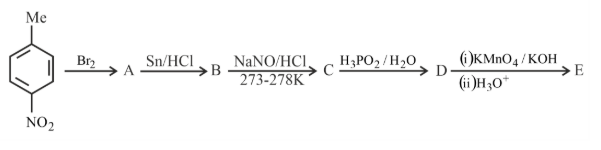
Identify the product formed (A and E)
NTA JEE Main 25th January 2023 Shift 1 - Question 48
Which of the following statements is incorrect for antibiotics?
NTA JEE Main 25th January 2023 Shift 1 - Question 49
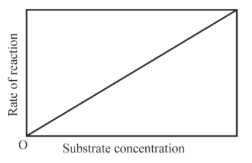
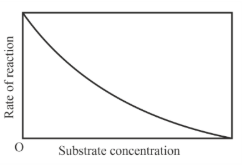
The variation of the rate of an enzyme catalyzed reaction with substrate concentration is correctly represented by graph
(a)
(b)
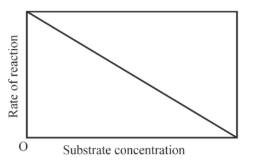
(c)
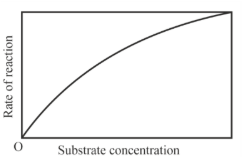
(d)
NTA JEE Main 25th January 2023 Shift 1 - Question 50
Match items of Row I with those of Row II.
Row I
(P)
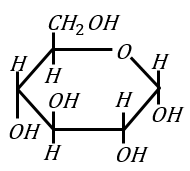
(Q)
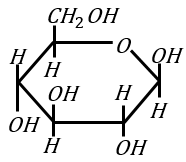
(R)
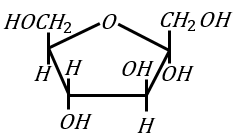
(S)
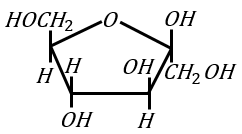
Row II:
(i) $$\alpha$$-D-(-) Fructofuranose
(ii) $$\beta$$-D-(-) Fructofuranose
(iii) $$\alpha$$-D-(-) Glucopyranose
(iv) $$\beta$$-D-(-) Glucopyranose
Correct match is