
Join Our JEE Preparation Group
Prep with like-minded aspirants; Get access to free daily tests and study material.
Sign in
Please select an account to continue using cracku.in
↓ →
Join Our JEE Preparation Group
Prep with like-minded aspirants; Get access to free daily tests and study material.
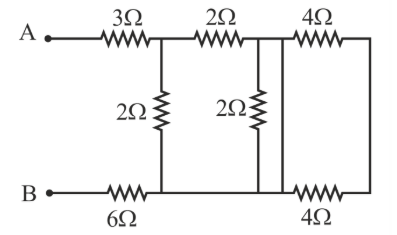
In the given circuit, the equivalent resistance between the terminals A and B is _____ $$\Omega$$
Correct Answer: 10
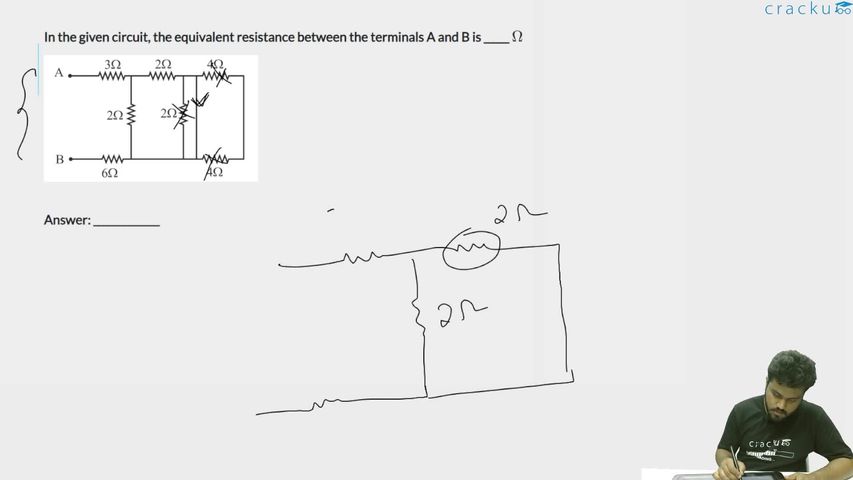
The vertical wire connected at the far right of the circuit acts as an ideal short circuit. This wire provides a path of zero resistance, effectively bypassing the two $$4\text{ }\Omega$$ resistors and the rightmost vertical $$2\text{ }\Omega$$ resistor. Consequently, the equivalent resistance of this entire section is $$0\text{ }\Omega$$.
Moving left, the horizontal $$2\text{ }\Omega$$ resistor is connected in series with the previously identified shorted section ($$0\text{ }\Omega$$):
$$R_{\text{series}} = 2\text{ }\Omega + 0\text{ }\Omega = 2\text{ }\Omega$$
This $$2\text{ }\Omega$$ equivalent branch is in parallel with the first vertical $$2\text{ }\Omega$$ resistor. The equivalent resistance ($$R_{p}$$) for this part is: $$R_{p} = \frac{2\text{ }\Omega \times 2\text{ }\Omega}{2\text{ }\Omega + 2\text{ }\Omega} = 1\text{ }\Omega$$
The circuit now reduces to three components in series between terminals A and B: the $$3\text{ }\Omega$$ top resistor, the $$1\text{ }\Omega$$ equivalent middle network, and the $$6\text{ }\Omega$$ bottom resistor.
$$R_{AB} = 3\text{ }\Omega + 1\text{ }\Omega + 6\text{ }\Omega$$
$$R_{AB} = 10\text{ }\Omega$$
Was this solution helpful?
Click on the Email ☝️ to Watch the Video Solution
Create a FREE account and get:
_1.webp)

Educational materials for JEE preparation

Ask our AI anything

AI can make mistakes. Please verify important information.
AI can make mistakes. Please verify important information.


