
Join Our JEE Preparation Group
Prep with like-minded aspirants; Get access to free daily tests and study material.
Sign in
Please select an account to continue using cracku.in
↓ →
Join Our JEE Preparation Group
Prep with like-minded aspirants; Get access to free daily tests and study material.
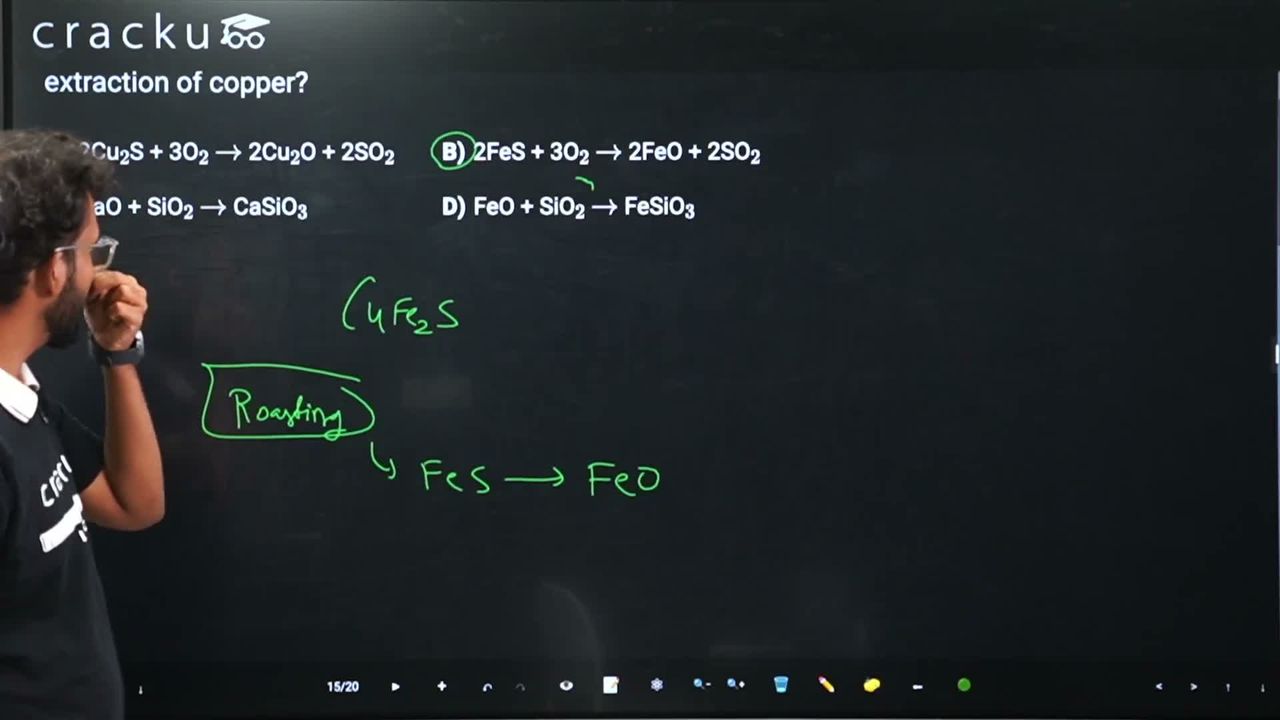
Four reactions are listed. We need to identify which one does NOT occur during the extraction of copper from copper pyrites (CuFeS$$_2$$). Copper is extracted through the following steps:
Roasting: The ore is heated in air to convert iron sulfide to iron oxide: $$2\text{FeS} + 3\text{O}_2 \to 2\text{FeO} + 2\text{SO}_2$$ This is Option B — it occurs during copper extraction.
Slag formation: SiO$$_2$$ is added as a flux and reacts with FeO to form slag: $$\text{FeO} + \text{SiO}_2 \to \text{FeSiO}_3$$ This is Option D — it occurs during copper extraction.
Partial roasting of Cu$$_2$$S: $$2\text{Cu}_2\text{S} + 3\text{O}_2 \to 2\text{Cu}_2\text{O} + 2\text{SO}_2$$ This is Option A — it occurs during copper extraction.
Option C states: CaO + SiO$$_2$$ $$\to$$ CaSiO$$_3$$. In copper extraction, the flux used is SiO$$_2$$, which reacts with FeO (not CaO). CaO is not involved in copper extraction. The reaction CaO + SiO$$_2$$ $$\to$$ CaSiO$$_3$$ occurs in iron extraction (blast furnace), not copper extraction.
Answer: Option C
Was this solution helpful?
Click on the Email ☝️ to Watch the Video Solution
Create a FREE account and get:
_1.webp)

Educational materials for JEE preparation

Ask our AI anything

AI can make mistakes. Please verify important information.
AI can make mistakes. Please verify important information.


