
Join Our JEE Preparation Group
Prep with like-minded aspirants; Get access to free daily tests and study material.
Sign in
Please select an account to continue using cracku.in
↓ →
Join Our JEE Preparation Group
Prep with like-minded aspirants; Get access to free daily tests and study material.
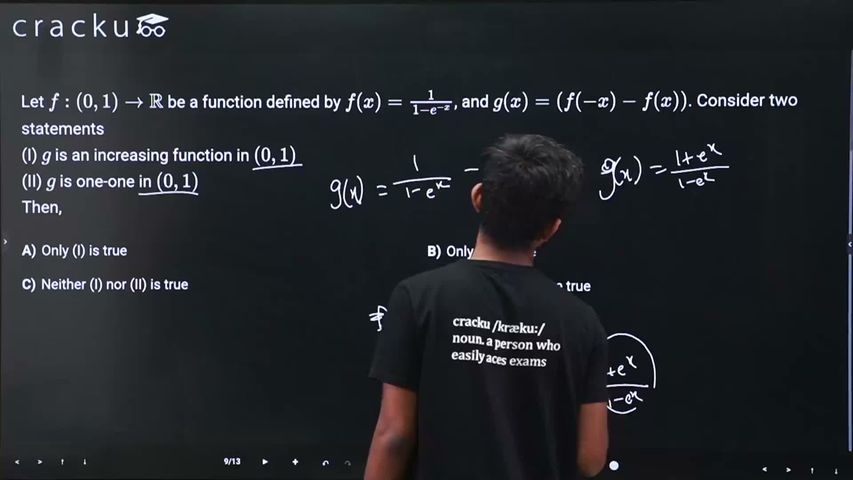
Let $$f : (0,1) \to \mathbb{R}$$ be a function defined by $$f(x) = \frac{1}{1-e^{-x}}$$, and $$g(x) = (f(-x) - f(x))$$. Consider two statements
(I) $$g$$ is an increasing function in $$(0, 1)$$
(II) $$g$$ is one-one in $$(0, 1)$$
Then,
Given $$f(x) = \dfrac{1}{1 - e^{-x}}$$ on $$(0, 1)$$ and $$g(x) = f(-x) - f(x)$$.
Simplifying $$g(x)$$:
$$f(-x) = \frac{1}{1 - e^x}$$
$$f(x) = \frac{1}{1 - e^{-x}} = \frac{e^x}{e^x - 1}$$
$$g(x) = \frac{1}{1 - e^x} - \frac{e^x}{e^x - 1} = \frac{-1}{e^x - 1} - \frac{e^x}{e^x - 1} = \frac{-(1 + e^x)}{e^x - 1}$$
$$g(x) = -1 - \frac{2}{e^x - 1}$$
(I) Is $$g$$ increasing in $$(0, 1)$$?
$$g'(x) = \frac{2e^x}{(e^x - 1)^2}$$
For $$x \in (0, 1)$$: $$e^x > 0$$ and $$(e^x - 1)^2 > 0$$, so $$g'(x) > 0$$.
Therefore $$g$$ is strictly increasing on $$(0, 1)$$. (I) is TRUE.
(II) Is $$g$$ one-one in $$(0, 1)$$?
Since $$g$$ is strictly increasing on $$(0, 1)$$, it is one-one. (II) is TRUE.
The answer is Option D: Both (I) and (II) are true.
Was this solution helpful?
Click on the Email ☝️ to Watch the Video Solution
Create a FREE account and get:
_1.webp)

Educational materials for JEE preparation

Ask our AI anything

AI can make mistakes. Please verify important information.
AI can make mistakes. Please verify important information.


