
Join Our JEE Preparation Group
Prep with like-minded aspirants; Get access to free daily tests and study material.
Sign in
Please select an account to continue using cracku.in
↓ →
Join Our JEE Preparation Group
Prep with like-minded aspirants; Get access to free daily tests and study material.
Let $$S_1$$ and $$S_2$$ be respectively the sets of all $$a \in \mathbb{R} - \{0\}$$ for which the system of linear equations
$$ax + 2ay - 3az = 1$$
$$(2a+1)x + (2a+3)y + (a+1)z = 2$$
$$(3a+5)x + (a+5)y + (a+2)z = 3$$
has unique solution and infinitely many solutions. Then
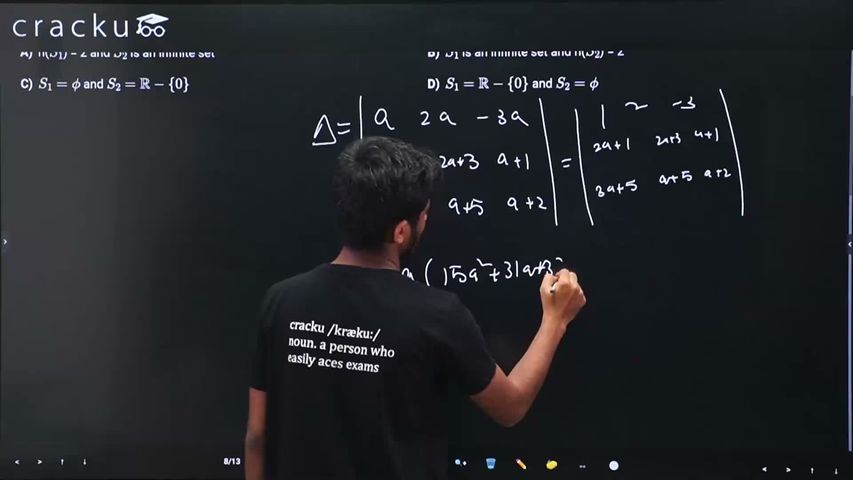
The coefficient matrix of the system is $$A = \begin{pmatrix} a & 2a & -3a \\ 2a+1 & 2a+3 & a+1 \\ 3a+5 & a+5 & a+2 \end{pmatrix}$$.
We compute the determinant by expanding along the first row. First, factor $$a$$ from row 1: $$\Delta = a \begin{vmatrix} 1 & 2 & -3 \\ 2a+1 & 2a+3 & a+1 \\ 3a+5 & a+5 & a+2 \end{vmatrix}$$.
Expanding this $$3 \times 3$$ determinant: $$= a\bigl[1\bigl((2a+3)(a+2) - (a+1)(a+5)\bigr) - 2\bigl((2a+1)(a+2) - (a+1)(3a+5)\bigr) + (-3)\bigl((2a+1)(a+5) - (2a+3)(3a+5)\bigr)\bigr]$$.
Computing each minor: $$(2a+3)(a+2) - (a+1)(a+5) = (2a^2+7a+6)-(a^2+6a+5) = a^2+a+1$$. Next: $$(2a+1)(a+2)-(a+1)(3a+5) = (2a^2+5a+2)-(3a^2+8a+5) = -a^2-3a-3$$. And: $$(2a+1)(a+5)-(2a+3)(3a+5) = (2a^2+11a+5)-(6a^2+19a+15) = -4a^2-8a-10$$.
So $$\Delta = a\bigl[(a^2+a+1) - 2(-a^2-3a-3) -3(-4a^2-8a-10)\bigr] = a(a^2+a+1+2a^2+6a+6+12a^2+24a+30) = a(15a^2+31a+37)$$.
The discriminant of $$15a^2+31a+37$$ is $$31^2 - 4(15)(37) = 961 - 2220 = -1259 < 0$$, so this quadratic has no real roots and is always positive (since the leading coefficient $$15 > 0$$). Therefore $$\Delta = 0$$ only when $$a = 0$$. Since $$a \in \mathbb{R} \setminus \{0\}$$, we have $$\Delta \neq 0$$ for all valid values of $$a$$, meaning the system always has a unique solution.
Thus $$S_1 = \mathbb{R} \setminus \{0\}$$ and $$S_2 = \phi$$. The answer is $$\boxed{\text{Option (D)}}$$.
Was this solution helpful?
Click on the Email ☝️ to Watch the Video Solution
Create a FREE account and get:
_1.webp)

Educational materials for JEE preparation

Ask our AI anything

AI can make mistakes. Please verify important information.
AI can make mistakes. Please verify important information.


