
Join Our JEE Preparation Group
Prep with like-minded aspirants; Get access to free daily tests and study material.
Sign in
Please select an account to continue using cracku.in
↓ →
Join Our JEE Preparation Group
Prep with like-minded aspirants; Get access to free daily tests and study material.
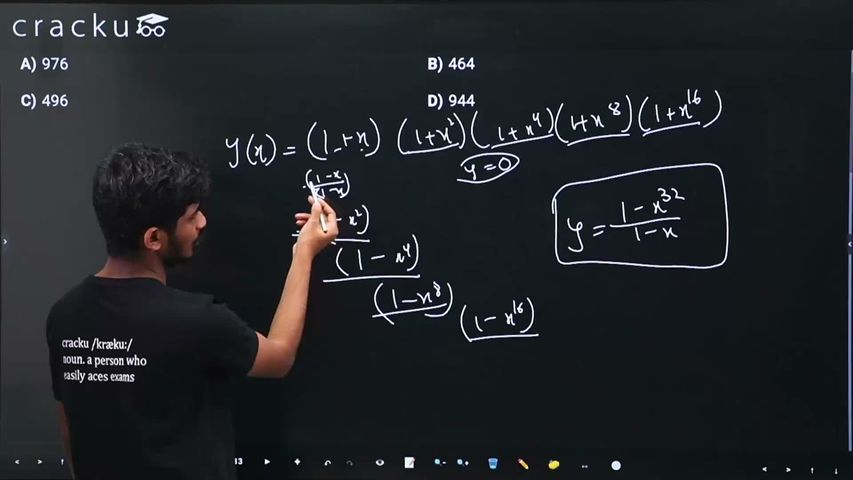
Let $$y(x) = (1+x)(1+x^2)(1+x^4)(1+x^8)(1+x^{16})$$. Then $$y' - y''$$ at $$x = -1$$ is equal to
Given $$y(x) = (1+x)(1+x^2)(1+x^4)(1+x^8)(1+x^{16})$$. Find $$y' - y''$$ at $$x = -1$$.
Multiply both sides by $$(1-x)$$:
$$ (1-x) \cdot y(x) = (1-x)(1+x)(1+x^2)(1+x^4)(1+x^8)(1+x^{16}) $$
Using the identity $$(1-a)(1+a) = 1-a^2$$ repeatedly:
$$ (1-x) \cdot y(x) = 1 - x^{32} $$
So $$y(x) = \frac{1 - x^{32}}{1 - x} = 1 + x + x^2 + \cdots + x^{31}$$ for $$x \neq 1$$.
$$ y'(x) = \sum_{k=1}^{31} k \cdot x^{k-1} $$
$$ y'(-1) = \sum_{k=1}^{31} k \cdot (-1)^{k-1} = 1 - 2 + 3 - 4 + \cdots + 31 $$
Group pairs: $$(1-2) + (3-4) + \cdots + (29-30) + 31 = -15 + 31 = 16$$
$$ y''(x) = \sum_{k=2}^{31} k(k-1) \cdot x^{k-2} $$
$$ y''(-1) = \sum_{k=2}^{31} k(k-1) \cdot (-1)^{k-2} = \sum_{k=2}^{31} k(k-1) \cdot (-1)^{k} $$
(since $$(-1)^{k-2} = (-1)^k$$)
Group consecutive even-odd pairs:
$$ = \sum_{m=1}^{15} [2m(2m-1) - (2m+1)(2m)] = \sum_{m=1}^{15} 2m[(2m-1) - (2m+1)] = \sum_{m=1}^{15} 2m(-2) = -4\sum_{m=1}^{15} m $$
$$ = -4 \times \frac{15 \times 16}{2} = -4 \times 120 = -480 $$
$$ y'(-1) - y''(-1) = 16 - (-480) = 16 + 480 = 496 $$
The correct answer is Option C: 496.
Was this solution helpful?
Click on the Email ☝️ to Watch the Video Solution
Create a FREE account and get:
_1.webp)

Educational materials for JEE preparation

Ask our AI anything

AI can make mistakes. Please verify important information.
AI can make mistakes. Please verify important information.


