
Join Our JEE Preparation Group
Prep with like-minded aspirants; Get access to free daily tests and study material.
Sign in
Please select an account to continue using cracku.in
↓ →
Join Our JEE Preparation Group
Prep with like-minded aspirants; Get access to free daily tests and study material.
Let $$x = 2$$ be a local minima of the function $$f(x) = 2x^4 - 18x^2 + 8x + 12$$, $$x \in (-4, 4)$$. If $$M$$ is local maximum value of the function $$f$$ in $$(-4, 4)$$, then $$M =$$
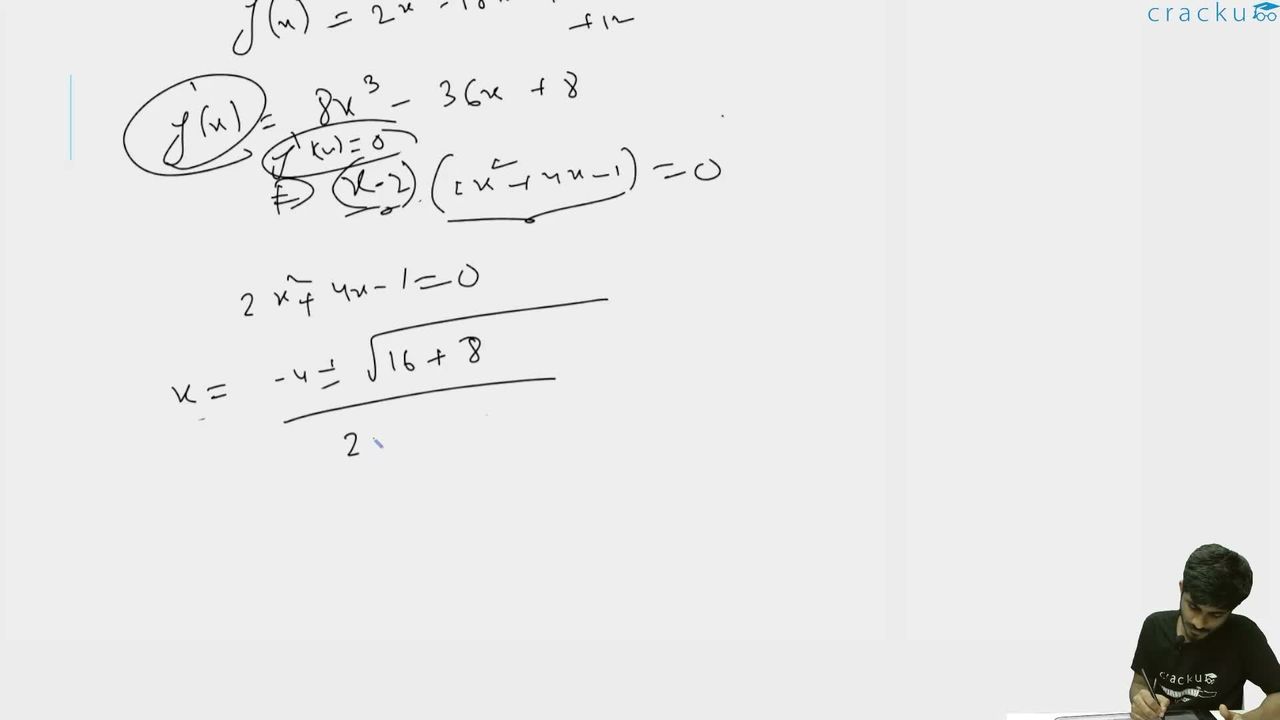
$$f'(x) = 8x^3 - 36x + 8$$
Set $$f'(x) = 0$$: $$8x^3 - 36x + 8 = 0$$
$$2x^3 - 9x + 2 = 0$$
$$2x^3 - 9x + 2 = (x - 2)(2x^2 + 4x - 1) = 0$$
$$x = \frac{-4 \pm \sqrt{16 - 4(2)(-1)}}{2(2)} = \frac{-4 \pm \sqrt{24}}{4} = \frac{-4 \pm 2\sqrt{6}}{4} = -1 \pm \frac{\sqrt{6}}{2}$$
Our critical points are $$x = 2$$, $$x = -1 + \frac{\sqrt{6}}{2} \approx 0.22$$, and $$x = -1 - \frac{\sqrt{6}}{2} \approx -2.22$$.
Using the second derivative test, $$f''(x) = 24x^2 - 36$$:
$$f''(2) = 24(4) - 36 = 60 > 0$$ (Confirms local minima at $$x=2$$).
$$f''(-1 - \frac{\sqrt{6}}{2}) > 0$$ (This is another local minima).
$$f''(-1 + \frac{\sqrt{6}}{2}) = 24(-1 + \frac{\sqrt{6}}{2})^2 - 36$$. Since $$(-1 + \frac{\sqrt{6}}{2})^2 \approx 0.05$$, $$f'' < 0$$ (This is the local maxima).
$$f(-1 + \frac{\sqrt{6}}{2})$$ = $$12\sqrt{6} - \frac{33}{2}$$
Was this solution helpful?
Click on the Email ☝️ to Watch the Video Solution
Create a FREE account and get:
_1.webp)

Educational materials for JEE preparation

Ask our AI anything

AI can make mistakes. Please verify important information.
AI can make mistakes. Please verify important information.


