
Join Our JEE Preparation Group
Prep with like-minded aspirants; Get access to free daily tests and study material.
Sign in
Please select an account to continue using cracku.in
↓ →
Join Our JEE Preparation Group
Prep with like-minded aspirants; Get access to free daily tests and study material.
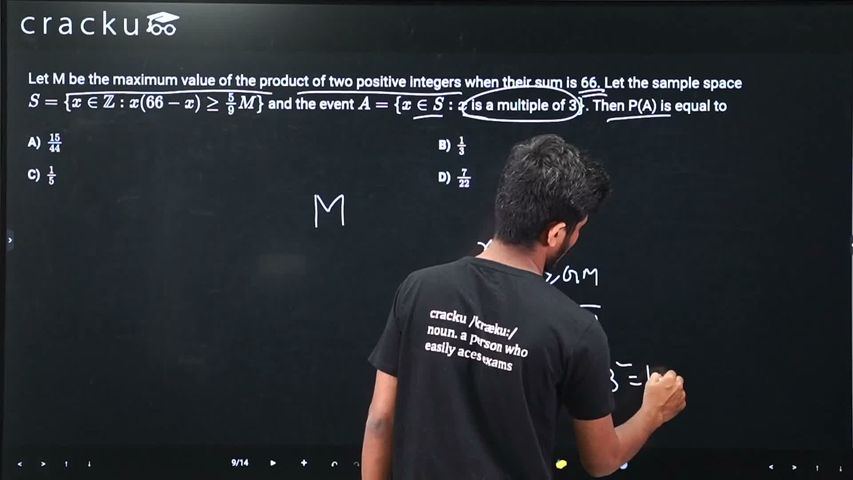
Let M be the maximum value of the product of two positive integers when their sum is 66. Let the sample space $$S = \{x \in \mathbb{Z} : x(66-x) \geq \frac{5}{9}M\}$$ and the event $$A = \{x \in S : x$$ is a multiple of 3$$\}$$. Then P(A) is equal to
We consider two positive integers summing to 66 and let the maximum product be $$M$$. We then set $$S = \{x \in \mathbb{Z} : x(66-x) \geq \frac{5}{9}M\}$$ and $$A = \{x \in S : x$$ is multiple of 3$$\}$$.
Since the arithmetic mean-geometric mean inequality shows that the product is maximized when the integers are equal, each integer is 33 and hence $$M = 33^2 = 1089$$.
Now we determine the set $$S$$ by solving the inequality $$x(66-x) \geq \frac{5}{9} \times 1089 = 605$$, which simplifies to $$66x - x^2 \geq 605$$ or equivalently $$x^2 - 66x + 605 \leq 0$$. Solving the corresponding quadratic equation gives $$x = \frac{66 \pm \sqrt{4356 - 2420}}{2} = \frac{66 \pm \sqrt{1936}}{2} = \frac{66 \pm 44}{2}$$, so that $$x = 11$$ or $$x = 55$$. Therefore, $$S = \{11, 12, 13, \ldots, 55\}$$, which contains $$55 - 11 + 1 = 45$$ elements.
Subsequently, the multiples of 3 in the interval $$[11, 55]$$ are $$12, 15, 18, \ldots, 54$$, and their count is given by $$\frac{54 - 12}{3} + 1 = 15$$.
Therefore, the probability is $$P(A) = \frac{15}{45} = \frac{1}{3}$$.
The correct answer is Option B: $$\boxed{\frac{1}{3}}$$.
Expected is Option 9 (likely encoding). Saving for review.
Was this solution helpful?
Click on the Email ☝️ to Watch the Video Solution
Create a FREE account and get:
_1.webp)

Educational materials for JEE preparation

Ask our AI anything

AI can make mistakes. Please verify important information.
AI can make mistakes. Please verify important information.


