
Join Our JEE Preparation Group
Prep with like-minded aspirants; Get access to free daily tests and study material.
Sign in
Please select an account to continue using cracku.in
↓ →
Join Our JEE Preparation Group
Prep with like-minded aspirants; Get access to free daily tests and study material.
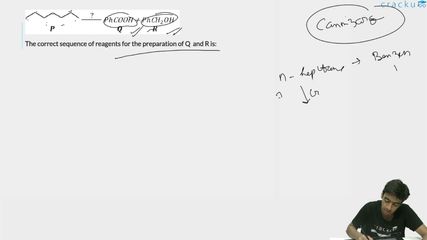
The conversion of n-heptane into benzoic acid and benzyl alcohol proceeds through aromatization, controlled oxidation, disproportionation, and acidification.
n-Heptane undergoes cyclization and dehydrogenation in the presence of chromium oxide at high temperature and pressure to form toluene:
$$\mathrm{C_7H_{16} \xrightarrow[20\,atm]{Cr_2O_3,\;770\,K} C_6H_5CH_3}$$
Toluene is then subjected to Étard oxidation using chromyl chloride followed by hydrolysis to give benzaldehyde:
$$\mathrm{C_6H_5CH_3 \xrightarrow{CrO_2Cl_2,\;H_3O^+} C_6H_5CHO}$$
Benzaldehyde contains no α-hydrogen and therefore undergoes the Cannizzaro reaction with concentrated sodium hydroxide:
$$\mathrm{2C_6H_5CHO + NaOH \rightarrow C_6H_5CH_2OH + C_6H_5COONa}$$
The sodium benzoate formed is acidified to obtain benzoic acid:
$$\mathrm{C_6H_5COONa + H_3O^+ \rightarrow C_6H_5COOH + Na^+ + H_2O}$$
Thus,
$$Q = \mathrm{C_6H_5COOH}$$
$$R = \mathrm{C_6H_5CH_2OH}$$
Hence, the correct sequence of reagents is
$$\boxed{(i)\ Cr_2O_3,\ 770\,K,\ 20\,atm \;\rightarrow\; (ii)\ CrO_2Cl_2,\ H_3O^+ \;\rightarrow\; (iii)\ NaOH \;\rightarrow\; (iv)\ H_3O^+}$$
Therefore, the correct answer is $$\boxed{\text{Option A}}$$.
Was this solution helpful?
Click on the Email ☝️ to Watch the Video Solution
Create a FREE account and get:
_1.webp)

Educational materials for JEE preparation

Ask our AI anything

AI can make mistakes. Please verify important information.
AI can make mistakes. Please verify important information.



