
Join Our JEE Preparation Group
Prep with like-minded aspirants; Get access to free daily tests and study material.
Sign in
Please select an account to continue using cracku.in
↓ →
Join Our JEE Preparation Group
Prep with like-minded aspirants; Get access to free daily tests and study material.
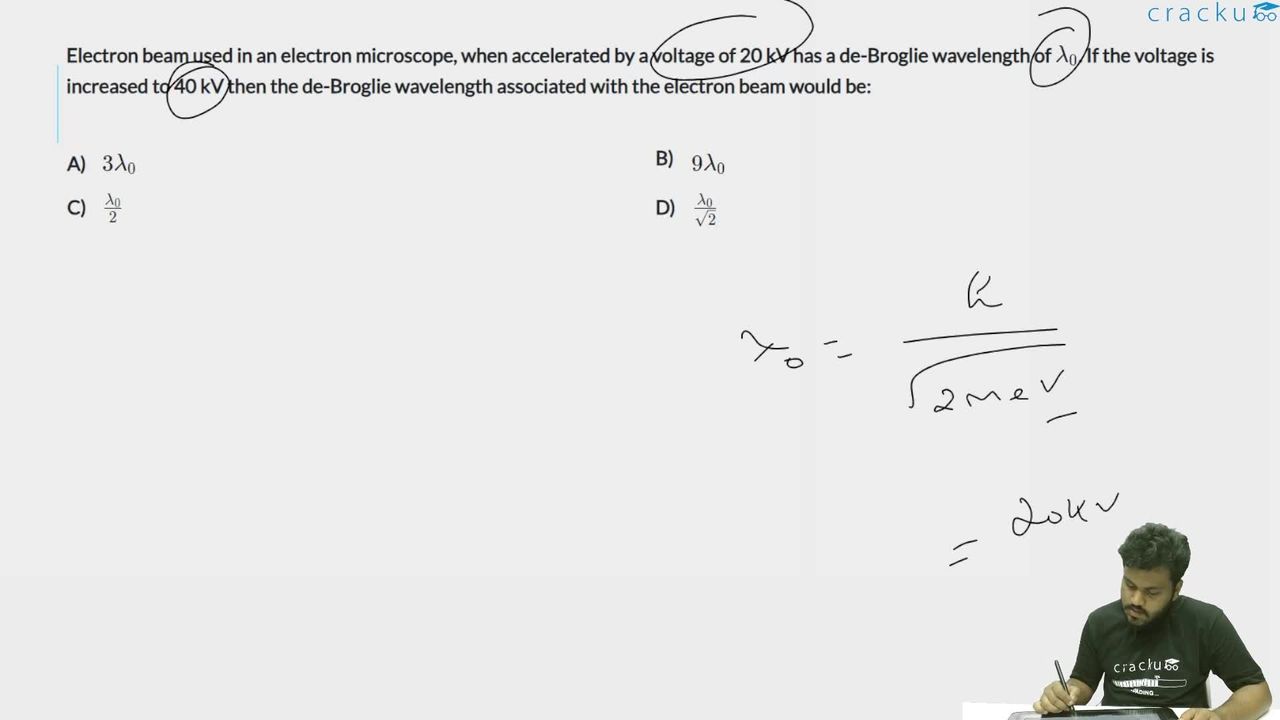
Electron beam used in an electron microscope, when accelerated by a voltage of 20 kV has a de-Broglie wavelength of $$\lambda_0$$. If the voltage is increased to 40 kV then the de-Broglie wavelength associated with the electron beam would be:
The de Broglie wavelength of a particle accelerated through a voltage $$V$$ is given by the relation $$\lambda = \frac{h}{\sqrt{2meV}}$$, so that $$\lambda \propto \frac{1}{\sqrt{V}}$$.
When the accelerating voltage changes from 20 kV to 40 kV, the ratio of the new wavelength $$\lambda'$$ to the original $$\lambda_0$$ becomes $$\frac{\lambda'}{\lambda_0} = \sqrt{\frac{20}{40}} = \frac{1}{\sqrt{2}}$$.
It follows that $$\lambda' = \frac{\lambda_0}{\sqrt{2}}$$.
The correct answer is Option D: $$\frac{\lambda_0}{\sqrt{2}}$$.
Was this solution helpful?
Click on the Email ☝️ to Watch the Video Solution
Create a FREE account and get:
_1.webp)

Educational materials for JEE preparation

Ask our AI anything

AI can make mistakes. Please verify important information.
AI can make mistakes. Please verify important information.


