
Join Our JEE Preparation Group
Prep with like-minded aspirants; Get access to free daily tests and study material.
Sign in
Please select an account to continue using cracku.in
↓ →
Join Our JEE Preparation Group
Prep with like-minded aspirants; Get access to free daily tests and study material.
A car is moving with a constant speed of 20 m s$$^{-1}$$ in a circular horizontal track of radius 40 m. A bob is suspended from the roof of the car by a massless string. The angle made by the string with the vertical will be: (Take g = 10 m s$$^{-2}$$)
A car moves in a circular horizontal track and a bob is suspended from the roof by a string. We need to find the angle the string makes with the vertical.
We are given that Speed $$v = 20$$ m/s, radius $$R = 40$$ m, $$g = 10$$ m/s$$^2$$.
To begin,
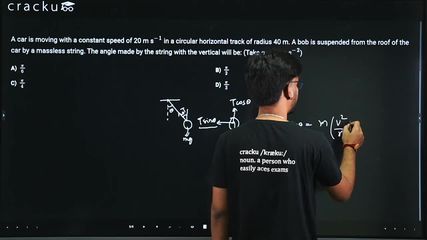
When the car moves in a circular path, it undergoes centripetal acceleration directed toward the centre of the circle. The bob, being inside the car, must also undergo this centripetal acceleration. The only forces on the bob are its weight ($$mg$$, downward) and the tension in the string ($$T$$, along the string). For the bob to have centripetal acceleration, the string must tilt away from the vertical (outward from the centre), so that the horizontal component of tension provides the centripetal force.
Next,
Let $$\theta$$ be the angle the string makes with the vertical.
Vertical equilibrium (no vertical acceleration):
$$ T\cos\theta = mg \quad \cdots (1) $$
Horizontal direction (centripetal acceleration $$a_c = v^2/R$$):
$$ T\sin\theta = \frac{mv^2}{R} \quad \cdots (2) $$
From here,
$$ \frac{T\sin\theta}{T\cos\theta} = \frac{mv^2/R}{mg} $$
$$ \tan\theta = \frac{v^2}{Rg} $$
Continuing,
$$ \tan\theta = \frac{(20)^2}{40 \times 10} = \frac{400}{400} = 1 $$
$$ \theta = \tan^{-1}(1) = 45° = \frac{\pi}{4} $$
The string makes an angle of $$\dfrac{\pi}{4}$$ with the vertical.
The correct answer is Option 3: $$\dfrac{\pi}{4}$$.
Was this solution helpful?
Click on the Email ☝️ to Watch the Video Solution
Create a FREE account and get:
_1.webp)

Educational materials for JEE preparation

Ask our AI anything

AI can make mistakes. Please verify important information.
AI can make mistakes. Please verify important information.


