
Join Our JEE Preparation Group
Prep with like-minded aspirants; Get access to free daily tests and study material.
Sign in
Please select an account to continue using cracku.in
↓ →
Join Our JEE Preparation Group
Prep with like-minded aspirants; Get access to free daily tests and study material.
An object of mass 8 kg is hanging from one end of a uniform rod $$CD$$ of mass 2 kg and length 1 m, is pivoted at its end $$C$$ on a vertical wall as shown in the figure. It is supported by a cable $$AB$$ such that the system is in equilibrium. The tension in the cable is: (Take $$g = 10$$ m s$$^{-2}$$)
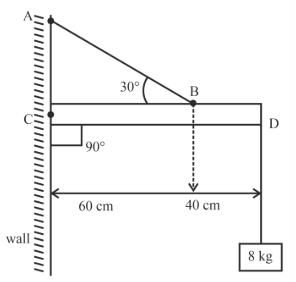
For the system to be in equilibrium, the net torque about the pivot point C must be zero ($$\sum \tau_C = 0$$)
$$W_{rod} = m \cdot g = 2\text{ kg} \times 10\text{ m/s}^2 = 20\text{ N}$$
$$\tau_{rod} = 20\text{ N} \times 0.5\text{ m} = \mathbf{10\text{ N m}}$$ (Clockwise)
$$W_{obj} = 8\text{ kg} \times 10\text{ m/s}^2 = 80\text{ N}$$
$$\tau_{obj} = 80\text{ N} \times 1\text{ m} = \mathbf{80\text{ N m}}$$ (Clockwise)
$$\tau_{clockwise} = 10 + 80 = \mathbf{90\text{ N m}}$$
The tension ($$T$$) in cable $$AB$$ provides the counter-clockwise torque to balance the weights. It acts at point $$B$$, which is $$60\text{ cm} = 0.6\text{ m}$$ from the pivot, at an angle of $$30^\circ$$.
$$\tau_{tension} = T \times r \times \sin \theta$$
$$\tau_{tension} = T \times 0.6\text{ m} \times \sin(30^\circ)$$
$$\tau_{tension} = T \times 0.6 \times 0.5 = \mathbf{0.3T}$$
$$\tau_{anticlockwise} = \tau_{clockwise}$$
$$T = \frac{90}{0.3} = \mathbf{300\text{ N}}$$
Was this solution helpful?
Click on the Email ☝️ to Watch the Video Solution
Create a FREE account and get:
_1.webp)

Educational materials for JEE preparation

Ask our AI anything

AI can make mistakes. Please verify important information.
AI can make mistakes. Please verify important information.


