
Join Our JEE Preparation Group
Prep with like-minded aspirants; Get access to free daily tests and study material.
Sign in
Please select an account to continue using cracku.in
↓ →
Join Our JEE Preparation Group
Prep with like-minded aspirants; Get access to free daily tests and study material.
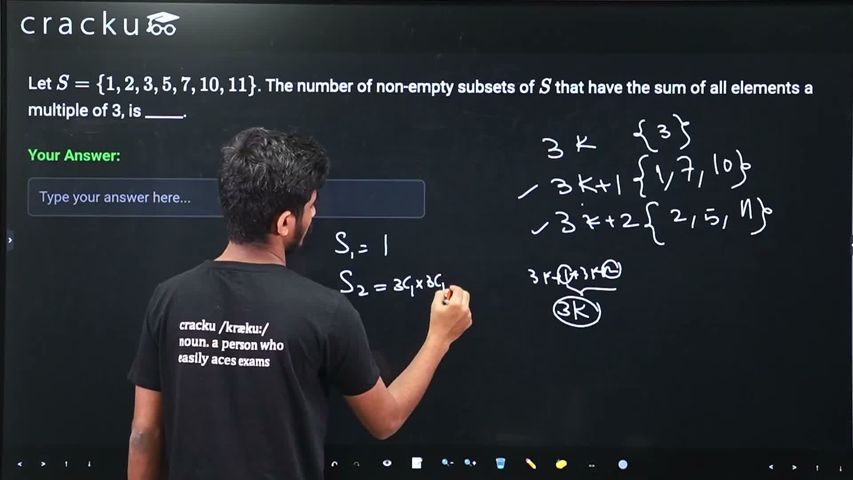
Let $$S = \{1, 2, 3, 5, 7, 10, 11\}$$. The number of non-empty subsets of $$S$$ that have the sum of all elements a multiple of 3, is _____.
Correct Answer: 43
We need to find the number of non-empty subsets of $$S = \{1, 2, 3, 5, 7, 10, 11\}$$ whose element sum is a multiple of 3.
Residue 0 group $$\{3\}$$: Including or excluding 3 does not affect the sum mod 3. So this element provides a factor of 2 (include or exclude).
Residue 1 group $$\{1, 7, 10\}$$: Each subset of this group has a sum with some residue mod 3. There are $$2^3 = 8$$ subsets (including empty).
Residue 2 group $$\{2, 5, 11\}$$: Similarly, $$2^3 = 8$$ subsets.
For the total sum to be $$\equiv 0 \pmod{3}$$, the contributions from residue-1 and residue-2 groups must satisfy:
$$r_1 + r_2 \equiv 0 \pmod{3}$$
Valid combinations $$(r_1, r_2)$$:
Total from residue 1 and 2 groups = $$4 + 9 + 9 = 22$$ subsets.
Element 3 can be included or excluded without affecting divisibility by 3:
$$22 \times 2 = 44 \text{ subsets (including empty set)}$$
$$44 - 1 = 43$$
The answer is $$43$$.
Was this solution helpful?
Click on the Email ☝️ to Watch the Video Solution
Create a FREE account and get:
_1.webp)

Educational materials for JEE preparation

Ask our AI anything

AI can make mistakes. Please verify important information.
AI can make mistakes. Please verify important information.


