NTA JEE Main 6th April 2023 Shift 1
For the following questions answer them individually
NTA JEE Main 6th April 2023 Shift 1 - Question 41
The difference between electron gain enthalpies will be maximum between:
NTA JEE Main 6th April 2023 Shift 1 - Question 42
Match List I with List II
List I (Oxide) List II (Type of bond)
A. N$$_2$$O$$_4$$ I. 1 N=O bond
B. NO$$_2$$ II. 1 N-O-N bond
C. N$$_2$$O$$_5$$ III. 1 N-N bond
D. N$$_2$$O IV. 1 N=N/N$$\equiv$$N bond
NTA JEE Main 6th April 2023 Shift 1 - Question 43
Match List-I with List-II.
List-I (Name of reaction) List-II (Reagent used)
A. Hell-Volhard Zelinsky reaction I. NaOH + I$$_2$$
B. Iodoform reaction II. (i) CrO$$_2$$Cl$$_2$$, CS$$_2$$ (ii) H$$_2$$O
C. Etard reaction III. (i) Br$$_2$$/red phosphorus (ii) H$$_2$$O
D. Gatterman-Koch reaction IV. CO, HCl, anhyd. AlCl$$_3$$

NTA JEE Main 6th April 2023 Shift 1 - Question 44
Given below are two statements, one is labelled as Assertion A and the other is labelled as Reason R.
Assertion A: The spin only magnetic moment value for Fe(CN)$$_6^{3-}$$ is 1.74 BM, whereas for [Fe(H$$_2$$O)$$_6$$]$$^{3+}$$ is 5.92 BM.
Reason B: In both complexes, Fe is present in +3 oxidation state.
In the light of the above statements, choose the correct answer from the options given below:
NTA JEE Main 6th April 2023 Shift 1 - Question 45
For the reaction

The correct statement is
NTA JEE Main 6th April 2023 Shift 1 - Question 46
The major products A and B from the following reactions are:
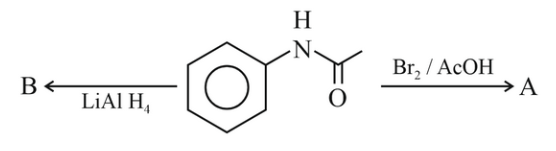
(1)
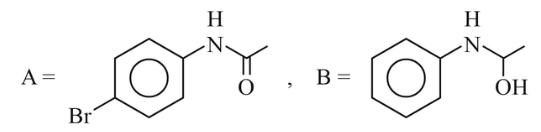
(2)
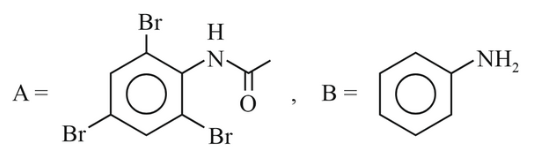
(3)
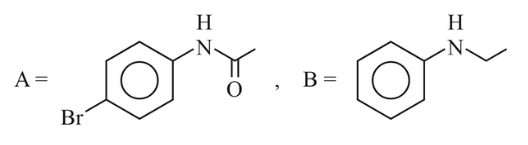
(4)
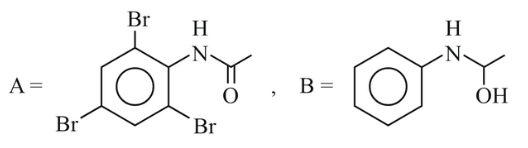
NTA JEE Main 6th April 2023 Shift 1 - Question 47
The major product formed in the following reaction is
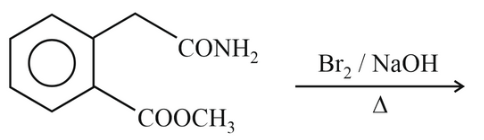
NTA JEE Main 6th April 2023 Shift 1 - Question 48
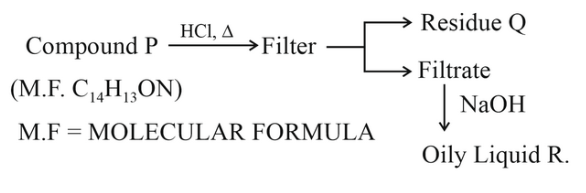
Compound P is neutral, Q gives effervescence with NaHCO$$_3$$ while R reacts with Hinsberg's reagent to give solid soluble in NaOH. Compound P is
NTA JEE Main 6th April 2023 Shift 1 - Question 49
Polymer used in orlon is:
NTA JEE Main 6th April 2023 Shift 1 - Question 50
Match List I and List II
List I (Vitamin) List II (Deficiency disease)
A. Vitamin A I. Beri-Beri
B. Thiamine II. Cheilosis
C. Ascorbic acid III. Xerophthalmia
D. Riboflavin IV. Scurvy
Choose the correct answer from the options given below