
Join Our JEE Preparation Group
Prep with like-minded aspirants; Get access to free daily tests and study material.
Sign in
Please select an account to continue using cracku.in
↓ →
Join Our JEE Preparation Group
Prep with like-minded aspirants; Get access to free daily tests and study material.
The energy levels of a hydrogen atom are shown below. The transition corresponding to emission of shortest wavelength is
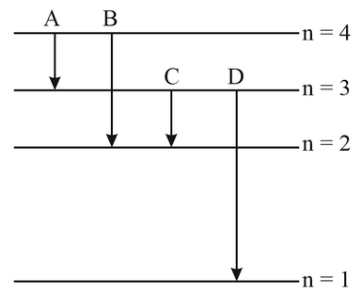
The energy of a photon emitted during a transition is given by Planck's relation: $$\Delta E = \frac{hc}{\lambda} \implies \lambda \propto \frac{1}{\Delta E}$$
To find the shortest wavelength ($$\lambda_{\text{min}}$$), we look for the transition with the largest energy difference ($$\Delta E_{\text{max}}$$).
Energy levels of a hydrogen atom ($$E_n = -\frac{13.6}{n^2}\ \text{eV}$$):
$$E_1 = -13.6\ \text{eV}$$, $$E_2 = -3.4\ \text{eV}$$, $$E_3 = -1.51\ \text{eV}$$, $$E_4 = -0.85\ \text{eV}$$
Transition A ($$n=4 \rightarrow n=3$$): $$\Delta E = -0.85 - (-1.51) = 0.66\ \text{eV}$$
Transition B ($$n=4 \rightarrow n=2$$): $$\Delta E = -0.85 - (-3.4) = 2.55\ \text{eV}$$
Transition C ($$n=3 \rightarrow n=2$$): $$\Delta E = -1.51 - (-3.4) = 1.89\ \text{eV}$$
Transition D ($$n=3 \rightarrow n=1$$): $$\Delta E = -1.51 - (-13.6) = 12.09\ \text{eV}$$
Since transition D involves the ground state ($$n=1$$), it has the largest energy gap, which results in the shortest emitted wavelength.
Was this solution helpful?
Create a FREE account and get:
_1.webp)

Educational materials for JEE preparation

Ask our AI anything

AI can make mistakes. Please verify important information.
AI can make mistakes. Please verify important information.
