
Join Our JEE Preparation Group
Prep with like-minded aspirants; Get access to free daily tests and study material.
Sign in
Please select an account to continue using cracku.in
↓ →
Join Our JEE Preparation Group
Prep with like-minded aspirants; Get access to free daily tests and study material.
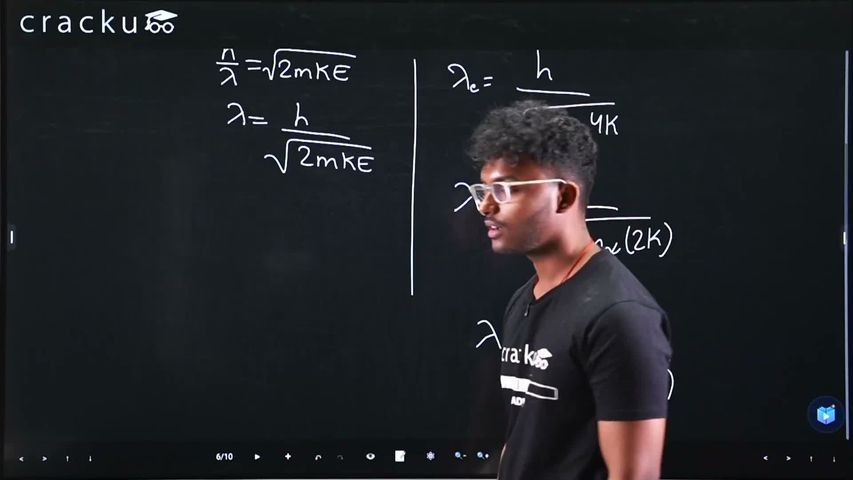
The kinetic energy of an electron, $$\alpha$$-particle and a proton are given as 4K, 2K and K respectively. The de-Broglie wavelength associated with electron $$(\lambda_e)$$, $$\alpha$$-particle $$(\lambda_\alpha)$$ and the proton $$(\lambda_p)$$ are as follows:
$$\lambda = \frac{h}{p} = \frac{h}{\sqrt{2mE_k}} \implies \lambda \propto \frac{1}{\sqrt{mE_k}}$$
Let the mass of an electron be $$m_e$$, a proton be $$m_p$$, and an $$\alpha$$-particle be $$m_\alpha$$. The standard mass relationships are: $$m_e \ll m_p \quad \text{and} \quad m_\alpha \approx 4m_p$$
Given kinetic energies: $$E_e = 4K, \quad E_\alpha = 2K, \quad E_p = K$$
For electron: $$m_e \cdot E_e = m_e \cdot 4K = 4m_e K$$
For proton: $$m_p \cdot E_p = m_p \cdot K = m_p K$$
For $$\alpha$$-particle: $$m_\alpha \cdot E_\alpha = (4m_p) \cdot 2K = 8m_p K$$
Since $$m_e$$ is extremely small compared to $$m_p$$ ($$m_p \approx 1836 m_e$$):
$$4m_e K \ll m_p K < 8m_p K$$ $$\implies (mE_k)_e < (mE_k)_p < (mE_k)_\alpha$$
Taking the inverse square root reverses the inequalities: $$\lambda_e > \lambda_p > \lambda_a \implies \lambda_\alpha < \lambda_p < \lambda_e$$
Was this solution helpful?
Click on the Email ☝️ to Watch the Video Solution
Create a FREE account and get:
_1.webp)

Educational materials for JEE preparation

Ask our AI anything

AI can make mistakes. Please verify important information.
AI can make mistakes. Please verify important information.
