
Join Our JEE Preparation Group
Prep with like-minded aspirants; Get access to free daily tests and study material.
Sign in
Please select an account to continue using cracku.in
↓ →
Join Our JEE Preparation Group
Prep with like-minded aspirants; Get access to free daily tests and study material.
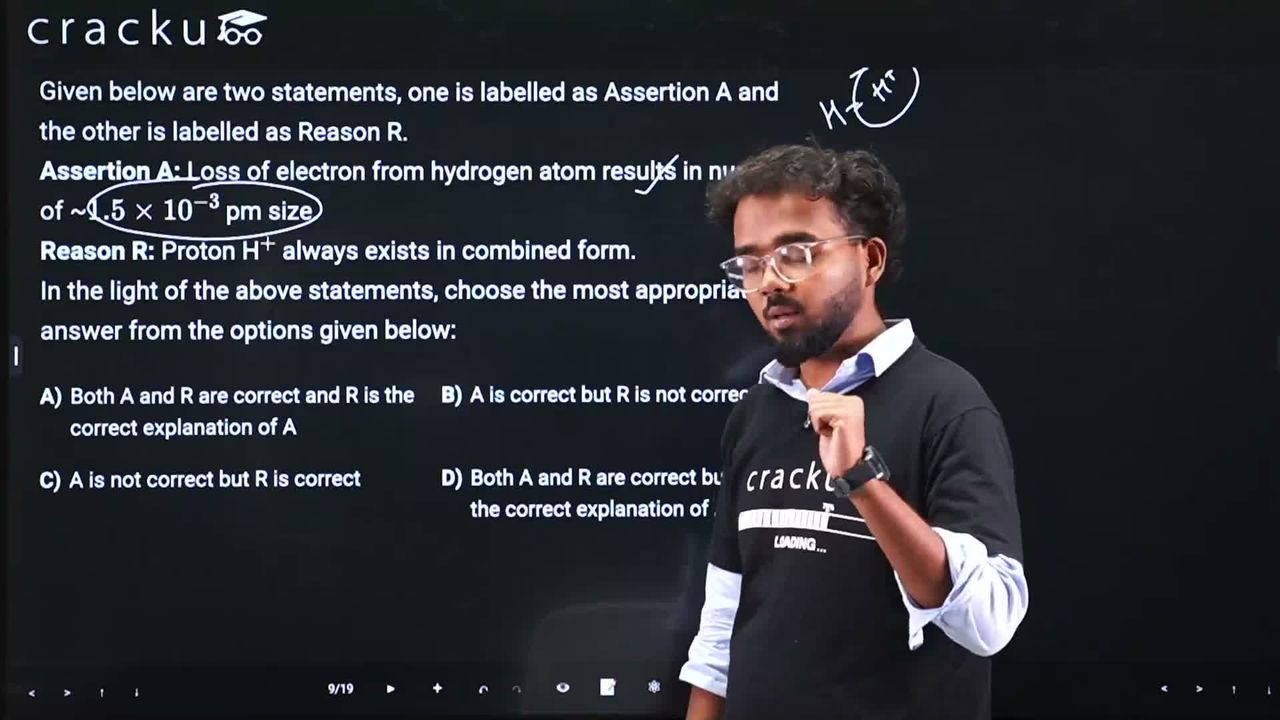
Given below are two statements, one is labelled as Assertion A and the other is labelled as Reason R.
Assertion A: Loss of electron from hydrogen atom results in nucleus of ~$$1.5 \times 10^{-3}$$ pm size.
Reason R: Proton H$$^+$$ always exists in combined form.
In the light of the above statements, choose the most appropriate answer from the options given below:
Assertion A: Loss of electron from hydrogen atom results in nucleus of ~$$1.5 \times 10^{-3}$$ pm size.
When hydrogen loses its only electron, we are left with just a proton (H⁺). The size of a proton is approximately $$1.5 \times 10^{-3}$$ pm (= 1.5 femtometers). This is correct.
Reason R: Proton H⁺ always exists in combined form.
A bare proton (H⁺) is extremely small and has very high charge density. In aqueous solution, it immediately combines with water to form hydronium ion (H₃O⁺) or other hydrated species. It never exists as a free proton in solution. This is correct.
However, R does not explain A. The small size of the proton (A) is due to the nuclear dimensions, not because of its tendency to combine with other species (R). These are two independent facts.
The correct answer is Both A and R are correct but R is NOT the correct explanation of A.
Was this solution helpful?
Click on the Email ☝️ to Watch the Video Solution
Create a FREE account and get:
_1.webp)

Educational materials for JEE preparation

Ask our AI anything

AI can make mistakes. Please verify important information.
AI can make mistakes. Please verify important information.
