
Join Our JEE Preparation Group
Prep with like-minded aspirants; Get access to free daily tests and study material.
Sign in
Please select an account to continue using cracku.in
↓ →
Join Our JEE Preparation Group
Prep with like-minded aspirants; Get access to free daily tests and study material.
Two resistances are given as $$R_1 = (10 \pm 0.5)$$ $$\Omega$$ and $$R_2 = (15 \pm 0.5)$$ $$\Omega$$. The percentage error in the measurement of equivalent resistance when they are connected in parallel is
We have two resistances $$R_1 = (10 \pm 0.5)\;\Omega$$ and $$R_2 = (15 \pm 0.5)\;\Omega$$ connected in parallel, and we need to find the percentage error in the equivalent resistance.
For resistances in parallel, the equivalent resistance is:
$$R_{eq} = \frac{R_1 R_2}{R_1 + R_2} = \frac{10 \times 15}{10 + 15} = \frac{150}{25} = 6\;\Omega$$
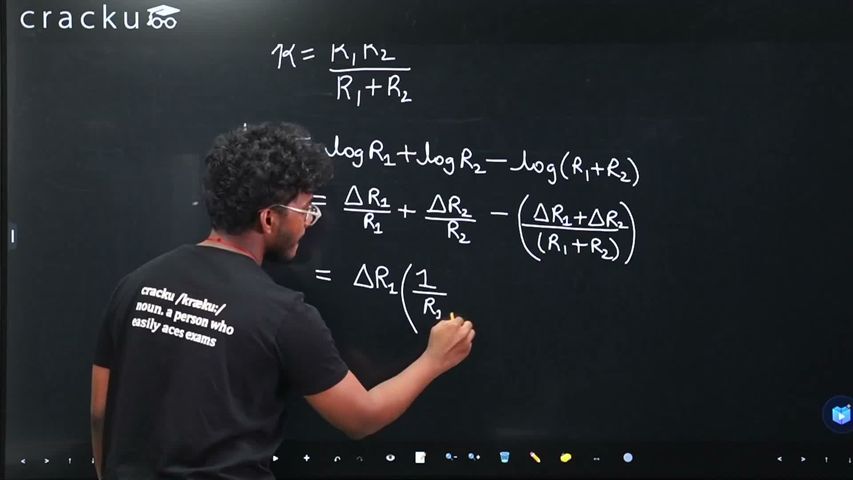
Now, to find the error propagation, we start from $$\frac{1}{R_{eq}} = \frac{1}{R_1} + \frac{1}{R_2}$$. Differentiating both sides and taking absolute values (since errors always add), the maximum absolute error in $$R_{eq}$$ is:
$$\Delta R_{eq} = R_{eq}^2 \left(\frac{\Delta R_1}{R_1^2} + \frac{\Delta R_2}{R_2^2}\right)$$
This follows because differentiating $$R_{eq}^{-1}$$ with respect to $$R_1$$ gives $$-R_1^{-2}$$, and similarly for $$R_2$$. Substituting the values with $$R_{eq}^2 = 36$$:
$$\Delta R_{eq} = 36 \left(\frac{0.5}{100} + \frac{0.5}{225}\right) = 36 \left(0.005 + 0.002222\right) = 36 \times 0.007222 = 0.26\;\Omega$$
So the percentage error is:
$$\%\;\text{error} = \frac{\Delta R_{eq}}{R_{eq}} \times 100 = \frac{0.26}{6} \times 100 = 4.33\%$$
Hence, the correct answer is Option 4.
Was this solution helpful?
Click on the Email ☝️ to Watch the Video Solution
Create a FREE account and get:
_1.webp)

Educational materials for JEE preparation

Ask our AI anything

AI can make mistakes. Please verify important information.
AI can make mistakes. Please verify important information.
