
Join Our JEE Preparation Group
Prep with like-minded aspirants; Get access to free daily tests and study material.
Sign in
Please select an account to continue using cracku.in
↓ →
Join Our JEE Preparation Group
Prep with like-minded aspirants; Get access to free daily tests and study material.
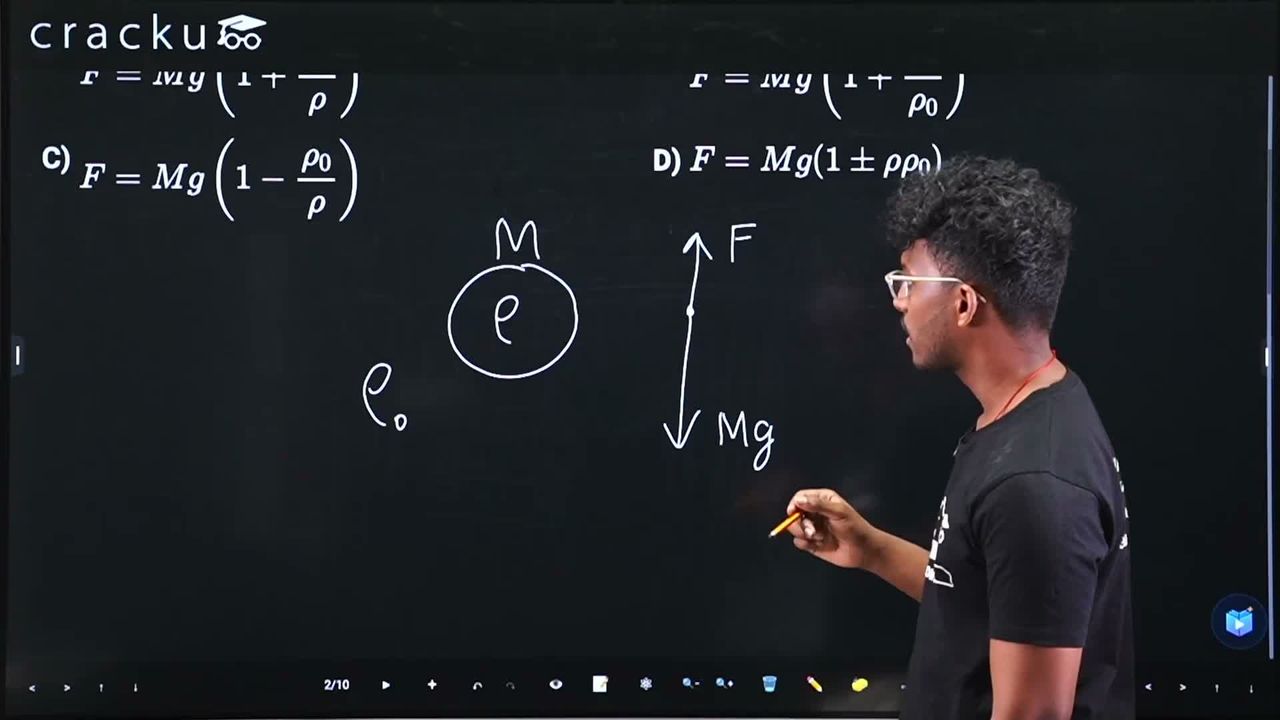
A small ball of mass $$M$$ and density $$\rho$$ is dropped in a viscous liquid of density $$\rho_0$$. After some time, the ball falls with a constant velocity. What is the viscous force on the ball?
We have a ball of mass $$M$$ and density $$\rho$$ dropped in a viscous liquid of density $$\rho_0$$. At terminal velocity, the net force on the ball is zero.
The forces acting on the ball are: the weight $$W = Mg$$ acting downward, the buoyant force $$F_b = V\rho_0 g$$ acting upward (where $$V = \frac{M}{\rho}$$ is the volume of the ball), and the viscous force $$F$$ acting upward.
At terminal velocity, these forces balance, so
$$Mg = F_b + F$$
$$F = Mg - F_b = Mg - \frac{M}{\rho}\rho_0 g$$
Factoring out $$Mg$$ (since the buoyant force reduces the effective weight by the density ratio):
$$F = Mg\left(1 - \frac{\rho_0}{\rho}\right)$$
Hence, the correct answer is $$F = Mg\left(1 - \dfrac{\rho_0}{\rho}\right)$$.
Was this solution helpful?
Click on the Email ☝️ to Watch the Video Solution
Create a FREE account and get:
_1.webp)

Educational materials for JEE preparation

Ask our AI anything

AI can make mistakes. Please verify important information.
AI can make mistakes. Please verify important information.
