
Join Our JEE Preparation Group
Prep with like-minded aspirants; Get access to free daily tests and study material.
Sign in
Please select an account to continue using cracku.in
↓ →
Join Our JEE Preparation Group
Prep with like-minded aspirants; Get access to free daily tests and study material.
A circle passing through the point $$P(\alpha, \beta)$$ in the first quadrant touches the two coordinate axes at the points A and B. The point P is above the line AB. The point Q on the line segment AB is the foot of perpendicular from P on AB. If PQ is equal to 11 units, then the value of $$\alpha\beta$$ is ______.
Correct Answer: 121
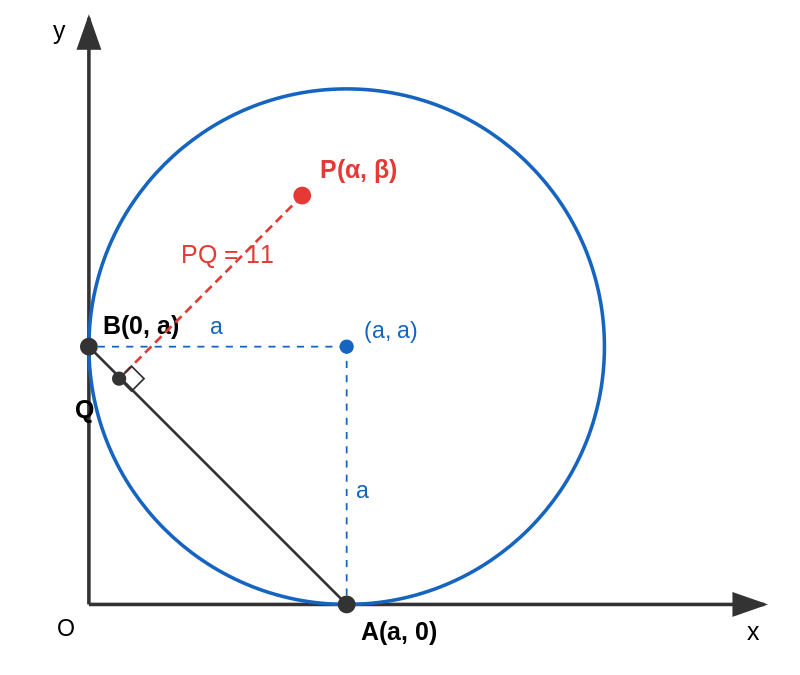
A circle in the first quadrant touches both coordinate axes. It passes through a point $$P(\alpha, \beta)$$ above the line AB, where A and B are the points where the circle touches the x-axis and y-axis respectively. PQ = 11 units, where Q is the foot of perpendicular from P onto line AB.
First, we set up the equation of the circle.
A circle touching both coordinate axes in the first quadrant has its centre at $$(a, a)$$ and radius $$a$$. The equation of the circle is:
$$(x - a)^2 + (y - a)^2 = a^2$$
The circle touches the x-axis at $$A(a, 0)$$ and the y-axis at $$B(0, a)$$.
Next, we write the equation of line AB.
The line joining $$A(a, 0)$$ and $$B(0, a)$$ has the equation:
$$\frac{x}{a} + \frac{y}{a} = 1 \implies x + y = a$$
From this, we use the perpendicular distance formula.
The perpendicular distance from $$P(\alpha, \beta)$$ to the line $$x + y - a = 0$$ is:
$$PQ = \frac{|\alpha + \beta - a|}{\sqrt{1^2 + 1^2}} = \frac{|\alpha + \beta - a|}{\sqrt{2}} = 11$$
Since P is above the line AB, we have $$\alpha + \beta > a$$, so:
$$\alpha + \beta - a = 11\sqrt{2} \implies a = \alpha + \beta - 11\sqrt{2} \quad \cdots (i)$$
Now, we use the condition that P lies on the circle.
Since $$P(\alpha, \beta)$$ lies on the circle:
$$(\alpha - a)^2 + (\beta - a)^2 = a^2$$
Expanding:
$$\alpha^2 - 2a\alpha + a^2 + \beta^2 - 2a\beta + a^2 = a^2$$
$$a^2 - 2a(\alpha + \beta) + \alpha^2 + \beta^2 = 0$$
Then, we rearrange and simplify.
Rewriting: $$(a - (\alpha + \beta))^2 - (\alpha + \beta)^2 + \alpha^2 + \beta^2 = 0$$
$$(a - (\alpha + \beta))^2 = (\alpha + \beta)^2 - \alpha^2 - \beta^2 = 2\alpha\beta$$
Continuing, we substitute from equation (i).
From equation (i), $$a - (\alpha + \beta) = -11\sqrt{2}$$. Substituting:
$$(-11\sqrt{2})^2 = 2\alpha\beta$$
$$242 = 2\alpha\beta$$
$$\alpha\beta = 121$$
The value of $$\alpha\beta$$ is 121.
Was this solution helpful?
Create a FREE account and get:
_1.webp)

Educational materials for JEE preparation

Ask our AI anything

AI can make mistakes. Please verify important information.
AI can make mistakes. Please verify important information.
