
Join Our JEE Preparation Group
Prep with like-minded aspirants; Get access to free daily tests and study material.
Sign in
Please select an account to continue using cracku.in
↓ →
Join Our JEE Preparation Group
Prep with like-minded aspirants; Get access to free daily tests and study material.
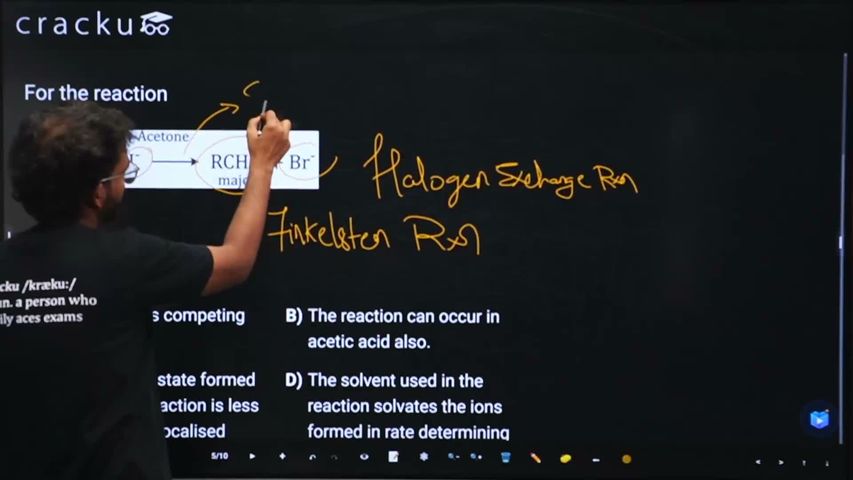
The given reaction is the Finkelstein reaction, which proceeds through an $$S_N2$$ (bimolecular nucleophilic substitution) mechanism.
In this reaction, an alkyl bromide ($RCH_2Br$) reacts with an iodide ion ($I^-$) in the presence of acetone to form an alkyl iodide ($RCH_2I$).
Consider each statement individually.
For option (C):
Initially, the reactants consist of a neutral alkyl halide and a localized iodide ion ($I^-$), where the entire negative charge resides on a single iodine atom.
During the $$S_N2$$ reaction, the nucleophile attacks the carbon atom while the leaving group departs simultaneously, producing the transition state
$$[I^{\delta-}\cdots CH_2(R)\cdots Br^{\delta-}]^{\ddagger}.$$
In this transition state, the negative charge is distributed over the incoming iodine atom, the central carbon atom, and the leaving bromine atom rather than being localized on a single atom.
As a result, the transition state has a lower charge density and is therefore less polar than the isolated iodide ion.
Hence, statement (C) is correct.
For option (A):
In the Finkelstein reaction, acetone dissolves sodium iodide but not sodium bromide.
As the reaction proceeds,
$$NaBr$$
precipitates out of the solution, removing $$Br^-$$ ions from the reaction mixture.
Therefore, $$Br^-$$ cannot effectively act as a competing nucleophile.
Hence, statement (A) is incorrect.
For option (B):
Acetic acid is a polar protic solvent.
Polar protic solvents strongly solvate nucleophilic anions such as $$I^-$$ through hydrogen bonding, significantly reducing their nucleophilicity and slowing the $$S_N2$$ reaction.
The Finkelstein reaction requires a polar aprotic solvent such as acetone.
Hence, statement (B) is incorrect.
For option (D):
Acetone is a polar aprotic solvent and does not strongly solvate anions because it cannot form hydrogen bonds with them.
Moreover, the rate-determining step involves a transition state rather than freely solvated ions.
Therefore, the statement that the solvent solvates the ions formed in the rate-determining step is incorrect.
Hence, statement (D) is incorrect.
Therefore, the only correct statement is
(C) The transition state is less polar than the iodide ion.
Was this solution helpful?
Click on the Email ☝️ to Watch the Video Solution
Create a FREE account and get:
_1.webp)

Educational materials for JEE preparation

Ask our AI anything

AI can make mistakes. Please verify important information.
AI can make mistakes. Please verify important information.

