Join WhatsApp Icon JEE WhatsApp Group
Question 46

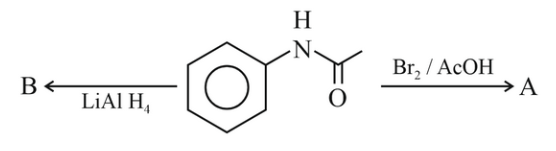
The major products A and B from the following reactions are:

image


(1)

image


(2)

image


(3)

image


(4)

image

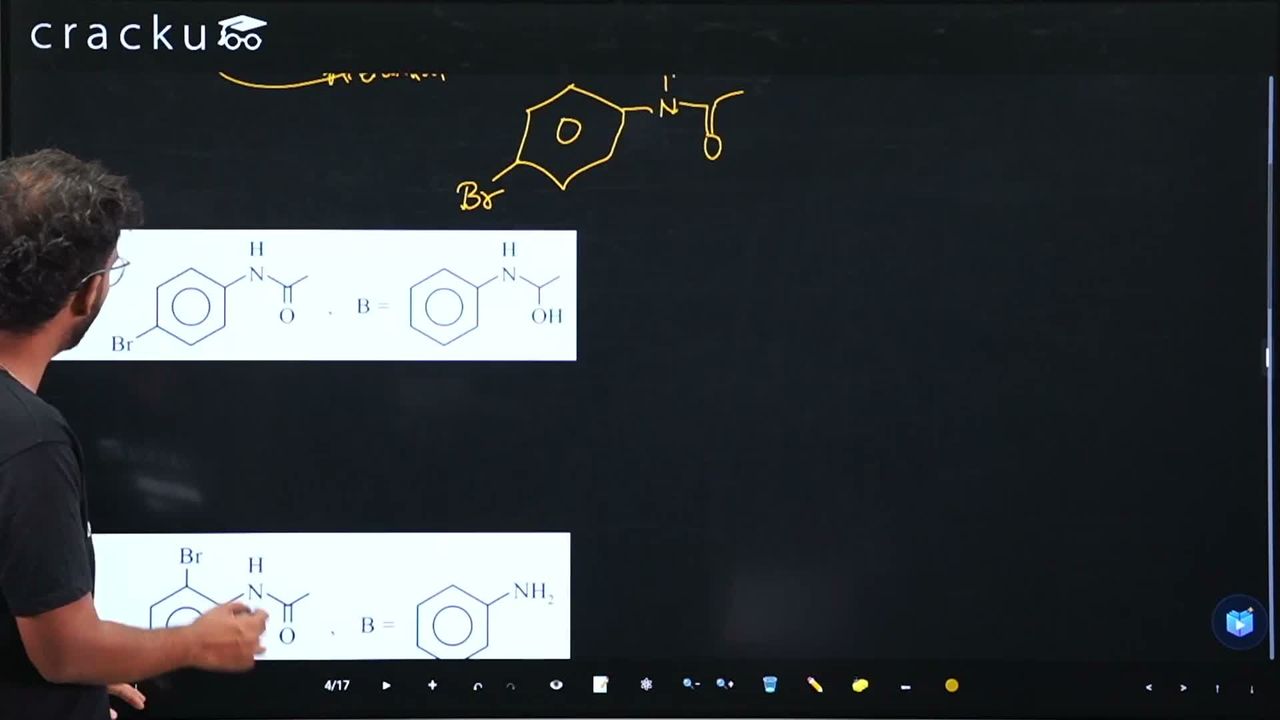
1. Formation of Product A (Bromination)

  • Reagents: $$\text{Br}_2\text{ / AcOH}$$ (Bromine in acetic acid)
  • Reaction Type: Electrophilic Aromatic Substitution (EAS)
  • Mechanism: The $$-\text{NHCOCH}_3$$ (acetamido) group attached to the benzene ring has a lone pair of electrons on the nitrogen atom. This makes it an ortho/para-directing activator.

    However, due to the steric bulk of the acetamido group, substitution at the ortho-position is heavily hindered. Therefore, electrophilic substitution predominantly occurs at the less hindered para-position.

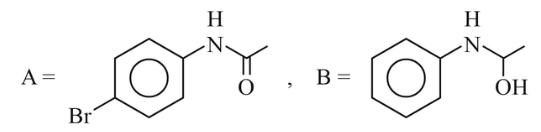
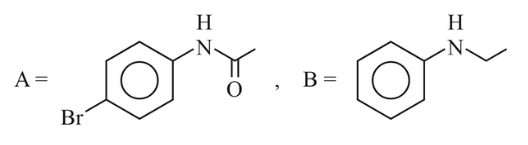
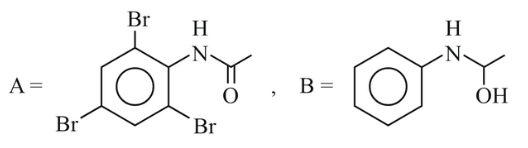
  • Product A: 4-bromoacetanilide (or p-bromoacetanilide)

2. Formation of Product B (Reduction)

  • Reagent: $$\text{LiAlH}_4$$ (Lithium Aluminum Hydride)
  • Reaction Type: Amide Reduction
  • Mechanism:

    $$\text{LiAlH}_4$$ is a powerful reducing agent that selectively reduces the carbonyl carbon ($$\text{-C=O}$$) of amides entirely into a methylene group ($$\text{-CH}_2\text{-}$$). Unlike ester or ketone reductions that yield alcohols, amides are converted directly into amines.

    Thus, the $$-\text{NH-CO-CH}_3$$ amide group is reduced to a $$-\text{NH-CH}_2\text{-CH}_3$$ secondary amine group.

  • Product B: $$N$$-ethylaniline

Get AI Help

Video Solution

video

Create a FREE account and get:

  • Free JEE Mains Previous Papers PDF
  • Take JEE Mains paper tests

Free JEE Topicwise Questions

JEE Rotational MotionJEE Units & MeasurementsJEE Atomic StructureJEE GravitationJEE Periodic Table & PeriodicityJEE StatisticsJEE Inverse Trigonometric FunctionsJEE Magnetism & Magnetic MaterialsJEE Sequences & SeriesJEE MatricesJEE Alternating CurrentsJEE Carboxylic AcidsJEE Permutations & CombinationsJEE Work, Energy & PowerJEE Electromagnetic InductionJEE Electronic DevicesJEE d and f-Block ElementsJEE Chemical KineticsJEE Heat TransferJEE Three Dimensional GeometryJEE Magnetic Effects of CurrentJEE Hydrocarbons - AromaticJEE Electromagnetic WavesJEE Aldehydes & KetonesJEE Hydrocarbons - AlkanesJEE Applications of DerivativesJEE EquilibriumJEE Indefinite IntegrationJEE Chemical ThermodynamicsJEE ElectrochemistryJEE ProbabilityJEE BiomoleculesJEE Continuity & DifferentiabilityJEE Kinetic Theory of GasesJEE Vector AlgebraJEE Hydrocarbons - AlkynesJEE Differential EquationsJEE Current & ResistanceJEE Straight LinesJEE WavesJEE Redox ReactionsJEE Hydrocarbons - AlkenesJEE DeterminantsJEE SolutionsJEE Ray OpticsJEE Dual Nature of Matter & RadiationJEE Chemical Bonding & Molecular StructureJEE Complex NumbersJEE Sets, Relations & FunctionsJEE Electric Charges & FieldsJEE Laws of MotionJEE Fluid MechanicsJEE Basic Concepts in ChemistryJEE Trigonometric FunctionsJEE LimitsJEE Laws of ThermodynamicsJEE Kinematics - 2D MotionJEE p-Block Elements (Groups 13-18)JEE Simple Harmonic MotionJEE Electric Potential & CapacitanceJEE Coordination CompoundsJEE JEE 2D GeometryJEE CirclesJEE Definite IntegrationJEE EMF & Circuit AnalysisJEE Surface TensionJEE Atoms & NucleiJEE Laboratory Experiments - XIJEE Number SystemJEE Basic Principles of Organic ChemistryJEE Wave OpticsJEE Quadratic EquationsJEE Alcohols, Phenols & EthersJEE Organic Compounds with HalogensJEE DifferentiationJEE Conic SectionsJEE Nitrogen-Containing CompoundsJEE ElasticityJEE Practical Organic ChemistryJEE Kinematics - 1D MotionJEE Purification & CharacterisationJEE Binomial Theorem
Ask AI