Join Our JEE Preparation Group
Prep with like-minded aspirants; Get access to free daily tests and study material.
Sign in
Please select an account to continue using cracku.in
↓ →
Join Our JEE Preparation Group
Prep with like-minded aspirants; Get access to free daily tests and study material.
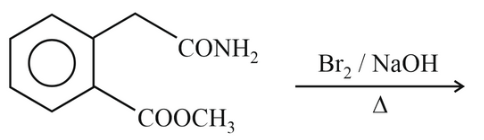
The reaction proceeds in two distinct steps.
In the first step, $$Br_2$$ and $$NaOH$$ (on heating) bring about the Hoffmann bromamide degradation.
This reaction converts a primary amide ($-CONH_2$) into a primary amine ($-NH_2$) with the loss of one carbon atom.
For the given substrate,
$$-CH_2CONH_2 \xrightarrow{Br_2/NaOH,\ \Delta} -CH_2NH_2.$$
After this transformation, the intermediate contains an ortho-substituted benzene ring with the following groups:
In the second step, the amino group acts as a nucleophile.
The lone pair on the nitrogen atom attacks the carbonyl carbon of the neighboring ester group, resulting in an intramolecular nucleophilic acyl substitution.
During this process, the methoxy group ($-OCH_3$) leaves, and a new bond is formed between the nitrogen atom and the carbonyl carbon, producing a cyclic amide (lactam).
To determine the ring size, count the atoms involved in ring formation:
Thus, a five-membered fused lactam ring is formed.
Examining the given options:
Hence, the major product formed in the reaction is option (B).
Was this solution helpful?
Click on the Email ☝️ to Watch the Video Solution
Create a FREE account and get:
_1.webp)

Educational materials for JEE preparation

Ask our AI anything

AI can make mistakes. Please verify important information.
AI can make mistakes. Please verify important information.