
Join Our JEE Preparation Group
Prep with like-minded aspirants; Get access to free daily tests and study material.
Sign in
Please select an account to continue using cracku.in
↓ →
Join Our JEE Preparation Group
Prep with like-minded aspirants; Get access to free daily tests and study material.
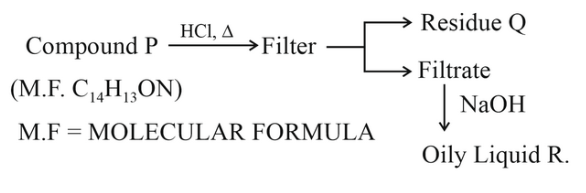
Compound P is neutral, Q gives effervescence with NaHCO$$_3$$ while R reacts with Hinsberg's reagent to give solid soluble in NaOH. Compound P is
The Double Bond Equivalent (also known as the Index of Hydrogen Deficiency) tells us the total number of rings and/or $$\pi$$-bonds present in the molecule. The general formula for a compound with the molecular formula $$\text{C}_\text{c}\text{H}_\text{h}\text{O}_\text{o}\text{N}_\text{n}$$ is:
$$\text{DBE} = \text{c} + 1 - \frac{\text{h} - \text{n}}{2}$$
Substituting the values from the given molecular formula ($$\text{C}_{14}\text{H}_{13}\text{ON}$$):
$$\text{DBE} = 14 + 1 - \frac{13 - 1}{2}$$
$$\text{DBE} = 15 - 6 = 9$$
A DBE value of 9 strongly indicates the presence of:
Neutral Nature of Compound P:
Compound P is described as neutral. Since it contains a nitrogen atom and an oxygen atom but lacks acidic or basic traits, it points directly toward a substituted amide group ($$\text{--CONH--}$$) rather than a free amine or carboxylic acid.
Acidic Hydrolysis of Amides:
When an amide is heated with dilute hydrochloric acid ($$\text{HCl}$$), it undergoes cleavage into a carboxylic acid and an amine salt:
$$\text{R--CONH--R'} \xrightarrow{\text{HCl, }\Delta} \text{R--COOH (Residue Q)} + \text{R'--NH}_3^\oplus\text{Cl}^\ominus \xrightarrow{\text{NaOH}} \text{R'--NH}_2\text{ (Oily Liquid R)}$$Analysis of Residue Q:
Residue Q gives brisk effervescence when treated with sodium bicarbonate ($$\text{NaHCO}_3$$), liberating carbon dioxide ($$\text{CO}_2$$) gas. This test is a hallmark confirmation for the presence of a carboxylic acid group ($$\text{--COOH}$$).
Analysis of Oily Liquid R (Hinsberg Test):
Oily liquid R reacts with Hinsberg's reagent (benzenesulfonyl chloride, $$\text{C}_6\text{H}_5\text{SO}_2\text{Cl}$$) to produce a solid sulfonamide compound that dissolves readily in aqueous sodium hydroxide ($$\text{NaOH}$$). This specific solubility profile proves that R must be a primary amine ($1^\circ\text{ amine}$ marketing as $$\text{R'--NH}_2$$), as its sulfonamide derivative still contains an acidic hydrogen on the nitrogen atom.
Since the hydrolysis fragments are a carboxylic acid and a primary amine, the parent structure P is a secondary amide linking two aromatic rings:
$$\text{4-methyl-N-phenylbenzamide} \quad (\text{p-CH}_3\text{--C}_6\text{H}_4\text{--CONH--C}_6\text{H}_5)$$
Let's verify the atom count for this structure:
The total formula is precisely $$\text{C}_{14}\text{H}_{13}\text{ON}$$, fitting every physical parameter and chemical constraint perfectly.
The combination of a calculated DBE of 9, its neutral nature, and the formation of a carboxylic acid along with a primary amine upon acid hydrolysis identifies compound P as N-(4-methylphenyl)benzamide / 4-methyl-N-phenylbenzamide.
Answer: The option displaying the structure with a 4-methylphenyl ring on one side and a phenyl group attached to the amide nitrogen ($$\text{p-CH}_3\text{--C}_6\text{H}_4\text{--CONH--C}_6\text{H}_5$$).
Was this solution helpful?
Click on the Email ☝️ to Watch the Video Solution
Create a FREE account and get:
_1.webp)

Educational materials for JEE preparation

Ask our AI anything

AI can make mistakes. Please verify important information.
AI can make mistakes. Please verify important information.
