
Join Our JEE Preparation Group
Prep with like-minded aspirants; Get access to free daily tests and study material.
Sign in
Please select an account to continue using cracku.in
↓ →
Join Our JEE Preparation Group
Prep with like-minded aspirants; Get access to free daily tests and study material.
Write the given equation in two parts:
$$|x^{2}-8x+15| - 2x + 7 = 0$$
The quadratic inside the absolute value factors as
$$x^{2}-8x+15 = (x-5)(x-3)$$
Its roots are $$x = 3$$ and $$x = 5$$, and the parabola opens upward, so
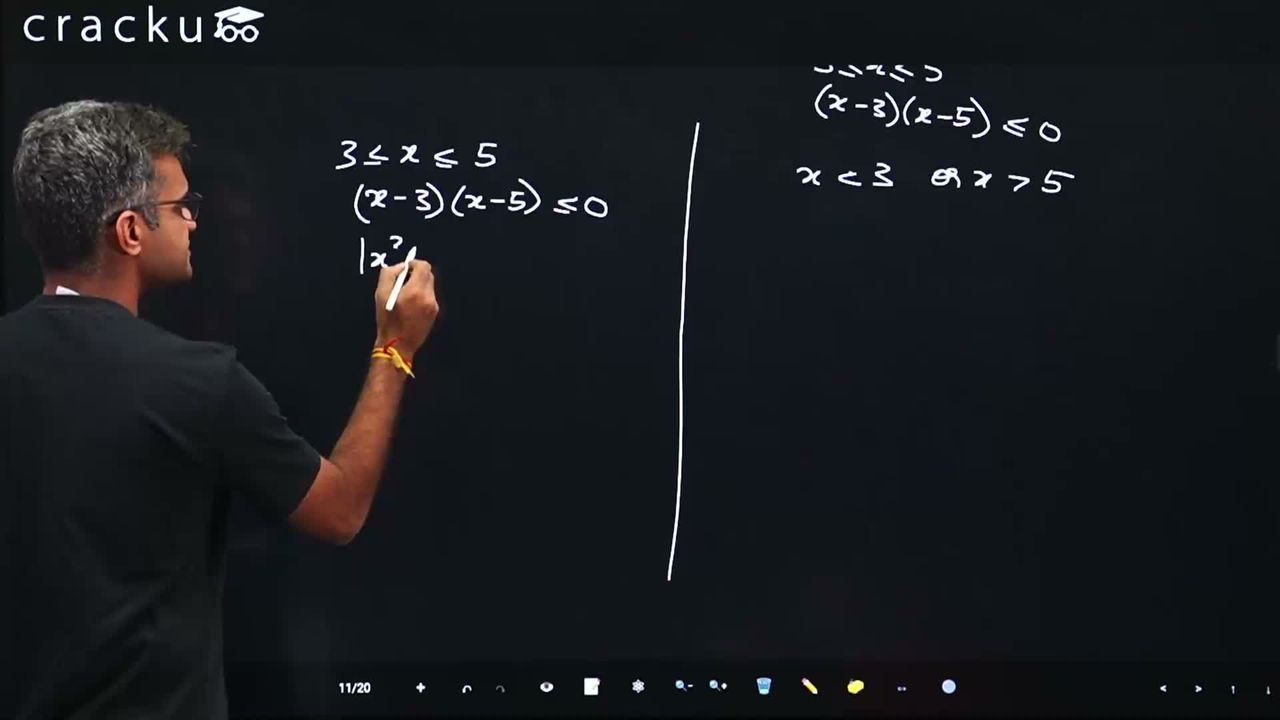
$$x^{2}-8x+15 \lt 0 \text{ for } 3 \lt x \lt 5,\qquad x^{2}-8x+15 \ge 0 \text{ for } x \le 3 \text{ or } x \ge 5$$
Therefore split the equation into two cases.
Case 1: $$x \le 3$$ or $$x \ge 5$$
Here $$|x^{2}-8x+15| = x^{2}-8x+15$$, so
$$x^{2}-8x+15 - 2x + 7 = 0 \\ \Rightarrow x^{2} - 10x + 22 = 0$$
Using the quadratic formula,
$$x = \frac{10 \pm \sqrt{100-88}}{2} = \frac{10 \pm 2\sqrt{3}}{2} = 5 \pm \sqrt{3}$$
Check which roots satisfy the domain of this case:
$$5+\sqrt{3} \approx 6.732 \ge 5 \quad \text{(acceptable)}$$
$$5-\sqrt{3} \approx 3.268 \quad (3 \lt 3.268 \lt 5,\; \text{reject})$$
Thus Case 1 contributes the root $$x = 5+\sqrt{3}$$.
Case 2: $$3 \lt x \lt 5$$
Now $$|x^{2}-8x+15| = -(x^{2}-8x+15)$$, so
$$-(x^{2}-8x+15) - 2x + 7 = 0 \\ \Rightarrow -x^{2} + 8x - 15 - 2x + 7 = 0 \\ \Rightarrow -x^{2} + 6x - 8 = 0 \\ \Rightarrow x^{2} - 6x + 8 = 0$$
Again apply the quadratic formula:
$$x = \frac{6 \pm \sqrt{36-32}}{2} = \frac{6 \pm 2}{2} = 3 \pm 1$$
So the possible solutions are $$x = 4$$ and $$x = 2$$. Only $$x = 4$$ lies in the interval $$3 \lt x \lt 5$$, hence it is the sole root from Case 2.
The complete set of roots is $$\{\,4,\;5+\sqrt{3}\,\}$$.
Sum of all roots:
$$4 + \bigl(5+\sqrt{3}\bigr) = 9 + \sqrt{3}$$
Therefore the required sum is $$9 + \sqrt{3}$$, which matches Option B.
Was this solution helpful?
Click on the Email ☝️ to Watch the Video Solution
Create a FREE account and get:
_1.webp)

Educational materials for JEE preparation

Ask our AI anything

AI can make mistakes. Please verify important information.
AI can make mistakes. Please verify important information.
