
Join Our JEE Preparation Group
Prep with like-minded aspirants; Get access to free daily tests and study material.
Sign in
Please select an account to continue using cracku.in
↓ →
Join Our JEE Preparation Group
Prep with like-minded aspirants; Get access to free daily tests and study material.
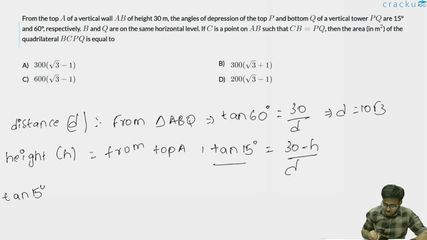
From the top $$A$$ of a vertical wall $$AB$$ of height 30 m, the angles of depression of the top $$P$$ and bottom $$Q$$ of a vertical tower $$PQ$$ are 15° and 60°, respectively. $$B$$ and $$Q$$ are on the same horizontal level. If $$C$$ is a point on $$AB$$ such that $$CB = PQ$$, then the area (in m$$^2$$) of the quadrilateral $$BCPQ$$ is equal to
Trigonometry:
Using $$\tan 15^\circ = 2 - \sqrt{3}$$:
$$30 - h = 10\sqrt{3}(2 - \sqrt{3}) = 20\sqrt{3} - 30 \implies \mathbf{h = 60 - 20\sqrt{3}}$$.
$$\text{Area} = d \times h = 10\sqrt{3}(60 - 20\sqrt{3}) = 600\sqrt{3} - 600$$.
Result: $$600(\sqrt{3} - 1) \text{ m}^2$$.
Was this solution helpful?
Click on the Email ☝️ to Watch the Video Solution
Create a FREE account and get:
_1.webp)

Educational materials for JEE preparation

Ask our AI anything

AI can make mistakes. Please verify important information.
AI can make mistakes. Please verify important information.
